🎁 Instant access to 1,825+ free resources β€” no sign-up needed. Or grab our 5 free bundles.

EYFS & early years Β Β·Β  5 min read

Continuous Provision in EYFS: What It Is, What It Isn't

The term is everywhere β€” but practice varies wildly

Continuous provision is one of the most-discussed EYFS approaches. Here's what it actually means and what good and bad versions look like.

<p>The phrase 'continuous provision' is everywhere in EYFS. It's in every job advert. It's in every Ofsted report. And it's used to mean wildly different things by different settings.</p> <h2 class="article-section-heading">What it actually means</h2> <p>Continuous provision is the resources and environment available to children throughout the session β€” without an adult constantly leading. Children choose what to do, return to it across days, develop projects over time. The provision is 'continuous' because it persists, not because it constantly changes.</p> <p>Crucially, it does NOT mean: a free-for-all with no learning intent. It does NOT mean: random toys put out for children to play with. It does NOT mean: the absence of adult-directed teaching.</p> <h2 class="article-section-heading">What good continuous provision looks like</h2> <div class="article-callout"><span class="article-callout__label">Deliberate planning</span><span class="article-callout__body">Every area of provision has a learning intent. The water tray today supports volume vocabulary. The construction area is set up to invite tall-building exploration. The mark-making area has the letters being taught this week.</span></div> <div class="article-callout"><span class="article-callout__label">Open-ended resources</span><span class="article-callout__body">Not single-purpose toys. Wooden blocks, fabric, loose parts, sticks, stones, mark-making tools. Things that can be used in many ways.</span></div> <div class="article-callout"><span class="article-callout__label">Connected to direct teaching</span><span class="article-callout__body">Children encounter a new concept in a short adult-led session. The provision lets them apply, explore, and consolidate it for hours afterwards. The two are not separate.</span></div> <div class="article-callout"><span class="article-callout__label">Adult interaction in the provision</span><span class="article-callout__body">Adults don't just supervise. They notice, ask questions, extend thinking, model vocabulary. Adults in continuous provision are doing some of the most skilled teaching of the day.</span></div> <div class="article-callout"><span class="article-callout__label">Refreshed thoughtfully, not constantly</span><span class="article-callout__body">Provision changes when there's a reason β€” children's interest shifts, a new learning focus, a new resource arrives. Not every Monday for the sake of it.</span></div> <h2 class="article-section-heading">What poor continuous provision looks like</h2> <p>Generic toys put out every day. No planning. No connection to teaching. Adults policing behaviour rather than developing learning. The same activities all year. Children losing interest by November.</p> <p>Or β€” equally bad β€” chasing novelty. New themed activities every week. Children never get to return to and develop a piece of work. The 'tray full of fairies and glitter' is not provision; it's decoration.</p> <h2 class="article-section-heading">The deepest provision is the simplest</h2> <p>The best Reception classrooms often look austere on first visit. Wooden blocks. Sand. Water. Books. Mark-making. The complexity is in what the children do with the simple things β€” and what the adults do to develop it.</p>
🌱

Free bundle for this topic

EYFS Essentials Pack

8 essentials for Reception and Kindergarten β€” provision, observation tools and activity cards.

Practical resources for this

Take this further

Printable, classroom-ready resources for the topics in this article.
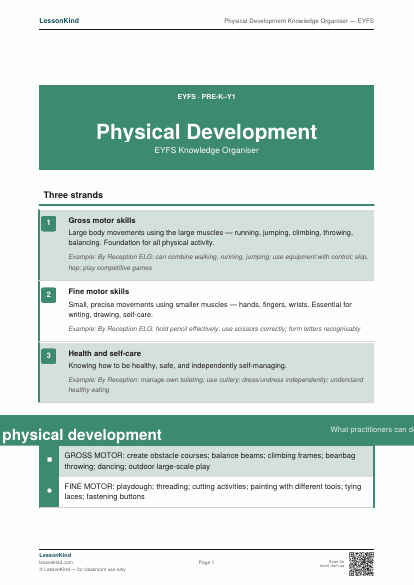
Preview of Physical Development Knowledge Organiser β€” EYFS
EYFS & Early YearsPre-KK1st

Physical Development Knowledge Organiser β€” EYFS

A Reception/KS1 reference for the EYFS physical development prime area β€” gross motor, fine motor, and health and self-care. Developmental milestones, key vocabulary, and activities to support each area.

πŸ“‹ Knowledge Organiser Free
Preview of Physical Development β€” EYFS Knowledge Organiser
EYFS & Early YearsPre-KK1st

Physical Development β€” EYFS Knowledge Organiser

A Reception/KS1 reference for the EYFS prime area of Physical Development β€” gross motor skills, fine motor skills, the ELG expectations, and the progression from reflex movements to skilled coordination.

πŸ“‹ Knowledge Organiser Free
Preview of Physical Development β€” EYFS Knowledge Organiser
EYFS & Early YearsPre-KK

Physical Development β€” EYFS Knowledge Organiser

A practitioner knowledge organiser on EYFS Physical Development β€” Gross Motor and Fine Motor Skills ELGs, what physical development looks like at different stages, and how provision supports both.

πŸ“‹ Knowledge Organiser Free
Preview of Physical Development in EYFS β€” Knowledge Organiser
EYFS & Early YearsPre-KK

Physical Development in EYFS β€” Knowledge Organiser

A practitioner knowledge organiser on EYFS Physical Development β€” the prime area covering Gross Motor and Fine Motor Skills ELGs, the development stages, and how to support both through provision.

πŸ“‹ Knowledge Organiser Free
Preview of Physical Development in EYFS β€” Knowledge Organiser
EYFS & Early YearsPre-KK

Physical Development in EYFS β€” Knowledge Organiser

A practitioner knowledge organiser on EYFS Physical Development β€” the Gross Motor and Fine Motor ELGs, core stability, handwriting readiness, and outdoor physical provision.
πŸ“‹ Knowledge Organiser Free
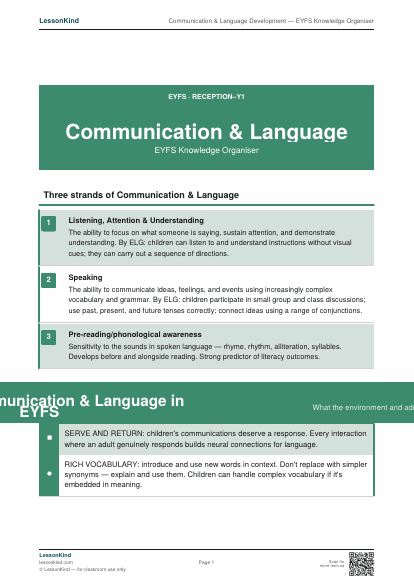
Preview of Communication & Language Development β€” EYFS Knowledge Organiser
EYFS & Early YearsPre-KK1st

Communication & Language Development β€” EYFS Knowledge Organiser

A Reception/KS1 knowledge organiser on the EYFS prime area of Communication and Language β€” listening and attention, understanding, and speaking. ELG expectations, developmental milestones, and what practitioners can do.

πŸ“‹ Knowledge Organiser Free
Preview of Communication, Language & Literacy β€” EYFS Knowledge Organiser
EYFS & Early YearsPre-KK1st

Communication, Language & Literacy β€” EYFS Knowledge Organiser

A practitioner knowledge organiser on the EYFS prime area of Communication and Language β€” Listening and Attention, Understanding, and Speaking. ELG expectations and what rich provision looks like.

πŸ“‹ Knowledge Organiser Free
Preview of Communication & Language in EYFS β€” Knowledge Organiser
EYFS & Early YearsPre-KK

Communication & Language in EYFS β€” Knowledge Organiser

A practitioner knowledge organiser on EYFS Communication and Language β€” Listening, Attention and Understanding, and Speaking ELGs; the development of vocabulary; the importance of adult-child talk; and rich language provision.

πŸ“‹ Knowledge Organiser Free

Going deeper

EYFS continuous provision books

Books we'd recommend on the topics raised in this article.

Convenience links to Amazon. As an Amazon Associate we earn from qualifying purchases at no extra cost to you. Read our affiliate disclosure.