EYFS & early years · 5 min read
The First Term in Reception: A Practical Guide
What to do in September, October, and November of your first Reception class
The first term in Reception is unlike any other teaching experience. This practical guide covers what to prioritise and what to let go.
Free bundle for this topic
EYFS Essentials Pack
8 essentials for Reception and Kindergarten — provision, observation tools and activity cards.
Practical resources for this
Take this further
Printable, classroom-ready resources for the topics in this article.
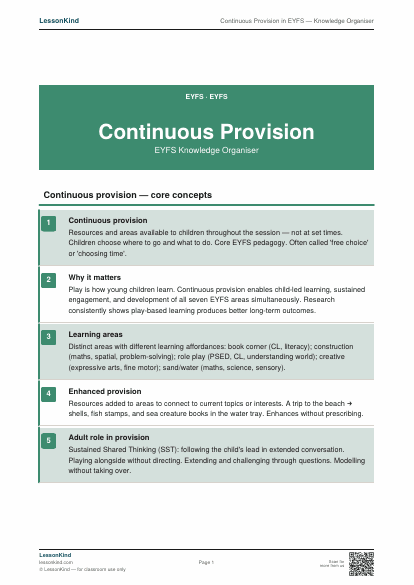
Continuous Provision in EYFS — Knowledge Organiser
A practitioner knowledge organiser on continuous provision — what it is, how to set up learning areas, adult roles in provision, how to plan for it, and how it links to all seven areas of the EYFS.
Continuous Provision in EYFS — Knowledge Organiser
A practitioner knowledge organiser on setting up and running high-quality continuous provision in EYFS — the areas of learning, the adult role, observation, and planning from children's interests.
Going deeper
Books on EYFS
Books we'd recommend on the topics raised in this article.
For practitioners
Convenience links to Amazon. As an Amazon Associate we earn from qualifying purchases at no extra cost to you. Read our affiliate disclosure.
Keep reading
EYFS & early years
The First Weeks: Settling Children Into Reception
The first weeks of Reception set the emotional tone for the year — and beyond. Here's what helps children settle securely.
5 min read
EYFS & early years
EYFS to Year 1: Managing the Transition Well
The Reception to Year 1 transition is a critical moment. Children move from play-based learning to more formal schooling. Done well, it supports development. Done badly, it can derail children who were flourishing in Reception.
5 min read
EYFS & early years
The EYFS to Year 1 Transition: Getting It Right
The EYFS to Year 1 transition is abrupt in England. Children move from play-based learning to formal schooling overnight. Here's how to make it work.
5 min read