Teaching in the Gaeltacht: What Makes It Different
Teaching in Ireland's Irish-speaking regions — the experience, the curriculum differences, and what it means for Gaeilge teaching
Teaching in a Gaeltacht school is the purest form of Irish language immersion — everything happens through Irish. Here's what teachers who have done it say about the experience.
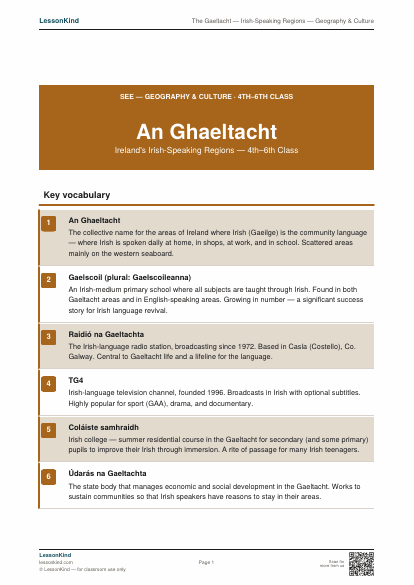
<p>Teaching in a Gaeltacht school is categorically different from teaching Irish in an English-medium school. In a Gaeltacht, Irish is not a subject — it is the medium. All lessons, all interaction, the staffroom, the playground: Irish. For teachers whose own Irish is functional rather than fluent, this is challenging. For teachers who love the language, it is extraordinary.</p> <h2 class="article-section-heading">The key differences</h2> <p>In a Gaeltacht school, the curriculum is the National Curriculum taught entirely through Irish. The Primary Language Curriculum operates in the Gaeltacht context — but Irish is the first language, not a subject. Children's home language is Irish; the school reinforces and extends it.</p> <p>The pupils often speak Irish more confidently than the teacher — particularly if the teacher is from an English-speaking area. This is unusual but not a problem: children respect effort and authenticity. A teacher who is genuinely trying, who asks children to help them with vocabulary, who shows pleasure in the language, earns enormous goodwill.</p> <h2 class="article-section-heading">Gaeltacht Irish vs standard Irish</h2> <p>There are three main dialects of Irish — Munster, Connacht, and Ulster. Gaeltacht schools teach in their local dialect. Standard written Irish (caighdeán oifigiúil) is also taught, but the spoken Irish is distinctively local. A teacher who learned the standard form may find Gaeltacht Irish sounds quite different.</p> <h2 class="article-section-heading">Teaching Irish as a foreign language</h2> <p>Gaeltacht schools also receive pupils from outside the Gaeltacht — children of families who have moved to the area. For these pupils, Irish is truly being learned as an additional language. Supporting them requires specific strategies: immersion support, buddy systems, visual scaffolding.</p> <h2 class="article-section-heading">The opportunity</h2> <p>For teachers who want to develop their Irish language skills rapidly, a year in a Gaeltacht school is by far the most effective route. Total immersion in a genuine Irish-speaking community produces fluency in a way that courses cannot match.</p>
Practical resources for this
Take this further
Printable, classroom-ready resources for the topics in this article.