EYFS & early years · 5 min read
How to Assess PSED in EYFS: A Practical Guide
Personal, Social and Emotional Development is the most important EYFS area — and the hardest to assess. Here's how.
PSED is the prime area that underpins everything else in EYFS. But it is also the hardest to assess reliably. These approaches make assessment of PSED both manageable and meaningful.
Free bundle for this topic
EYFS Essentials Pack
8 essentials for Reception and Kindergarten — provision, observation tools and activity cards.
Practical resources for this
Take this further
Printable, classroom-ready resources for the topics in this article.
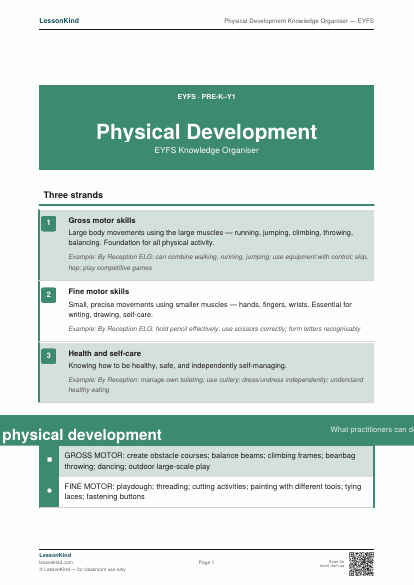
Physical Development Knowledge Organiser — EYFS
A Reception/KS1 reference for the EYFS physical development prime area — gross motor, fine motor, and health and self-care. Developmental milestones, key vocabulary, and activities to support each area.
Physical Development — EYFS Knowledge Organiser
A Reception/KS1 reference for the EYFS prime area of Physical Development — gross motor skills, fine motor skills, the ELG expectations, and the progression from reflex movements to skilled coordination.
Physical Development — EYFS Knowledge Organiser
A practitioner knowledge organiser on EYFS Physical Development — Gross Motor and Fine Motor Skills ELGs, what physical development looks like at different stages, and how provision supports both.
Physical Development in EYFS — Knowledge Organiser
A practitioner knowledge organiser on EYFS Physical Development — the prime area covering Gross Motor and Fine Motor Skills ELGs, the development stages, and how to support both through provision.
Physical Development in EYFS — Knowledge Organiser
A practitioner knowledge organiser on EYFS Physical Development — the Gross Motor and Fine Motor ELGs, core stability, handwriting readiness, and outdoor physical provision.
Going deeper
PSED assessment books
Books we'd recommend on the topics raised in this article.
For practitioners
Convenience links to Amazon. As an Amazon Associate we earn from qualifying purchases at no extra cost to you. Read our affiliate disclosure.
Keep reading
EYFS & early years
How to Set Up Continuous Provision: A Beginner's Guide
Continuous provision — the system of self-directed learning activities that children access independently — is central to good EYFS practice. Here's how to set it up, what to put in each area, and how to make it work.
7 min read
EYFS & early years
Continuous Provision: A Beginner's Guide for Year 1 Teachers
Continuous provision — self-directed learning through carefully planned areas — is central to EYFS and increasingly valued in Year 1. Here's how to set it up if you're new to it.
5 min read
EYFS & early years
The Reception–Year 1 Transition: What Children Need and What Schools Get Wrong
The move from Reception to Year 1 is the biggest change most children experience in primary school. Here's what the research shows about how to make it successful.
5 min read