🎁 Instant access to 1,825+ free resources β€” no sign-up needed. Or grab our 5 free bundles.

Classroom culture Β Β·Β  5 min read

PDMU in Practice: Activities That Build Real Mutual Understanding

Beyond the syllabus β€” classroom activities that genuinely develop understanding between communities in Northern Ireland

PDMU's 'Mutual Understanding' strand is unique to Northern Ireland β€” and genuinely challenging to teach well. These activities build real connection without being preachy or awkward.

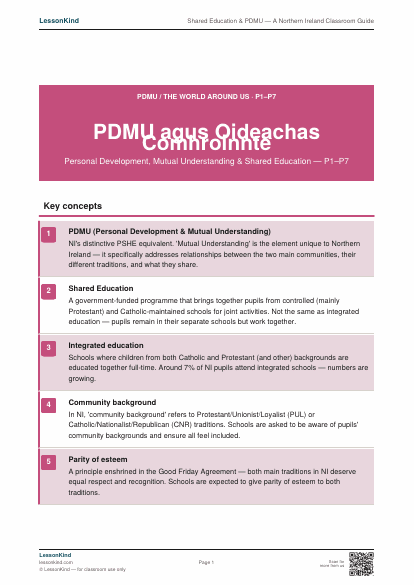
<p>Personal Development and Mutual Understanding (PDMU) is the Area of Learning unique to Northern Ireland. The 'Mutual Understanding' strand specifically addresses relationships between the two main communities. It is one of the most important things Northern Ireland schools do β€” and one of the most delicate to do well.</p> <h2 class="article-section-heading">What not to do</h2> <p>Don't make it a lesson about politics. Children in primary school are not well-served by a lecture on Unionism vs Nationalism. They absorb their communities' perspectives at home β€” what school can do is create genuine human connections that make those political abstractions less totalising.</p> <h2 class="article-section-heading">What actually works</h2> <div class="article-callout"><span class="article-callout__label">Shared history, not divided history</span><span class="article-callout__body">Find the history both communities share β€” the linen industry, Irish emigration to America, the natural world of Ulster, the GAA (which has Protestant as well as Catholic members), the music (traditional Irish music belongs to no one tradition).</span></div> <div class="article-callout"><span class="article-callout__label">Shared Education partnerships</span><span class="article-callout__body">If your school is in a Shared Education partnership with a school from the other tradition, the joint activities are where real relationships form β€” joint science projects, shared PE sessions, paired writing projects. The task matters less than the sustained contact.</span></div> <div class="article-callout"><span class="article-callout__label">Stories from both traditions</span><span class="article-callout__body">Fiction and memoir can go where direct discussion cannot. SiobhΓ‘n Parkinson's novels, Sam McBratney's picture books, and β€” for older pupils β€” Malorie Blackman's 'Noughts and Crosses' (about a different kind of divided society) all create space for thinking about division and belonging without making it personal.</span></div> <div class="article-callout"><span class="article-callout__label">Common ground activities</span><span class="article-callout__body">What do pupils in both traditions have in common? Food, music, sport, family, the land, the weather (a great equaliser in Northern Ireland). Starting from shared experience is more honest than performing tolerance.</span></div> <h2 class="article-section-heading">The difficult conversations</h2> <p>Some children will say things that reflect strong community perspectives. 'My dad says...' is a phrase that requires careful handling. The response is not to dismiss the father or the view β€” it is to acknowledge it, hold it alongside other perspectives, and avoid making the child feel their community is wrong.</p>
🧳

Free bundle for this topic

Cover Day Survival Pack

9 resources for cover days and routines, including behavior systems and morning meeting scripts.

Going deeper

Books on classroom culture

Books we'd recommend on the topics raised in this article.

Convenience links to Amazon. As an Amazon Associate we earn from qualifying purchases at no extra cost to you. Read our affiliate disclosure.