Teaching Local History Through the World Around Us (NI)
How to make the 'World Around Us' History strand come alive using your own community
The NI Curriculum's World Around Us integrates history, geography, and science. Local history is its strongest strand. Here's how to use your immediate community as a primary source.
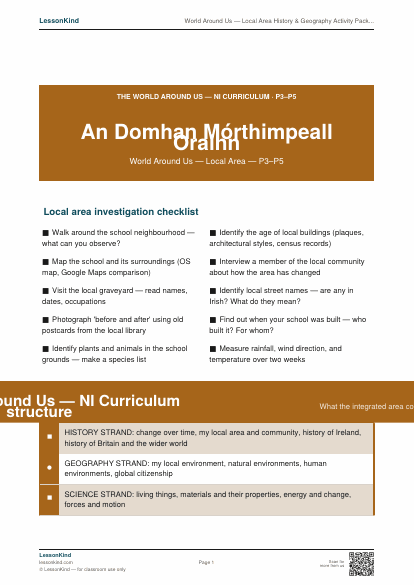
<p>The 'World Around Us' strand of the NI Curriculum has a distinctive feature: it starts local. Before Viking longboats or the Plantation, children study their own environment — the streets they walk, the buildings they pass, the people who live nearby. This is not just a pedagogical kindness. Local history produces skills (observation, questioning, use of sources) that transfer to any historical topic.</p> <h2 class="article-section-heading">Why local is powerful</h2> <p>Children in Northern Ireland live in one of the most historically layered landscapes in the world. Within a few kilometres of most NI schools: a plantation castle, a ringfort, a 19th-century mill, a Peace Wall or interface, a memorial, a Gaelic or Ulster-Scots place name. This is extraordinary richness.</p> <h2 class="article-section-heading">Starting points</h2> <div class="article-callout"><span class="article-callout__label">The school itself</span><span class="article-callout__body">When was it built? Who was it built for? Is it a controlled school, a Catholic-maintained school, or an integrated school? What does its name tell you about its history?</span></div> <div class="article-callout"><span class="article-callout__label">Street and place names</span><span class="article-callout__body">'Derry' vs 'Londonderry' on signposts is a living history lesson. Irish placename origins (townlands) tell you about landscape, flora, families. Ulster-Scots-origin names tell you about settlement patterns.</span></div> <div class="article-callout"><span class="article-callout__label">Buildings and architecture</span><span class="article-callout__body">The style of houses, the age of churches, the location of mills beside rivers — these are readable history in stone.</span></div> <div class="article-callout"><span class="article-callout__label">Living memory</span><span class="article-callout__body">Someone in almost every NI community has lived through the Troubles, emigration, deindustrialisation, or earlier. Oral history interviews — carefully conducted, with parental consent — produce primary sources that no textbook can match.</span></div> <h2 class="article-section-heading">Sensitivity in NI local history</h2> <p>Northern Ireland's recent history (The Troubles, partition) is present in most communities. Some families have direct connections to events. The key principle: local history can be taught honestly without being partisan. Acknowledge complexity without taking sides. 'People felt strongly about this for different reasons.'</p>
Practical resources for this
Take this further
Printable, classroom-ready resources for the topics in this article.