Teaching strategy · 5 min read
Teaching Science in SESE: A Practical Guide for Irish Primary Teachers
Science in the integrated SESE framework — how to balance inquiry-based learning with curriculum coverage
Science in Irish primary schools sits within SESE alongside History and Geography. Here's how to make the most of the integrated approach and deliver genuine scientific inquiry.
<p>Science within SESE (Social, Environmental and Scientific Education) is distinctive in that it sits alongside History and Geography as part of an integrated area. This creates genuine opportunities for cross-strand teaching that standalone science cannot achieve.</p> <h2 class="article-section-heading">The five science strands in Irish primary</h2> <p>Living things; Energy and forces; Materials; Environmental awareness and care; and Science and the environment. These map roughly onto KS2 science in England, with a stronger environmental and sustainability emphasis in the Irish version.</p> <h2 class="article-section-heading">Inquiry-based learning</h2> <p>The NCCA curriculum strongly emphasises inquiry — children asking questions, making predictions, testing, and drawing conclusions. Procedural skills (observing, classifying, measuring, experimenting, communicating) are given equal weight with content knowledge.</p> <p>In practice, this means: resist the urge to tell children the answer before they've investigated. The question 'what do you think will happen if...?' matters as much as the answer.</p> <h2 class="article-section-heading">The Irish context in science</h2> <p>Use Ireland's distinctive environments as science contexts: boglands (decomposition, carbon storage, preservation), rocky coastlines (intertidal ecology, erosion), river systems (water quality, flow, biodiversity), and native Irish species. Irish children should understand the ecology of the island they live on.</p> <h2 class="article-section-heading">Cross-strand SESE: an example</h2> <p>A bogland unit can cover: Science (bog ecology, carbon storage, native species), History (bog bodies, preserved artefacts, turf-cutting tradition), and Geography (where are Irish bogs, how large, what threats). This is genuinely integrated SESE — the three strands enriching each other.</p>
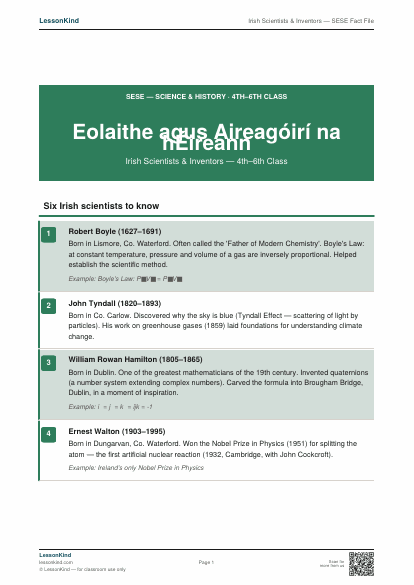
Practical resources for this
Take this further
Printable, classroom-ready resources for the topics in this article.
Going deeper
Books on teaching strategy
Books we'd recommend on the topics raised in this article.
For teachers
Convenience links to Amazon. As an Amazon Associate we earn from qualifying purchases at no extra cost to you. Read our affiliate disclosure.