Teaching strategy · 5 min read
Teaching RE as a Non-Specialist: A Practical Guide
Most primary teachers are not RE specialists. Here's how to teach it confidently and well
RE is one of the few subjects where the teacher's personal beliefs are genuinely relevant — and potentially complicated. Here's how to teach it confidently, fairly, and engagingly regardless of your own position.
<p>Religious Education is taught in every primary school in England, Wales, Scotland, and Northern Ireland. In most, it is taught by the class teacher who is not an RE specialist and may or may not hold personal religious beliefs. This creates an unusual pedagogical situation.</p> <h2 class="article-section-heading">What RE is actually for</h2> <p>RE is not about making children religious. It is about developing knowledge of religious and non-religious worldviews, fostering understanding and respect for diversity, and supporting children in exploring their own developing beliefs and values. This is something any thoughtful teacher can do regardless of their personal faith position.</p> <h2 class="article-section-heading">The key principle: phenomenological RE</h2> <p>The most widely used approach to non-confessional RE is phenomenological — studying religion as a human phenomenon, from the inside. Not 'here is what Christians believe' delivered neutrally, but 'here is how this belief looks and feels to the people who hold it.' This requires genuine curiosity and respectful imagination.</p> <h2 class="article-section-heading">Practical strategies</h2> <div class="article-callout"><span class="article-callout__label">Invite in</span><span class="article-callout__body">Primary-age children are generally not equipped to evaluate truth claims. They are well-equipped to understand stories, practices, and communities. Teach through narrative and experience.</span></div> <div class="article-callout"><span class="article-callout__label">Use the children's backgrounds</span><span class="article-callout__body">In most primary classes, several children have some religious background. With care, these children can be the most powerful teachers in RE — if they feel safe.</span></div> <div class="article-callout"><span class="article-callout__label">Big Questions</span><span class="article-callout__body">What happens when we die? Why is there suffering? How should we treat each other? These are questions every religion addresses. They are also the most genuinely engaging entry points for children.</span></div> <div class="article-callout"><span class="article-callout__label">Your own position</span><span class="article-callout__body">You don't have to share it. 'That's a question I think about too' is a legitimate response. What you should not do is use RE to push your own beliefs — or your own scepticism.</span></div> <h2 class="article-section-heading">Handling sensitive moments</h2> <p>A child says something that conflicts with another child's belief. A parent objects to content. A child is distressed by material about death or suffering. These happen in RE more than most subjects. The response is always: acknowledge the feeling, hold space for different views, and don't resolve it artificially.</p>
Practical resources for this
Take this further
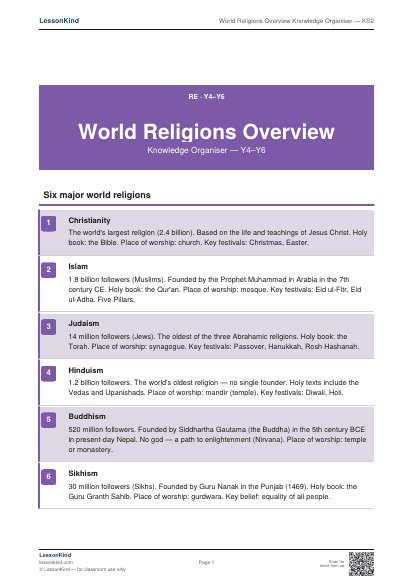
Printable, classroom-ready resources for the topics in this article.
Going deeper
RE resources for primary teachers
Books we'd recommend on the topics raised in this article.
For teachers
Convenience links to Amazon. As an Amazon Associate we earn from qualifying purchases at no extra cost to you. Read our affiliate disclosure.