
About this resource
How to set up a peer-buddy system that supports a struggling child without overburdening another. Includes selection, briefing, support and rotation.
What's included
- Print-ready PDF — A4 and US Letter compatible
- No sign-up required — download instantly
- Free to use in your classroom
More like this
More Behavior & Classroom Management resources
First-Week Routines Pack
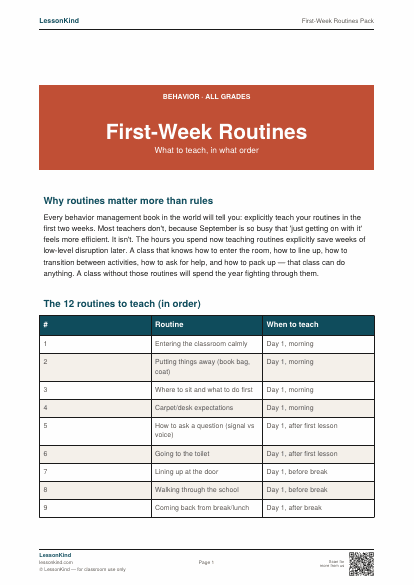
The 12 routines you must establish in the first two weeks — entry, transitions, lining up, asking for help, finishing work, end of day. With explicit teaching scripts.

Carpet & Lining-Up Expectations Poster
A two-poster set showing exactly what 'good carpet' and 'good lining up' look like. Visual support for younger children — print A3, mount where children can see.

Lunchtime & Break Expectations Pack
What to teach children about break and lunchtime — the routines, the social expectations, the unwritten rules. Useful for class teachers and lunchtime supervisors.

Transition Routines — Pack of 6 Visual Cues
Six classroom transition routines that genuinely work — from carpet to desks, between activities, lining up, end of day. Visual cues, scripts and timing.

The 2×10 Strategy — Relationship Tracker
An evidence-informed approach to building relationship with the most challenging child in your class — 2 minutes a day, 10 days, talking only about non-school topics. With a tracking sheet.

Praise Script Bank — 50 Specific Phrases
50 specific praise phrases you can use in the classroom — focused on effort, strategy, and behavior, not ability. Built around the research on what kinds of praise actually motivate children.
This page contains affiliate links. We may earn a commission at no extra cost to you. Full disclosure →
Stay Safe Online with NordVPN
Protect your connection on school networks and at home — trusted by millions. Recommended for teachers and students.
Get NordVPN →