
The 6-question framework
Every script below is a variation on the same six questions — the standard restorative-practice structure, focused on harm, accountability and repair rather than blame alone. Learn this once and you can adapt it to almost any incident on the spot.
- What happened? — get their account first, without correcting it yet.
- What were you thinking at the time?
- Who's been affected, and how?
- What do you think you need to do to make things right?
- What do you need from us to help that happen?
- What will you do differently next time?
1. Low-level disruption
When to use: calling out, distracting others, off-task behaviour — the everyday stuff. Aim for under 3 minutes, ideally not in front of the whole class.
2. Friendship rupture
When to use: a falling-out between two children — run it with both present, one at a time for questions 1-3, then together for 4-6. Budget 10-15 minutes.
3. After-incident reset
When to use: after a bigger incident (physical, major disruption) once everyone is calm — never run this while a child is still dysregulated. Budget 10-15 minutes, in private.
4. The chronic refuser
When to use: a child who shuts down, shrugs, or refuses to answer every time. Don't force it — lower the pressure and come back later.
5. Parent-present reset
When to use: the same conversation with a parent/carer in the room — slow down, use plain language, and make sure everyone leaves knowing what happens next.
Frequently asked questions
What is a restorative conversation, in plain terms?
A structured conversation after a behaviour incident that focuses on what happened, who was affected, and how to put it right — not only on punishment. It runs on six questions: what happened, what were you thinking, who's affected and how, what needs to happen to make it right, what support is needed, and what will change next time.
Do I need special training to run one?
No — these scripts are designed for any class teacher to use without restorative-practice training. If your school runs whole-staff CPD on this, use its script where the two differ, since consistency across the school matters more than exact wording.
What if the child won't engage or just shrugs at every question?
See the chronic-refuser script above. In short: don't force it in the moment. Offer a shorter, lower-pressure version, give processing time, and come back to it later rather than pushing through silence, which usually escalates things.
Should a restorative conversation replace a sanction?
That depends on your school's behaviour policy — the two aren't mutually exclusive. Many schools use both: a sanction for the immediate consequence, a restorative conversation to repair the relationship and reduce repeat incidents.
How long should this take?
For low-level disruption, 2-3 minutes is enough. For a bigger incident or a two-child friendship rupture, budget 10-15 minutes so nobody feels rushed — a restorative conversation that feels hurried usually doesn't land.
What about involving parents?
See the parent-present reset script above. The main adjustment is running the same six questions but slower, in plain language, and making sure everyone leaves knowing what happens next — not just what went wrong.
More like this
More Behavior & Classroom Management resources
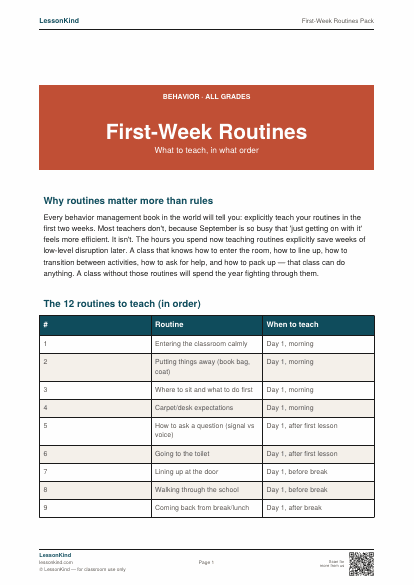
First-Week Routines Pack
The 12 routines you must establish in the first two weeks, with explicit teaching scripts.

The 2×10 Strategy — Relationship Tracker
2 minutes a day, 10 days, non-school topics only — building relationship with your most challenging child.

Praise Script Bank — 50 Specific Phrases
50 specific praise phrases focused on effort, strategy and behaviour, not ability.
This page contains affiliate links. We may earn a commission at no extra cost to you. Full disclosure →
Stay Safe Online with NordVPN
Protect your connection on school networks and at home — trusted by millions. Recommended for teachers and students.
Get NordVPN →