19 resources
EAL & New Arrivals
Free printable eal & new arrivals resources for primary and elementary teachers — no sign-up required.
All resources
EAL & New Arrivals — 19 free resources

EAL New Arrival — First Day Checklist
What to do in the first hour, first morning and first afternoon when a child with no English joins your class. Practical, kind, ready to print.

EAL Initial Language Assessment Form
A printable form for the first formal EAL assessment — based on the DfE Proficiency in English scale. Use in week 2-4 once child has settled.

EAL Home Language Information Form
A short form to send home with new arrivals — gathers essential information about the child's language background, prior schooling and family situation.

EAL Parent Welcome Pack
A welcome pack for EAL families joining the school — explains the school day, key terms, what to bring, parent-teacher communication.
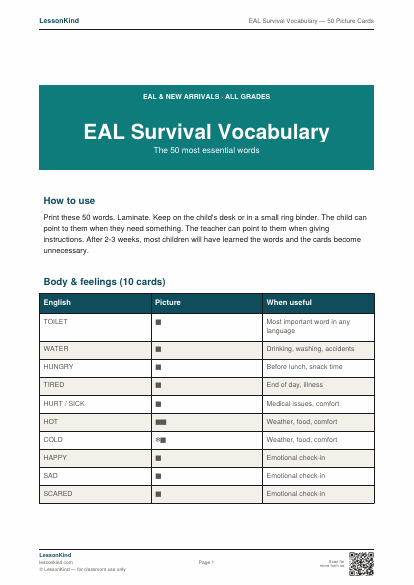
EAL Survival Vocabulary — 50 Picture Cards
The 50 most essential English words for a new arrival — toilet, water, hungry, hurt, friend, help. Picture cards to laminate and use daily.

EAL Classroom Communication Board
A single-sheet visual board children can point to when they don't have the English to say what they need. Print A3, laminate, mount on the wall.

EAL Visual Timetable — Cut-Out Cards
Picture cards for every subject and routine in a typical school day. Arrange in order to show 'what's happening today' to a child who can't yet read.

EAL Math Vocabulary — Picture Cards
40 essential math words for EAL learners — add, subtract, equals, more, less, half. Each with a visual cue and example sentence.

EAL Science Vocabulary — 40 Picture Cards
40 high-frequency science words organised by topic — life, materials, forces, earth and space — with picture cues and example uses.

EAL Pre-Teaching Vocabulary — Lesson Template
A simple template for pre-teaching key vocabulary before a lesson — 5 minutes that transforms how an EAL child can access mainstream content.

EAL Sentence Stems — Cross-Curricular Pack
Sentence starters for every part of the school day — answering questions, giving opinions, explaining work, asking for help. Print, laminate, give the child their own copy.

EAL Writing Frames — 6 Levels of Support
Six writing frames at increasing levels of support, from copying full sentences to filling in single words. Pick the level that matches your child's current English.

EAL Bilingual Story Prompts
12 story prompts that EAL learners can write in their first language, English, or both. Strengthens both languages and respects the child's full linguistic identity.

EAL Phonics Starter Pack
Adapted phonics introduction for EAL learners — pictures and visual cues for every sound, no English vocabulary assumed.

EAL Pronunciation Challenges by First Language
A practical reference: which English sounds tend to be hard for speakers of specific first languages. Covers Spanish, Polish, Arabic, Mandarin, Urdu, Somali.

School Life Explained — A Guide for Newcomers
An illustrated guide explaining the unwritten rules of school in English-speaking countries — for children newly arrived. Covers PE kits, packed lunches, assemblies, school trips and more.

Celebrating Our Class Cultures — Activity Pack
Five activities that put EAL children's cultures at the centre — a class flags wall, a 'word of the week' from a child's language, a culture share day, and more.

EAL Quick Reference — One Page for Mainstream Teachers
A one-page reference card summarising the most important things mainstream teachers need to know when supporting EAL learners. Print and stick on your desk.

EAL Progress Tracking Template
A simple half-termly tracker for an EAL learner's progress across listening, speaking, reading and writing. Plus space for next-step priorities.
Free Age-Appropriate Classroom Activities
Discount School Supply offers a huge library of free, downloadable activity ideas — perfect for lesson planning and cover days.
Get Free Activities →As an Amazon Associate and affiliate partner, LessonKind earns from qualifying purchases and referrals at no extra cost to you. Full disclosure →
NordVPN
Protect your devices when working from home or on school Wi-Fi — trusted by teachers and remote workers worldwide.
Get NordVPN →NordPass
One secure vault for every school platform, subscription and login — stop the forgotten-password routine for good.
Get NordPass →