Reading for Pleasure — Whole-School Strategy
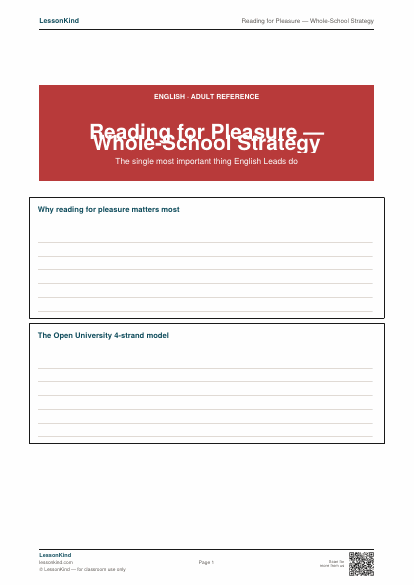
How English Leads build a school-wide reading culture. Covers the Open University's 4-strand model, library setup, daily read-aloud rituals, reluctant-reader strategies, parent engagement, and how to measure reading-for-pleasure (it's harder than measuring fluency). The most important single thing an English Lead does.
Preview
Page count: 10. Print-ready PDF — letter / A4 friendly. Click image to see all pages.
Learning objective
Equip English Leads to build and sustain a school-wide reading-for-pleasure culture, recognising it as the single biggest predictor of long-term reading attainment.
About this resource
- Subject: English / Language Arts
- Type: Lesson Plan
- Grade levels: Pre-Kindergarten (ages 3-4, ≈ Nursery), Kindergarten (ages 4-6, ≈ Reception / Y1), Grade 1 (ages 6-7, ≈ Year 2), Grade 2 (ages 7-8, ≈ Year 3), Grade 3 (ages 8-9, ≈ Year 4), Grade 4 (ages 9-10, ≈ Year 5), Grade 5 (ages 10-11, ≈ Year 6), Grade 6 (ages 11-12, ≈ Year 7)
- Pages: 10
- Date added: 2026-11-08
- Credit: Qualified primary teacher
Books mentioned in this resource
Convenience links to some of the read-aloud books and authors mentioned above. These are titles widely used in primary read-aloud across UKS2 and LKS2.
-
M
Matilda — Roald Dahl
KS2 read-aloud classic -
T
The BFG — Roald Dahl
KS1-KS2 read-aloud -
G
Gorilla — Anthony Browne
Picture book — emotion and family -
H
Holes — Louis Sachar
UKS2 read-aloud -
W
Wonder — R.J. Palacio
UKS2 read-aloud, themes of kindness -
N
Northern Lights (His Dark Materials) — Philip Pullman
UKS2 read-aloud -
H
How to Train Your Dragon — Cressida Cowell
LKS2 read-aloud -
T
The Boy, the Mole, the Fox and the Horse — Charlie Mackesy
All ages — gentle reflection
Disclosure: Links above go to Amazon. LessonKind may earn a small commission if you buy via these links — at no extra cost to you. We only link to books and items we already recommend in our resources. We are not paid by Amazon to recommend specific titles.
Part of these collections
Curated bundles where this resource appears alongside related ones.
Read more about this
Articles that go deeper on the topic this resource covers.
You might also like
Selected based on subject, grade, and type — with a free option always included.
Y6 SATs Reading — Strategies for the Three Texts
The Reading paper is 1 hour, 3 texts of increasing difficulty, around 50 marks. This pack covers the question-type taxonomy (retrieval / inference / vocabulary / structure), pacing strategy across the three texts, and the 'how to use the text' approach that beats reading-from-memory.
Whole-School Reading Progression — Pre-K to Grade 6
How reading skills develop across primary — phase 1 phonics through KS2 inference, summarisation, and critical reading. Includes year-by-year skill expectations, common misconceptions, and the assessment markers that show whether children are on track. The reference document an English Lead returns to most often.
Whole-School Writing Progression — Pre-K to Grade 6
How writing skills develop across primary — emergent mark-making through KS2 sustained writing. Year-by-year skill expectations covering composition, transcription, vocabulary, sentence structure, and editing. Pairs with the reading progression as the English Lead's two foundational reference docs.
SATs Week Survival Guide
Practical guide for teachers and parents on supporting Y6 children through SATs week — sleep, food, anxiety, post-paper recovery, and the things that don't help.
SATs Grammar & Punctuation Paper Prep
Comprehensive prep for the KS2 SATs Grammar, Punctuation and Spelling (GPS) paper. Coverage of every concept tested, plus practice questions and answer keys.
Y6 SATs SPaG (Spelling, Punctuation, Grammar) — Reference Pack
The SPaG paper tests technical English knowledge — terminology, punctuation use, grammatical structures. This pack covers the 30+ technical terms children must recognise, plus the punctuation and grammar rules that come up most often. The single revision document Y6 children should keep on their desk.