60 resources
EYFS & Early Years
Free printable eyfs & early years resources for primary and elementary teachers — no sign-up required.
All resources
EYFS & Early Years — 60 free resources

Continuous Provision — Weekly Planning Template
A simple weekly planning template for continuous provision — what's available where, what's been enhanced, what learning is being noticed. Replaces 30-page planning documents with one page that actually gets used.
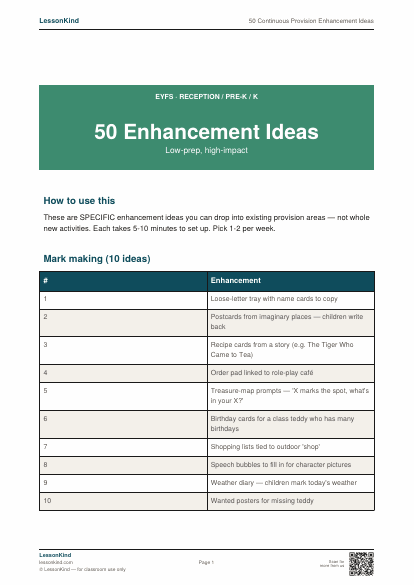
50 Continuous Provision Enhancement Ideas
50 specific, low-prep enhancements for the main provision areas — by area, by season, by skill. Useful for the Sunday-night moment when you're staring at the planning sheet.

EYFS Provision Audit Checklist
Walk around your provision with this list — does each area genuinely support the EYFS curriculum, or is it just pretty? 60-question audit organised by area.
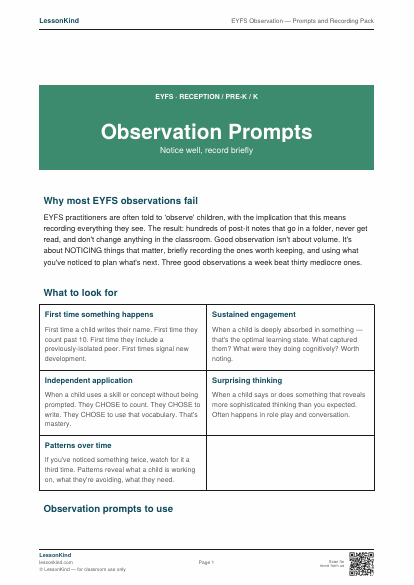
EYFS Observation — Prompts and Recording Pack
How to observe purposefully, what to write down, and how to avoid the all-too-common pattern of recording everything and learning nothing. With prompt cards.

Quick Assessment Recording Sheet
A one-page recording sheet for quick formative assessments — phonics, number, fine motor, name writing. Use as a snapshot every half-term.

Characteristics of Effective Learning — Tracker
A tracker for the three characteristics of effective learning — playing & exploring, active learning, creating & thinking critically. Useful for end-of-year EYFS reports and Reception-to-Y1 transition.
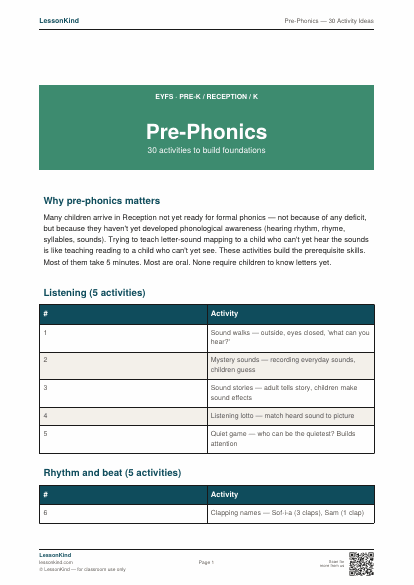
Pre-Phonics — 30 Activity Ideas
30 activities to develop the foundations BEFORE introducing letters — listening, rhythm, rhyme, alliteration, oral blending. The skills that determine how well phonics will land later.

Phase 1 Phonics — Sound Bag Activities
How to set up and use sound bags — a Phase 1 phonics staple. With 12 themed bag ideas and how to scaffold across the year.

Subitising Cards — 1 to 10
Picture cards for subitising — instantly recognising small quantities without counting. The single most important early-number skill, with cards in five different arrangements per number.

Number Bonds for the Youngest — Activity Pack
How to introduce number bonds to 5 and 10 in EYFS without worksheets — with tens-frames, real objects, story contexts and games.
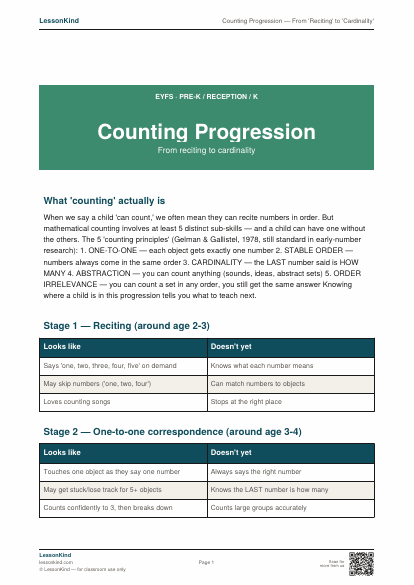
Counting Progression — From 'Reciting' to 'Cardinality'
What counting actually involves — five distinct sub-skills that develop in a roughly predictable order. With assessment ideas for each stage.
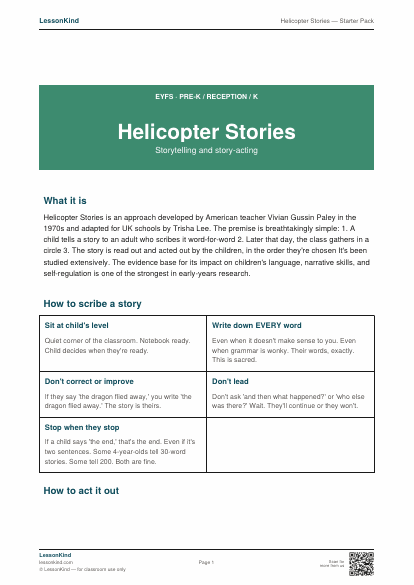
Helicopter Stories — Starter Pack
An introduction to Helicopter Stories — Vivian Gussin Paley's storytelling-and-story-acting approach. One of the most evidence-informed early-language interventions there is.

Talk-Rich Prompts — 40 Conversation Starters
40 prompts that get EYFS children TALKING — for snack time, circle time, walks, transitions. Beyond 'tell me about your weekend.'

Daily Routine Vocabulary — Picture Cards
Picture cards for the language of the EYFS day: tidy up time, snack, register, carpet, choosing. Useful for EAL learners and any child who finds school language an effort.

Reception to Year 1 Transition Pack — EYFS Resource
How to make the Reception-to-Year-1 transition gentler — when to start preparing, what to talk about with parents, what to pass to the next teacher, what to actually do in the last half-term.

EYFS Home Learning — 30 Activity Cards
30 home-learning activities for Reception families — none of them worksheets. Cooking, walking, talking, counting, drawing — the things that actually develop young children.

EYFS Parent Communication — Templates
Pre-written email and note templates for the most common EYFS parent comms — settling-in updates, behavior notes, achievement notes, transition info, end-of-day pickup messages.
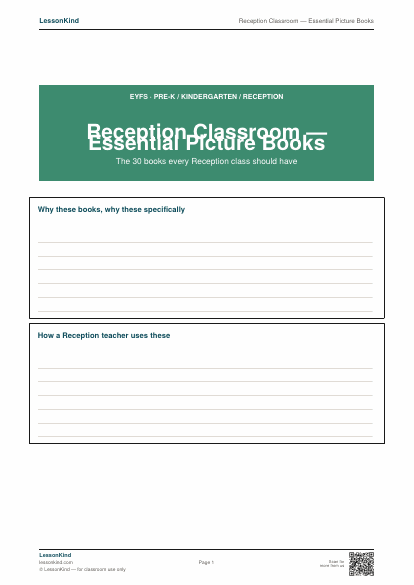
Reception Classroom — Essential Picture Books
The 30 picture books every Reception classroom should have — read-aloud favourites, repeat-read classics, and the books that build the foundational vocabulary, rhythm, and story-sense Reception children need.

Continuous Provision — Area Labels & Signage
Printable area labels for an EYFS continuous provision setup — sand, water, construction, role play, fine motor, mark making, maths, books, creative, investigation, small world, outdoor.

Continuous Provision Planning Grid (Weekly)
A weekly planning grid for EYFS continuous provision — for each area, plan the core invitation, the focus skill, vocabulary to introduce, adult-led enhancements and observation focus.

Continuous Provision Observation Tracker
A weekly observation tracker — tick which children visit which areas, plus a focus column for noticing learning. Helps spot the children getting missed.

Continuous Provision — Rotation System (Half-Term Plan)
A half-term rotation system for keeping provision fresh — what to refresh weekly, fortnightly, and termly. Plus the principle of 'hooking back' to children's interests.

Communication & Language Knowledge Organiser — EYFS
A Reception and KS1 reference for the communication and language prime area — listening, understanding, and speaking. Developmental milestones, strategies, and vocabulary for practitioners.

Early Maths in EYFS — Knowledge Organiser
A practitioner knowledge organiser on EYFS mathematics — the Number ELG, subitising, cardinality, ordinality, composition of number, and how to develop maths through provision.
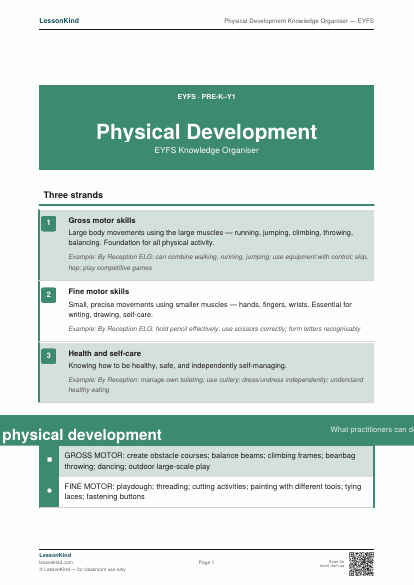
Physical Development in EYFS — Knowledge Organiser
A practitioner knowledge organiser on EYFS Physical Development — the prime area covering Gross Motor and Fine Motor Skills ELGs, the development stages, and how to support both through provision.

Expressive Arts & Design Knowledge Organiser — EYFS
A Reception/KS1 reference for the EYFS expressive arts and design area — creating with materials, being imaginative and expressive. Two sub-areas, key vocabulary, and activity ideas.

Literacy Development Knowledge Organiser — EYFS
A Reception/KS1 reference for the EYFS literacy area — word reading, phonics, comprehension, and early writing. Developmental milestones, practitioner strategies, and ELG expectations.
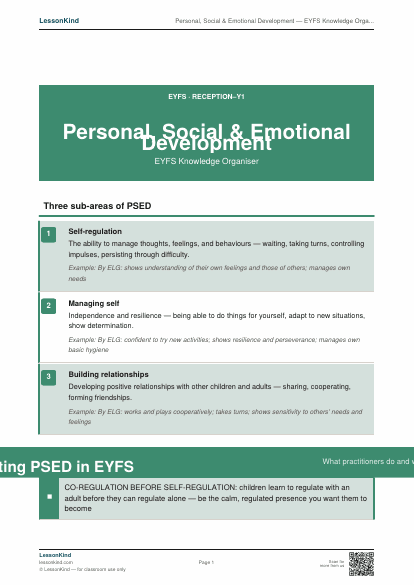
Personal, Social & Emotional Development in EYFS — Knowledge Organiser
A practitioner knowledge organiser on EYFS PSED — the three ELG strands (Self-Regulation, Managing Self, Building Relationships), how they develop, and practical provision ideas.

Early Mathematics Knowledge Organiser — EYFS
A Reception/KS1 reference for the EYFS mathematics area — number (numerical patterns and number sense) and shape, space and measures. Key concepts, practitioner strategies, and ELG expectations.
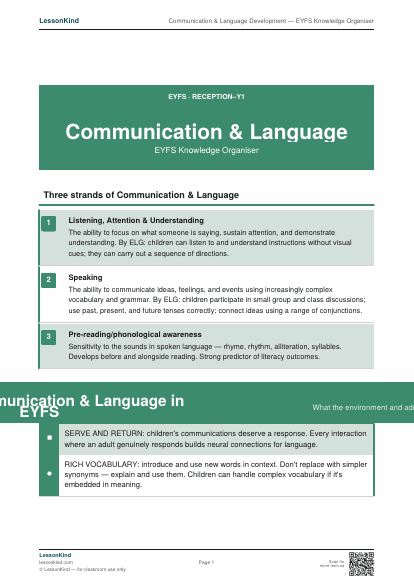
Communication & Language in EYFS — Knowledge Organiser
A practitioner knowledge organiser on EYFS Communication and Language — Listening, Attention and Understanding, and Speaking ELGs; the development of vocabulary; the importance of adult-child talk; and rich language provision.

Expressive Arts & Design in EYFS — Knowledge Organiser
A practitioner knowledge organiser on the EYFS Expressive Arts and Design prime/specific area — Creating with Materials, and Being Imaginative and Expressive. ELGs, what great provision looks like.
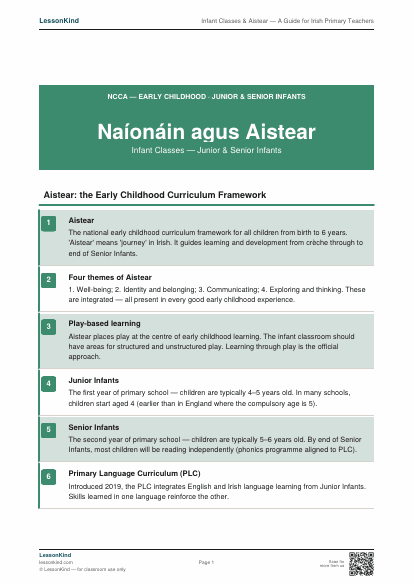
Infant Classes & Aistear — A Guide for Irish Primary Teachers
A guide to teaching Junior and Senior Infants in Irish primary schools — Aistear (the early childhood framework), play-based learning, integrated learning, the Infant curriculum, and the transition to 1st Class.
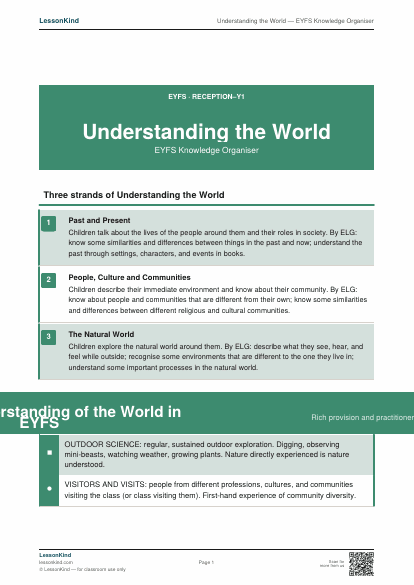
Understanding the World in EYFS — Knowledge Organiser
A practitioner knowledge organiser on the EYFS specific area Understanding the World — People, Culture and Communities; The Natural World; and Past and Present. ELGs and what rich provision looks like.

Early Phonics & Literacy Knowledge Organiser — EYFS/KS1
A Reception/KS1 knowledge organiser on early phonics — the phases of systematic synthetic phonics (Letters and Sounds / Read Write Inc), grapheme-phoneme correspondences, blending and segmenting, high-frequency words, and supporting early readers.

Mathematical Development in EYFS Knowledge Organiser
A Reception/KS1 knowledge organiser on mathematical development in the EYFS — number sense, counting, shape/space/measure, and the ELGs. How young children develop mathematical understanding and what practitioners do to support it.
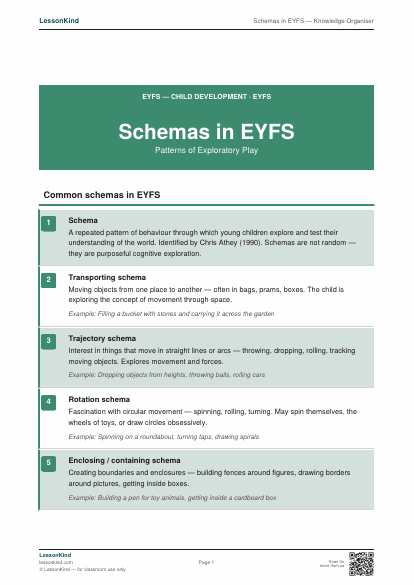
Schemas in EYFS — Knowledge Organiser
A practitioner knowledge organiser on Athey's schemas — the repeated patterns of behaviour that young children use to explore the world, how to identify schemas, and how to plan provision that supports and extends them.

SEND in EYFS — Early Identification & Support Knowledge Organiser
A practitioner knowledge organiser on identifying and supporting children with SEND in the EYFS — early signs, the graduated approach, EHCP, working with parents, and what good inclusive early years provision looks like.
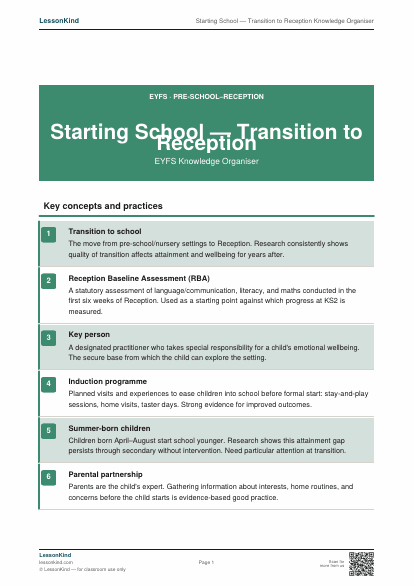
Starting School — Transition to Reception Knowledge Organiser
A practitioner knowledge organiser on the transition to school — what research says about this critical moment, how to support children and families, baseline assessment, and building relationships in the first weeks.

Outdoor Learning in EYFS — Knowledge Organiser
A practitioner knowledge organiser on outdoor learning in EYFS — the statutory requirement, what the outdoor environment should provide, how to plan outdoor provision, and Forest School principles.

Theories of Play — EYFS Knowledge Organiser
A practitioner knowledge organiser on play theories — Piaget, Vygotsky, Bruner, Froebel, Montessori, and forest school. How each theory shapes practice in the EYFS.
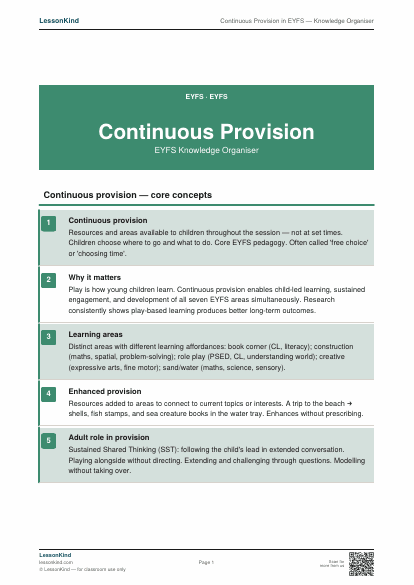
Continuous Provision in EYFS — Knowledge Organiser
A practitioner knowledge organiser on continuous provision — what it is, how to set up learning areas, adult roles in provision, how to plan for it, and how it links to all seven areas of the EYFS.

Safeguarding in EYFS — Knowledge Organiser
A practitioner knowledge organiser on safeguarding in the EYFS — the four categories of abuse, signs to watch for, the duty to report, Prevent duty, FGM, and what to do when a child discloses.

Attachment Theory & EYFS — Knowledge Organiser
A practitioner knowledge organiser on attachment theory — Bowlby and Ainsworth, secure and insecure attachment, the key person approach, and what attachment means for EYFS practice.

Mark Making & Emergent Writing in EYFS — Knowledge Organiser
A practitioner knowledge organiser on mark making and emergent writing — the developmental stages from random marks to phonetic spelling, how to support progression, and what EYFS writing should look like.

PSED in EYFS — Knowledge Organiser
A practitioner knowledge organiser on PSED (Personal, Social and Emotional Development) in EYFS — the three ELGs, self-regulation, managing self, and building relationships. What PSED looks like in practice.

Mathematics in EYFS — Knowledge Organiser
A practitioner knowledge organiser on EYFS Mathematics — Number, and Numerical Patterns ELGs, early number development, the role of subitising, and how to develop mathematical thinking through play.

Mark Making & Early Writing in EYFS — Knowledge Organiser
A practitioner knowledge organiser on EYFS mark making and early writing development — the stages from random marks to phonemic representation, provision for mark making, and links to phonics.

Literacy in EYFS — Knowledge Organiser
A practitioner knowledge organiser on EYFS Literacy — the Comprehension and Word Reading ELGs, the reading for pleasure culture, phonics in EYFS, and supporting children before formal reading.

Phonics Phases 1 & 2 Knowledge Organiser — EYFS
A practitioner knowledge organiser on EYFS phonics Phases 1 and 2 — environmental sound discrimination, oral blending, the first graphemes, and how to teach Phase 2 letters.

Developing Number Sense in EYFS — Knowledge Organiser
A practitioner knowledge organiser on EYFS number sense — what it is, how it develops, the number path (1-10 deep understanding), subitising activities, and the NCETM Mastering Number programme.
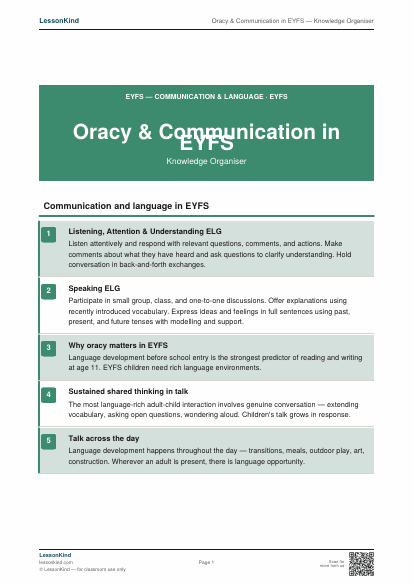
Oracy & Communication in EYFS — Knowledge Organiser
A practitioner knowledge organiser on EYFS Communication, Language and Literacy ELGs, oracy provision, vocabulary development, and supporting EAL children's communication.
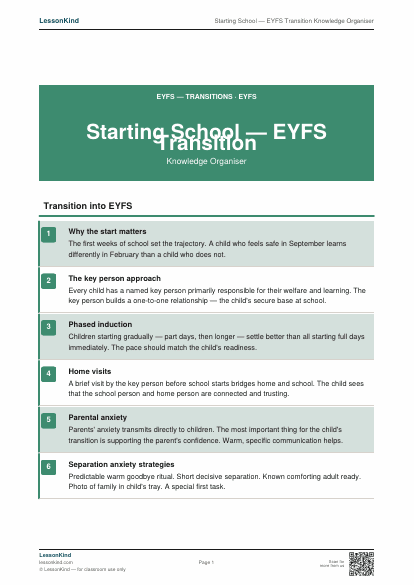
Starting School — EYFS Transition Knowledge Organiser
A practitioner knowledge organiser on children starting school — phased induction, the key person, home visits, parental anxiety, separation strategies, and information gathering.

Personal, Social & Emotional Development in EYFS
A practitioner knowledge organiser on PSED in EYFS — the three ELGs (Self-Regulation, Managing Self, Building Relationships), attachment, and how to support children's social and emotional development.

Assessment & Observation in EYFS — Knowledge Organiser
A practitioner knowledge organiser on EYFS assessment — formative and summative assessment, observation methods, the EYFS profile, and how to record children's learning.
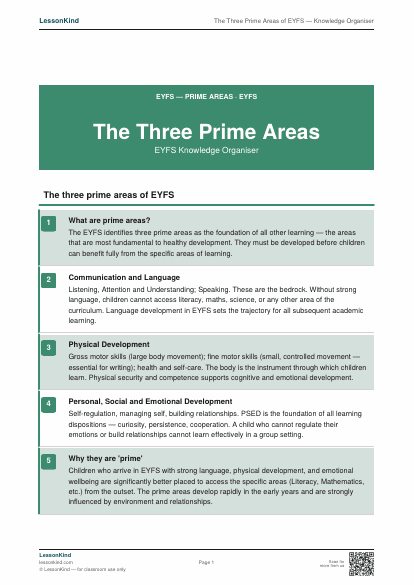
The Three Prime Areas of EYFS — Knowledge Organiser
A practitioner knowledge organiser on the three Prime Areas of the EYFS — Communication and Language, Physical Development, and Personal, Social and Emotional Development.
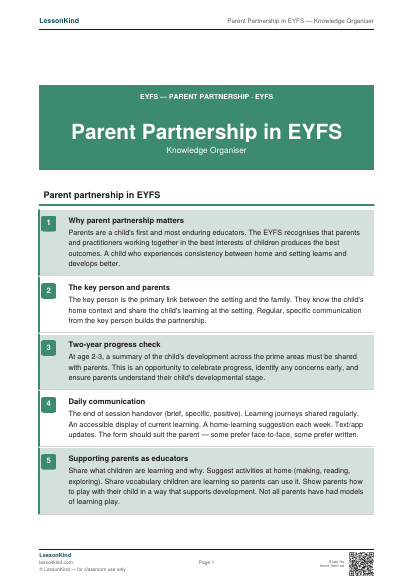
Parent Partnership in EYFS — Knowledge Organiser
A practitioner knowledge organiser on parent partnership in EYFS — why it matters, how to build it, key communications, and supporting parents as their children's first educators.
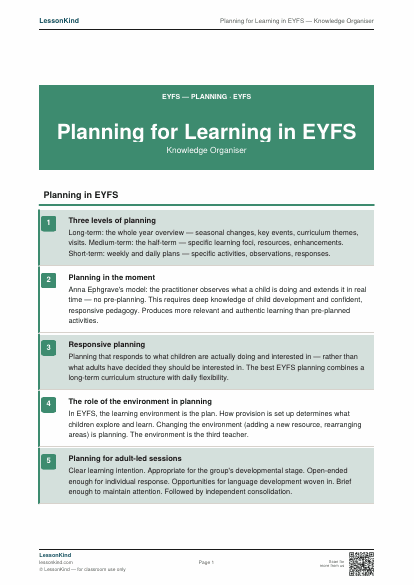
Planning for Learning in EYFS — Knowledge Organiser
A practitioner knowledge organiser on planning in EYFS — long-term, medium-term, and short-term planning, planning in the moment, and what good EYFS planning looks like.

EYFS Observation Record Template
A practitioner observation record template for EYFS — narrative observation, development matters link, next steps, and parent communication note.

Gross Motor Development in EYFS — Knowledge Organiser
A practitioner knowledge organiser on gross motor development in EYFS — the developmental sequence, activities that build core strength and coordination, and identifying delays.

Fine Motor Development in EYFS — Knowledge Organiser
A practitioner knowledge organiser on fine motor development in EYFS — the developmental sequence, the tripod grip, pre-writing activities, and supporting children to write readiness.