50 Continuous Provision Enhancement Ideas
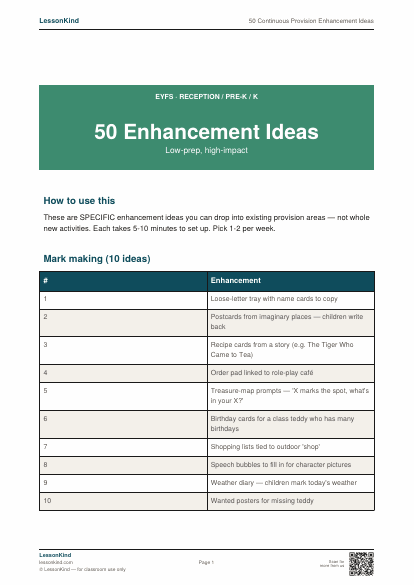
50 specific, low-prep enhancements for the main provision areas — by area, by season, by skill. Useful for the Sunday-night moment when you're staring at the planning sheet.
Preview
Page count: 11. Print-ready PDF — letter / A4 friendly. Click image to see all pages.
Learning objective
Build a working bank of continuous provision enhancements teachers can pull from when planning.
About this resource
- Subject: EYFS & Early Years
- Type: Fact File
- Grade levels: Pre-Kindergarten (ages 3-4, ≈ Nursery), Kindergarten (ages 4-6, ≈ Reception / Y1)
- Pages: 11
- Date added: 2026-09-10
- Credit: Qualified primary teacher
Part of these collections
Curated bundles where this resource appears alongside related ones.
Read more about this
Articles that go deeper on the topic this resource covers.
EYFS & early years · 8 min read
Play-Based Learning Isn't Lower Expectations — It's Different Expectations
Walk into a Reception classroom and you'll see children playing. Walk into a Year 3 classroom and you'll see children working. The mistake most adults make is assuming the second is more rigorous than the first.
EYFS & early years · 7 min read
What 'School Readiness' Actually Means (And What It Doesn't)
Every year, parents worry about whether their 4-year-old is 'ready for school.' Schools advertise 'school readiness' programmes. Politicians make speeches about it. Most of what gets said about school readiness is wrong.
Behavior & classroom management · 7 min read
When to Worry About Your Child's Handwriting
Most concerns about handwriting at primary age are about pace, not problem. But some patterns are worth taking seriously — and the pencil grip thing is more interesting than most parents realise. Here's how to tell the difference.
EYFS & early years · 9 min read
How EYFS Leads Actually Run Their Settings
EYFS leadership is one of the least-discussed roles in primary, despite running the foundational years that shape everything that comes after. This is what the role actually looks like from the inside — the planning, the parent conversations, the OFSTED preparation, and the rhythms that separate sustainable EYFS leads from burned-out ones.
EYFS & early years · 6 min read
What Good Continuous Provision Actually Looks Like
Continuous provision is the heart of EYFS practice. But many settings end up with beautiful-looking provision that doesn't actually teach much. Here's what separates the two.
EYFS & early years · 5 min read
The Importance of the Mark-Making Area
Adults often dismiss mark-making as 'just scribbling'. The cognitive science says it's where writing actually begins. Here's what to look for, and how to support it well.
EYFS & early years · 5 min read
The Quiet Power of Storytime in Early Years
Daily read-aloud is doing more cognitive work than almost any other activity in the EYFS day. Here's what the science says, and how to make it count.
EYFS & early years · 5 min read
The Reception-to-Year-1 Jump
Children who thrived in Reception sometimes wobble badly in Year 1. The drop from play-based to sit-down learning is bigger than the curriculum suggests.
EYFS & early years · 6 min read
What Reception Teachers Know That the Rest of the School Should
Reception teachers operate with a different framework from the rest of primary — one that the rest of the school could learn a great deal from.
EYFS & early years · 6 min read
What Reception Teachers Know That the Rest of the School Should
Reception teachers operate with a different framework from the rest of primary — one the whole school could learn from.
Parent communication · 6 min read
What Is EYFS? A Guide for New Parents
EYFS stands for Early Years Foundation Stage. It covers children from birth to the end of Reception. This guide explains what it is, what your child will experience, and how progress is measured.
EYFS & early years · 7 min read
How to Set Up Continuous Provision: A Beginner's Guide
Continuous provision — the system of self-directed learning activities that children access independently — is central to good EYFS practice. Here's how to set it up, what to put in each area, and how to make it work.
You might also like
Selected based on subject, grade, and type — with a free option always included.
Reception Classroom — Essential Picture Books
The 30 picture books every Reception classroom should have — read-aloud favourites, repeat-read classics, and the books that build the foundational vocabulary, rhythm, and story-sense Reception children need.
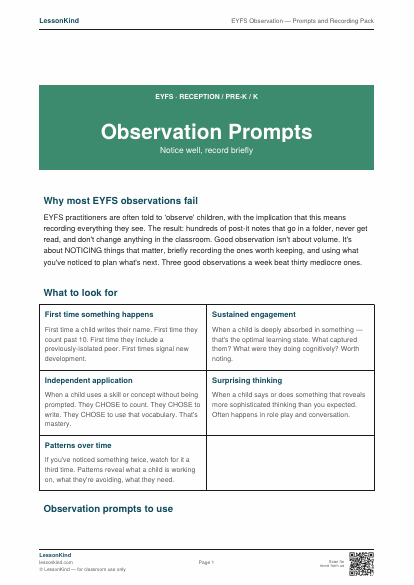
EYFS Observation — Prompts and Recording Pack
How to observe purposefully, what to write down, and how to avoid the all-too-common pattern of recording everything and learning nothing. With prompt cards.
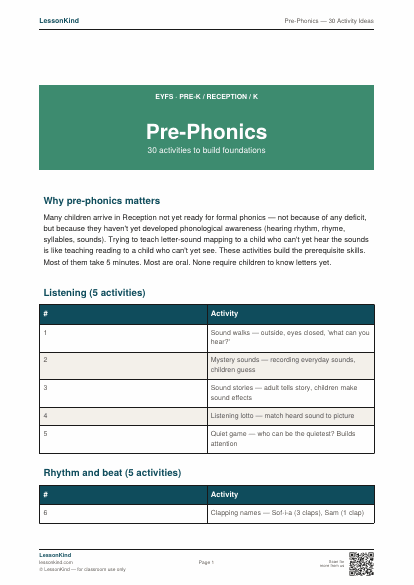
Pre-Phonics — 30 Activity Ideas
30 activities to develop the foundations BEFORE introducing letters — listening, rhythm, rhyme, alliteration, oral blending. The skills that determine how well phonics will land later.
Helicopter Stories — Starter Pack
An introduction to Helicopter Stories — Vivian Gussin Paley's storytelling-and-story-acting approach. One of the most evidence-informed early-language interventions there is.
Reception to Year 1 Transition Pack
How to make the Reception-to-Year-1 transition gentler — when to start preparing, what to talk about with parents, what to pass to the next teacher, what to actually do in the last half-term.
Counting Progression — From 'Reciting' to 'Cardinality'
What counting actually involves — five distinct sub-skills that develop in a roughly predictable order. With assessment ideas for each stage.