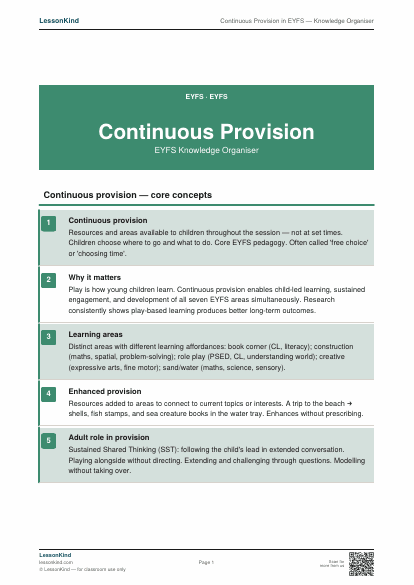
About this resource
A practitioner knowledge organiser on continuous provision — what it is, how to set up learning areas, adult roles in provision, how to plan for it, and how it links to all seven areas of the EYFS.
What's included
- Print-ready PDF — A4 and US Letter compatible
- No sign-up required — download instantly
- Free to use in your classroom
More like this
More EYFS & Early Years resources

Continuous Provision — Weekly Planning Template
A simple weekly planning template for continuous provision — what's available where, what's been enhanced, what learning is being noticed. Replaces 30-page planning documents with one page that actually gets used.
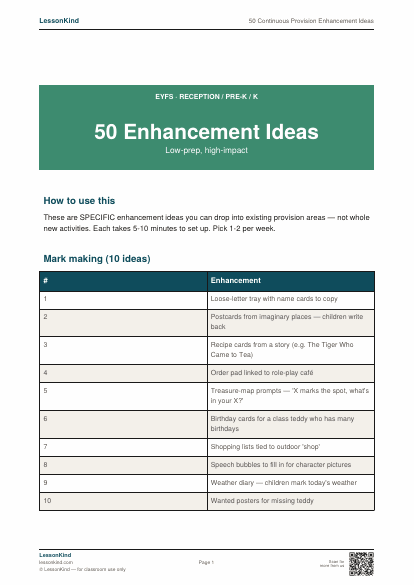
50 Continuous Provision Enhancement Ideas
50 specific, low-prep enhancements for the main provision areas — by area, by season, by skill. Useful for the Sunday-night moment when you're staring at the planning sheet.

EYFS Provision Audit Checklist
Walk around your provision with this list — does each area genuinely support the EYFS curriculum, or is it just pretty? 60-question audit organised by area.
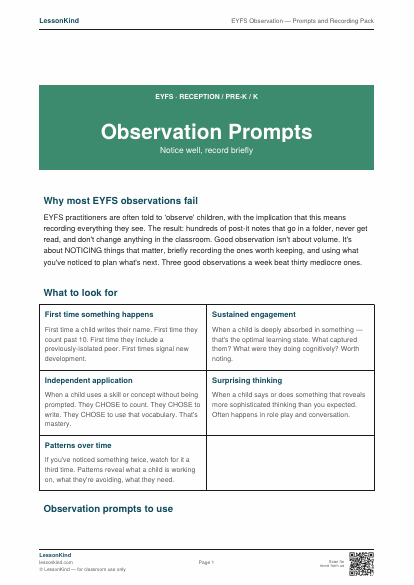
EYFS Observation — Prompts and Recording Pack
How to observe purposefully, what to write down, and how to avoid the all-too-common pattern of recording everything and learning nothing. With prompt cards.

Quick Assessment Recording Sheet
A one-page recording sheet for quick formative assessments — phonics, number, fine motor, name writing. Use as a snapshot every half-term.

Characteristics of Effective Learning — Tracker
A tracker for the three characteristics of effective learning — playing & exploring, active learning, creating & thinking critically. Useful for end-of-year EYFS reports and Reception-to-Y1 transition.
This page contains affiliate links. We may earn a commission at no extra cost to you.
Stay Safe Online with NordVPN
Protect your connection on school networks and at home. NordVPN is trusted by millions — recommended for teachers and students alike.
Get NordVPN →