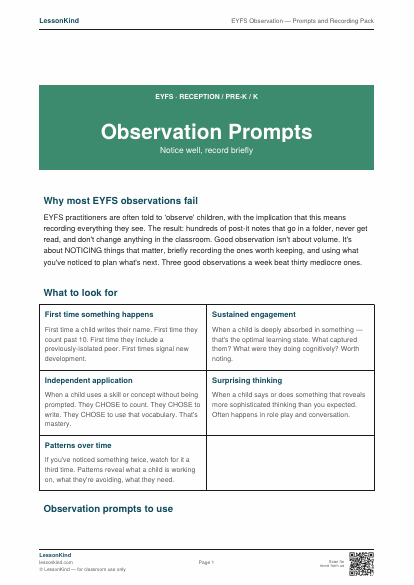
Quick Assessment Recording Sheet
A one-page recording sheet for quick formative assessments — phonics, number, fine motor, name writing. Use as a snapshot every half-term.
Preview
Page count: 9. Print-ready PDF — letter / A4 friendly. Click image to see all pages.
Learning objective
Track key EYFS skills with a simple, repeatable assessment format.
About this resource
- Subject: EYFS & Early Years
- Type: Template
- Grade levels: Pre-Kindergarten (ages 3-4, ≈ Nursery), Kindergarten (ages 4-6, ≈ Reception / Y1)
- Pages: 9
- Date added: 2026-09-12
- Credit: Qualified primary teacher
Part of these collections
Curated bundles where this resource appears alongside related ones.
Read more about this
Articles that go deeper on the topic this resource covers.
EYFS & early years · 7 min read
What 'School Readiness' Actually Means (And What It Doesn't)
Every year, parents worry about whether their 4-year-old is 'ready for school.' Schools advertise 'school readiness' programmes. Politicians make speeches about it. Most of what gets said about school readiness is wrong.
Reading & literacy · 8 min read
When to Worry About a Five-Year-Old Who's Not Reading Yet
Reception and Year 1 parents worry constantly about their child's reading. Most of the worry isn't warranted. Some of it is. Here's how to tell the difference — and what to do about both.
Reading & literacy · 7 min read
What 'Reading Level' Actually Means in Year 2
If your child has come home with a book labelled 'orange band' or 'lime' or 'level 9,' you've probably wondered what it actually means. The honest answer is messier than schools tend to admit.
EYFS & early years · 9 min read
How EYFS Leads Actually Run Their Settings
EYFS leadership is one of the least-discussed roles in primary, despite running the foundational years that shape everything that comes after. This is what the role actually looks like from the inside — the planning, the parent conversations, the OFSTED preparation, and the rhythms that separate sustainable EYFS leads from burned-out ones.
EYFS & early years · 6 min read
What Good Continuous Provision Actually Looks Like
Continuous provision is the heart of EYFS practice. But many settings end up with beautiful-looking provision that doesn't actually teach much. Here's what separates the two.
EYFS & early years · 5 min read
The Reception Baseline (And What It Actually Tests)
The Reception Baseline Assessment is one of the most misunderstood tests in primary education. Here's what it actually measures and why it doesn't decide your child's future.
You might also like
Selected based on subject, grade, and type — with a free option always included.
Continuous Provision — Weekly Planning Template
A simple weekly planning template for continuous provision — what's available where, what's been enhanced, what learning is being noticed. Replaces 30-page planning documents with one page that actually gets used.
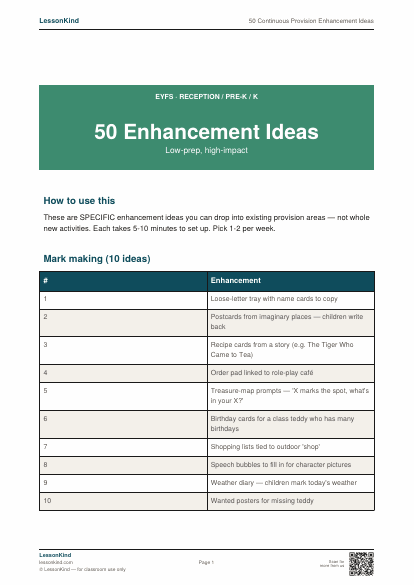
Continuous Provision Planning Grid (Weekly)
A weekly planning grid for EYFS continuous provision — for each area, plan the core invitation, the focus skill, vocabulary to introduce, adult-led enhancements and observation focus.
Characteristics of Effective Learning — Tracker
A tracker for the three characteristics of effective learning — playing & exploring, active learning, creating & thinking critically. Useful for end-of-year EYFS reports and Reception-to-Y1 transition.
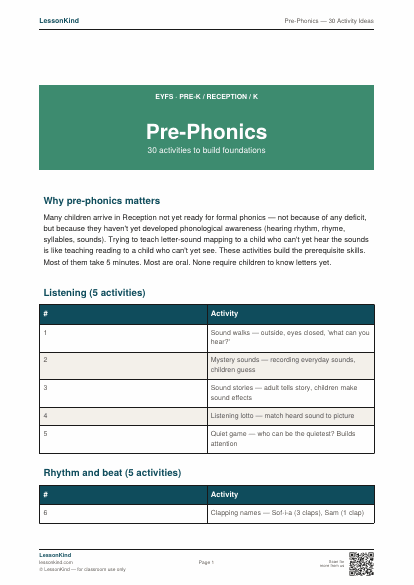
EYFS Parent Communication — Templates
Pre-written email and note templates for the most common EYFS parent comms — settling-in updates, behavior notes, achievement notes, transition info, end-of-day pickup messages.
Continuous Provision Observation Tracker
A weekly observation tracker — tick which children visit which areas, plus a focus column for noticing learning. Helps spot the children getting missed.
Reception Classroom — Essential Picture Books
The 30 picture books every Reception classroom should have — read-aloud favourites, repeat-read classics, and the books that build the foundational vocabulary, rhythm, and story-sense Reception children need.