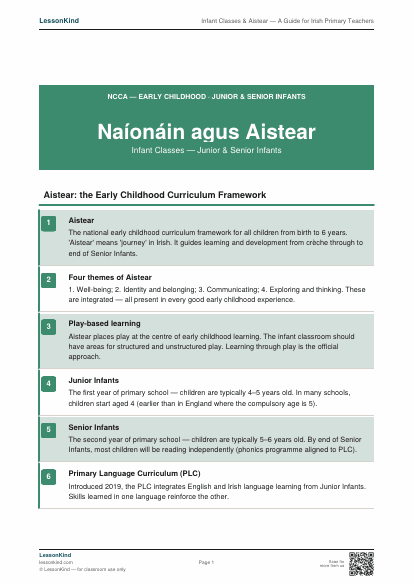
About this resource
A guide to teaching Junior and Senior Infants in Irish primary schools — Aistear (the early childhood framework), play-based learning, integrated learning, the Infant curriculum, and the transition to 1st Class.
What's included
- Print-ready PDF — A4 and US Letter compatible
- No sign-up required — download instantly
- Free to use in your classroom
More like this
More EYFS & Early Years resources

Continuous Provision — Weekly Planning Template
A simple weekly planning template for continuous provision — what's available where, what's been enhanced, what learning is being noticed. Replaces 30-page planning documents with one page that actually gets used.
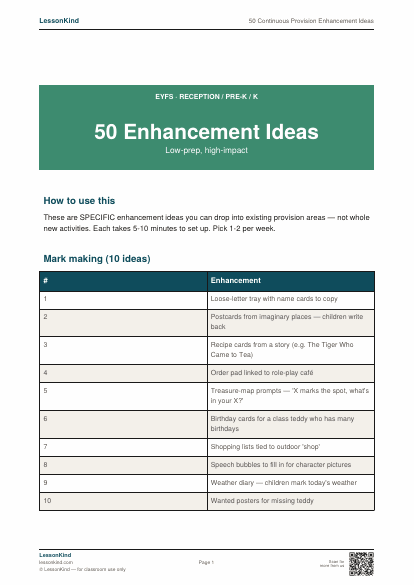
50 Continuous Provision Enhancement Ideas
50 specific, low-prep enhancements for the main provision areas — by area, by season, by skill. Useful for the Sunday-night moment when you're staring at the planning sheet.

EYFS Provision Audit Checklist
Walk around your provision with this list — does each area genuinely support the EYFS curriculum, or is it just pretty? 60-question audit organised by area.
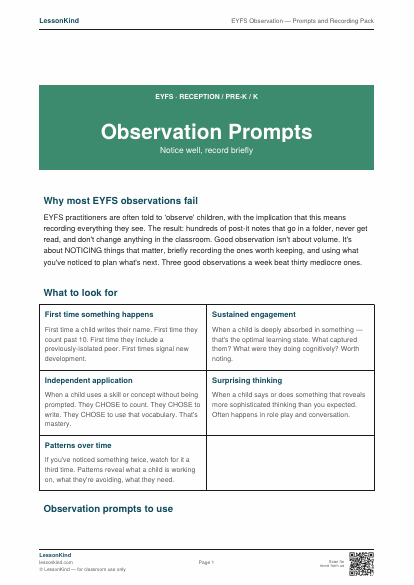
EYFS Observation — Prompts and Recording Pack
How to observe purposefully, what to write down, and how to avoid the all-too-common pattern of recording everything and learning nothing. With prompt cards.

Quick Assessment Recording Sheet
A one-page recording sheet for quick formative assessments — phonics, number, fine motor, name writing. Use as a snapshot every half-term.

Characteristics of Effective Learning — Tracker
A tracker for the three characteristics of effective learning — playing & exploring, active learning, creating & thinking critically. Useful for end-of-year EYFS reports and Reception-to-Y1 transition.
This page contains affiliate links. We may earn a commission at no extra cost to you.
Stay Safe Online with NordVPN
Protect your connection on school networks and at home. NordVPN is trusted by millions — recommended for teachers and students alike.
Get NordVPN →