🎁 Instant access to 1,825+ free resources — no sign-up needed. Or grab our 5 free bundles.

Geography

Belfast — History, Geography & Culture Knowledge Organiser (NI)

A P4–P7 knowledge organiser on Belfast — from its linen-mill origins to the Titanic, the Falls and Shankill Roads, the peace walls, regeneration, and what Belfast is like today.

Knowledge OrganiserGrade 3Grade 4Grade 5Grade 6Free

Preview

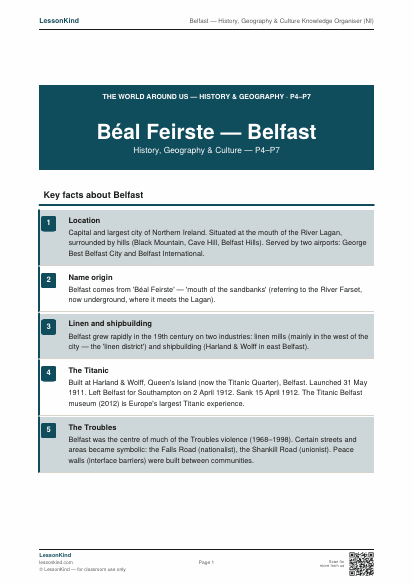
First page preview of Belfast — History, Geography & Culture Knowledge Organiser (NI) 📄 Open full PDF →

Page count: 3. Print-ready PDF — letter / A4 friendly. Click image to see all pages.

Key facts about Belfast

  1. 1 Location Capital and largest city of Northern Ireland. Situated at the mouth of the River Lagan, surrounded by hills (Black Mountain, Cave Hill, Belfast Hills). Served by two airports: George Best Belfast City and Belfast International.
  2. 2 Name origin Belfast comes from 'Béal Feirste' — 'mouth of the sandbanks' (referring to the River Farset, now underground, where it meets the Lagan).
  3. 3 Linen and shipbuilding Belfast grew rapidly in the 19th century on two industries: linen mills (mainly in the west of the city — the 'linen district') and shipbuilding (Harland & Wolff in east Belfast).
  4. 4 The Titanic Built at Harland & Wolff, Queen's Island (now the Titanic Quarter), Belfast. Launched 31 May 1911. Left Belfast for Southampton on 2 April 1912. Sank 15 April 1912. The Titanic Belfast museum (2012) is Europe's largest Titanic experience.
  5. 5 The Troubles Belfast was the centre of much of the Troubles violence (1968–1998). Certain streets and areas became symbolic: the Falls Road (nationalist), the Shankill Road (unionist). Peace walls (interface barriers) were built between communities.
  6. 6 Peace walls Physical barriers separating Protestant/Unionist and Catholic/Nationalist communities, mainly in west and north Belfast. First built in 1969. Approximately 100 peace walls still stand — though most have gates that are open during the day.

Belfast today

A city transformed

  • REGENERATION: the Titanic Quarter (former shipyard), Cathedral Quarter (arts and hospitality), and Victoria Square (retail) have transformed post-industrial areas.
  • POPULATION: approximately 340,000 city proper, 670,000 greater Belfast area.
  • TOURISM: Belfast is now a major tourist destination. Game of Thrones filming locations in NI brought a global audience. The Titanic Belfast museum has welcomed 6 million+ visitors.
  • SPORT: Windsor Park (soccer, Northern Ireland national team), Casement Park (GAA, being redeveloped), the SSE Arena (concerts and ice hockey).
  • UNIVERSITIES: Queen's University Belfast (founded 1845) and Ulster University. Significant student population.
  • FOOD: Belfast has developed a strong food scene — St George's Market (Victorian covered market), Cathedral Quarter restaurants, artisan food producers.
  • PEACE WALL QUESTION: should peace walls be taken down? Many community residents say they still feel safer with them. Others say they perpetuate division. The debate continues.

Learning objective

Describe Belfast's geographical location and history; explain the significance of linen and shipbuilding industries; understand the peace process context; and describe how Belfast has changed since the Good Friday Agreement.

About this resource

  • Subject: Geography
  • Type: Knowledge Organiser
  • Grade levels: Grade 3 (ages 8-9, ≈ Year 4), Grade 4 (ages 9-10, ≈ Year 5), Grade 5 (ages 10-11, ≈ Year 6), Grade 6 (ages 11-12, ≈ Year 7)
  • Pages: 3
  • Date added: 2026-05-28
  • Credit: Qualified primary teacher