Derry / Londonderry — The Walled City Knowledge Organiser (NI)
A P4–P7 knowledge organiser on Derry/Londonderry — the plantation origins, the iconic city walls, the Siege of Derry (1689), the Bogside murals, and how the city has changed since the Good Friday Agreement.
Preview
Page count: 3. Print-ready PDF — letter / A4 friendly. Click image to see all pages.
Key facts
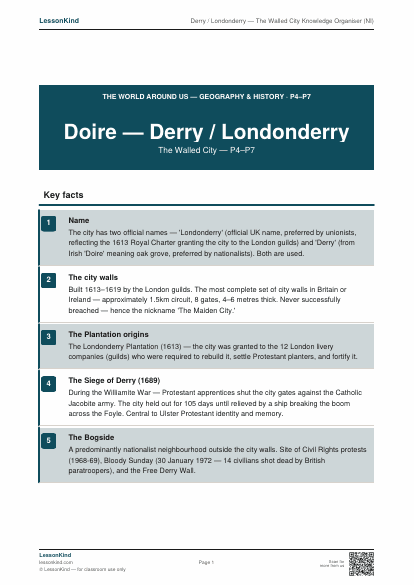
- 1 Name The city has two official names — 'Londonderry' (official UK name, preferred by unionists, reflecting the 1613 Royal Charter granting the city to the London guilds) and 'Derry' (from Irish 'Doire' meaning oak grove, preferred by nationalists). Both are used.
- 2 The city walls Built 1613–1619 by the London guilds. The most complete set of city walls in Britain or Ireland — approximately 1.5km circuit, 8 gates, 4–6 metres thick. Never successfully breached — hence the nickname 'The Maiden City.'
- 3 The Plantation origins The Londonderry Plantation (1613) — the city was granted to the 12 London livery companies (guilds) who were required to rebuild it, settle Protestant planters, and fortify it.
- 4 The Siege of Derry (1689) During the Williamite War — Protestant apprentices shut the city gates against the Catholic Jacobite army. The city held out for 105 days until relieved by a ship breaking the boom across the Foyle. Central to Ulster Protestant identity and memory.
- 5 The Bogside A predominantly nationalist neighbourhood outside the city walls. Site of Civil Rights protests (1968-69), Bloody Sunday (30 January 1972 — 14 civilians shot dead by British paratroopers), and the Free Derry Wall.
- 6 UK City of Culture 2013 Derry/Londonderry was the UK's first City of Culture (2013) — a major transformation point. The city is now a significant arts and tourism destination.
Derry today
A city transformed
- ▶ POPULATION: approximately 83,000 (Derry City and Strabane district: 150,000). NI's second largest city.
- ▶ THE PEACE BRIDGE (2011): a curved pedestrian/cycle bridge over the Foyle connecting the mainly nationalist west bank to the mainly unionist east bank — a deliberate symbol of reconciliation.
- ▶ THE BOGSIDE MURALS: a series of large political murals in the Bogside depicting key events — 'You are now entering Free Derry', the Battle of the Bogside, Bloody Sunday. A significant tourist attraction.
- ▶ CULTURE NIGHT: Derry hosts one of Ireland's largest Culture Night events annually.
- ▶ HALLOWEEN: Derry/Londonderry holds one of the world's largest Halloween festivals — drawing on its proximity to Samhain traditions and the Bogside's creativity.
- ▶ TRANSPORT: Derry is being linked to Belfast by the A6 dual carriageway upgrade. Cross-border rail connection to the Republic was severed in 1965 — discussions continue about restoration.
Learning objective
Explain the significance of the city walls; describe the Siege of Derry; understand the political sensitivity around the city's name; and identify how Derry has changed since the Good Friday Agreement.