🎁 Instant access to 1,825+ free resources — no sign-up needed. Or grab our 5 free bundles.

Geography

The South Wales Valleys — Geography & History Knowledge Organiser

A Years 4–6 knowledge organiser on the South Wales Valleys — the geography of the coalfield, the communities it built, deindustrialisation, present-day challenges, and the cultural legacy of the valleys.

Knowledge OrganiserGrade 4Grade 5Grade 6Free

Preview

First page preview of The South Wales Valleys — Geography & History Knowledge Organiser 📄 Open full PDF →

Page count: 3. Print-ready PDF — letter / A4 friendly. Click image to see all pages.

Key facts

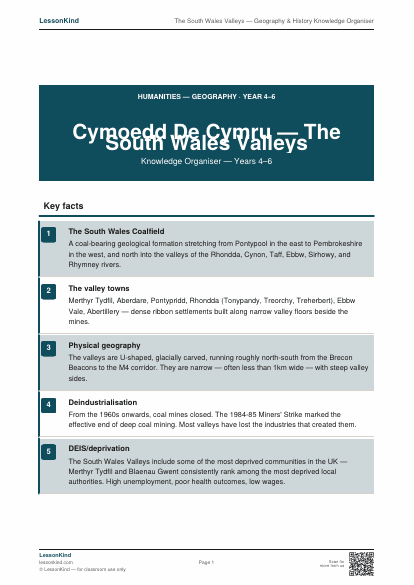
  1. 1 The South Wales Coalfield A coal-bearing geological formation stretching from Pontypool in the east to Pembrokeshire in the west, and north into the valleys of the Rhondda, Cynon, Taff, Ebbw, Sirhowy, and Rhymney rivers.
  2. 2 The valley towns Merthyr Tydfil, Aberdare, Pontypridd, Rhondda (Tonypandy, Treorchy, Treherbert), Ebbw Vale, Abertillery — dense ribbon settlements built along narrow valley floors beside the mines.
  3. 3 Physical geography The valleys are U-shaped, glacially carved, running roughly north-south from the Brecon Beacons to the M4 corridor. They are narrow — often less than 1km wide — with steep valley sides.
  4. 4 Deindustrialisation From the 1960s onwards, coal mines closed. The 1984-85 Miners' Strike marked the effective end of deep coal mining. Most valleys have lost the industries that created them.
  5. 5 DEIS/deprivation The South Wales Valleys include some of the most deprived communities in the UK — Merthyr Tydfil and Blaenau Gwent consistently rank among the most deprived local authorities. High unemployment, poor health outcomes, low wages.
  6. 6 Cultural legacy Despite economic hardship, the valleys produced a rich culture: male voice choirs, rugby, Non-conformist chapels, radical politics, and some of Wales's most famous sons and daughters.

The Valleys — culture and identity

What the valleys gave Wales

  • MALE VOICE CHOIRS: originated in mining communities — men singing together after shifts. Still active across the valleys. Treorchy Male Choir (Rhondda) is the most famous.
  • RUGBY UNION: the game became woven into valley identity in the late 19th century. Wales's greatest players have overwhelmingly come from the valleys: Gareth Edwards, Barry John, JPR Williams.
  • POLITICS: the valleys were the heartland of the South Wales Labour movement. They have returned Labour MPs continuously since 1922. Aneurin Bevan (Ebbw Vale), Neil Kinnock (Tredegar/Islwyn), Michael Foot (Ebbw Vale).
  • CHAPEL CULTURE: Non-conformist chapels (Methodist, Baptist, Congregational) were the social centres of valley communities. Many have now closed or been converted.
  • TODAY: transport improvements (A465 'Heads of the Valleys road', proposed South Wales Metro) aim to connect the valleys to Cardiff employment. Regeneration includes tourism, green energy (wind farms on former pit sites).
  • ABERFAN (1966): 144 people — 116 of them children — died when a colliery spoil tip collapsed onto Pantglas Junior School, Aberfan. One of the most devastating disasters in Welsh history.

Learning objective

Describe the physical geography of the South Wales Valleys; explain how the coalfield shaped the communities; understand the impact of deindustrialisation; and know the cultural legacy of the valleys.

About this resource

  • Subject: Geography
  • Type: Knowledge Organiser
  • Grade levels: Grade 4 (ages 9-10, ≈ Year 5), Grade 5 (ages 10-11, ≈ Year 6), Grade 6 (ages 11-12, ≈ Year 7)
  • Pages: 3
  • Date added: 2026-05-28
  • Credit: Qualified primary teacher