🎁 Instant access to 1,825+ free resources — no sign-up needed. Or grab our 5 free bundles.

Languages

Welsh Medium Education: A Guide for Parents and New Teachers

A clear guide to Welsh Medium Education (WME) — schools where everything is taught through Welsh — what they are, how they work, language immersion in practice, and outcomes for pupils.

Fact FilePre-KindergartenKindergartenGrade 1Grade 2Grade 3Grade 4Grade 5Grade 6Free

Preview

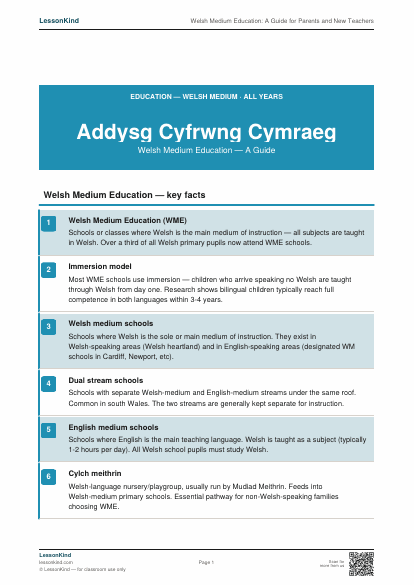
First page preview of Welsh Medium Education: A Guide for Parents and New Teachers 📄 Open full PDF →

Page count: 3. Print-ready PDF — letter / A4 friendly. Click image to see all pages.

Welsh Medium Education — key facts

  1. 1 Welsh Medium Education (WME) Schools or classes where Welsh is the main medium of instruction — all subjects are taught in Welsh. Over a third of all Welsh primary pupils now attend WME schools.
  2. 2 Immersion model Most WME schools use immersion — children who arrive speaking no Welsh are taught through Welsh from day one. Research shows bilingual children typically reach full competence in both languages within 3-4 years.
  3. 3 Welsh medium schools Schools where Welsh is the sole or main medium of instruction. They exist in Welsh-speaking areas (Welsh heartland) and in English-speaking areas (designated WM schools in Cardiff, Newport, etc).
  4. 4 Dual stream schools Schools with separate Welsh-medium and English-medium streams under the same roof. Common in south Wales. The two streams are generally kept separate for instruction.
  5. 5 English medium schools Schools where English is the main teaching language. Welsh is taught as a subject (typically 1-2 hours per day). All Welsh school pupils must study Welsh.
  6. 6 Cylch meithrin Welsh-language nursery/playgroup, usually run by Mudiad Meithrin. Feeds into Welsh-medium primary schools. Essential pathway for non-Welsh-speaking families choosing WME.

Why Welsh Medium Education works

The evidence on bilingual education outcomes

  • BILINGUAL ADVANTAGE: research consistently shows bilingual children develop stronger executive function — better attention, task-switching, and problem-solving.
  • NO DISADVANTAGE: studies in Wales show WME pupils achieve at the same level or better in English than EM school pupils — learning through Welsh does not harm English.
  • LANGUAGES ON TOP: WME pupils finish school with Welsh and English as functional languages. Many then add Modern Foreign Languages on top.
  • IMMERSION TIMELINE: most English-speaking children who start WME in Reception are functionally bilingual by Year 3-4.
  • DEMAND IS GROWING: WME school places are in significant demand. The Welsh Government has set a target of 40% of 16-year-olds speaking Welsh by 2050. WME expansion is central to this.
  • FOR NEW TEACHERS: teaching in a WME school as a non-Welsh speaker is possible in specialist English subject roles. Many WME schools are actively training Welsh language skills among staff.

Learning objective

Explain what Welsh Medium Education is and how it differs from English-medium education; describe the immersion model; and understand the evidence on bilingual outcomes.

About this resource

  • Subject: Languages
  • Type: Fact File
  • Grade levels: Pre-Kindergarten (ages 3-4, ≈ Nursery), Kindergarten (ages 4-6, ≈ Reception / Y1), Grade 1 (ages 6-7, ≈ Year 2), Grade 2 (ages 7-8, ≈ Year 3), Grade 3 (ages 8-9, ≈ Year 4), Grade 4 (ages 9-10, ≈ Year 5), Grade 5 (ages 10-11, ≈ Year 6), Grade 6 (ages 11-12, ≈ Year 7)
  • Pages: 3
  • Date added: 2026-05-28
  • Credit: Qualified primary teacher