173 resources
Pre-Kindergarten
Free printable resources for Pre-Kindergarten — no sign-up required.
Browse resources
173 resources for Pre-K

Numbers 1–10 Tracing Sheet
Trace each number from 1 to 10. Includes a quick counting picture for each.

Alphabet Tracing — A to Z
Trace each letter of the alphabet, uppercase and lowercase. One picture cue per letter.

Beginner Phonics Sound Mat
All 26 single letters plus the most common digraphs. Stick on desks for independent writing support.

My Five Senses
Match each sense to its body part and to things you can sense with it.

Handwashing & Hygiene Poster
Six steps to proper handwashing plus a daily-hygiene checklist for the youngest classes.

Fundamental Movement Skills Reference
10 fundamental movement skills every child should master before age 8 — with how-to-coach cues.

Teacher's Weekly Planner Template
A clean one-page weekly planning grid for teachers — Monday to Friday with five subject slots per day.

Parent–Teacher Conference Notes Template
Structured conference notes form — strengths, areas to develop, agreed actions, parent comments.

Lesson Plan Template (one page)
A one-page lesson plan template — objective, success criteria, hook, main task, assessment, plenary.

Before-School Settling Activity Pack
Calm, gentle activities for children who arrive early and need help settling in. Reduces school-anxiety.

Morning Assembly Week 4 — Local Heroes
Template for highlighting local community helpers — firefighters, teachers, shop workers, bus drivers, volunteers.

Thanksgiving & Gratitude Traditions
Thanksgiving in North America, harvest festivals worldwide, and ways to practice gratitude — includes gratitude activity sheets.

Continuous Provision — Weekly Planning Template
A simple weekly planning template for continuous provision — what's available where, what's been enhanced, what learning is being noticed. Replaces 30-page planning documents with one page that actually gets used.
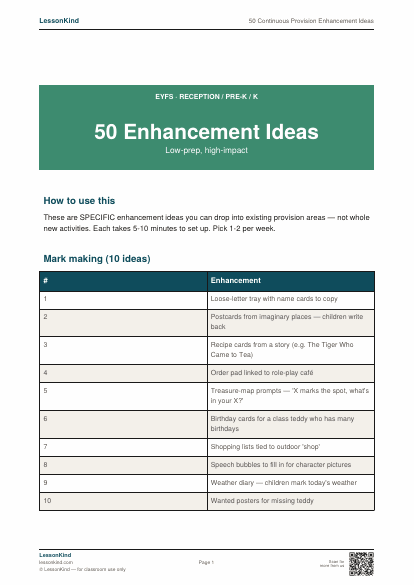
50 Continuous Provision Enhancement Ideas
50 specific, low-prep enhancements for the main provision areas — by area, by season, by skill. Useful for the Sunday-night moment when you're staring at the planning sheet.

EYFS Provision Audit Checklist
Walk around your provision with this list — does each area genuinely support the EYFS curriculum, or is it just pretty? 60-question audit organised by area.
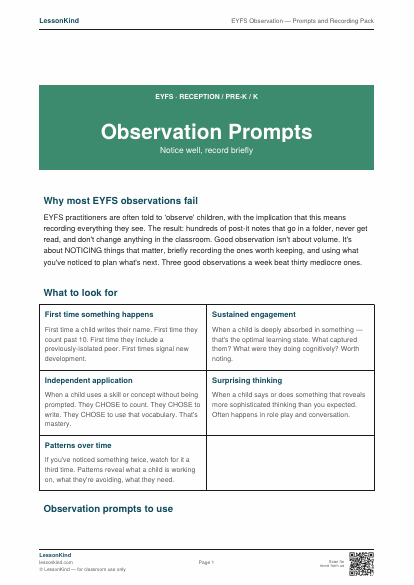
EYFS Observation — Prompts and Recording Pack
How to observe purposefully, what to write down, and how to avoid the all-too-common pattern of recording everything and learning nothing. With prompt cards.

Quick Assessment Recording Sheet
A one-page recording sheet for quick formative assessments — phonics, number, fine motor, name writing. Use as a snapshot every half-term.

Characteristics of Effective Learning — Tracker
A tracker for the three characteristics of effective learning — playing & exploring, active learning, creating & thinking critically. Useful for end-of-year EYFS reports and Reception-to-Y1 transition.
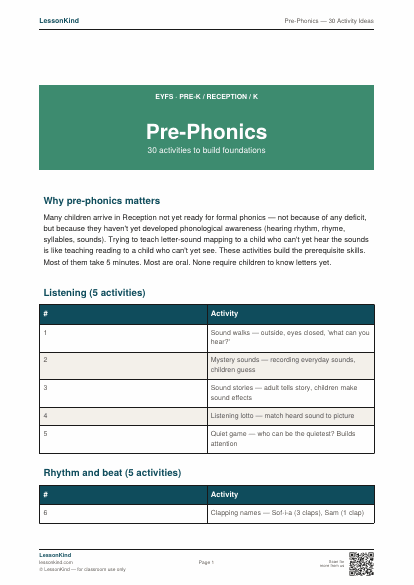
Pre-Phonics — 30 Activity Ideas
30 activities to develop the foundations BEFORE introducing letters — listening, rhythm, rhyme, alliteration, oral blending. The skills that determine how well phonics will land later.

Phase 1 Phonics — Sound Bag Activities
How to set up and use sound bags — a Phase 1 phonics staple. With 12 themed bag ideas and how to scaffold across the year.

Subitising Cards — 1 to 10
Picture cards for subitising — instantly recognising small quantities without counting. The single most important early-number skill, with cards in five different arrangements per number.

Number Bonds for the Youngest — Activity Pack
How to introduce number bonds to 5 and 10 in EYFS without worksheets — with tens-frames, real objects, story contexts and games.
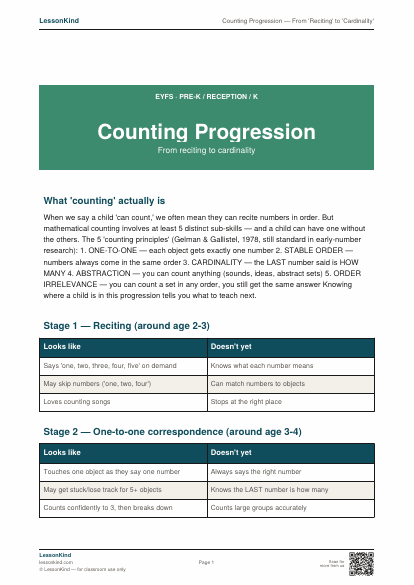
Counting Progression — From 'Reciting' to 'Cardinality'
What counting actually involves — five distinct sub-skills that develop in a roughly predictable order. With assessment ideas for each stage.
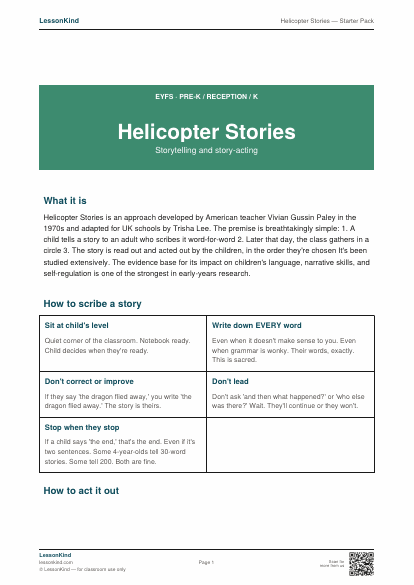
Helicopter Stories — Starter Pack
An introduction to Helicopter Stories — Vivian Gussin Paley's storytelling-and-story-acting approach. One of the most evidence-informed early-language interventions there is.