257 resources
English / Language Arts
Free printable english / language arts resources for primary and elementary teachers — no sign-up required.
All resources
English / Language Arts — 257 free resources

Alphabet Tracing — A to Z
Trace each letter of the alphabet, uppercase and lowercase. One picture cue per letter.

Beginner Phonics Sound Mat
All 26 single letters plus the most common digraphs. Stick on desks for independent writing support.

CVC Words — Read and Build
Read, sound out and build consonant-vowel-consonant words. Includes word families.

Rhyming Words — Match and Make
Match rhyming pairs, then make your own. Includes a rhyme-finder picture activity.

Sight Words Flashcards (Kindergarten)
The most common sight words for kindergarten readers. Print, cut and laminate.

Grade 1 Sight Words List
Common Grade 1 sight words, with tick boxes for spelling assessment.

Sentence Building
Build complete sentences from word banks. Practice capital letters, spaces, and end punctuation.

Grade 2 Common Words List
Tricky and common words for Grade 2, with tick boxes for spelling assessment.

Story Sequencing — Putting Events in Order
Cut, mix and re-order story events. Builds narrative comprehension and writing structure.

Adjectives Word Bank
Themed adjective banks (appearance, feeling, weather, character) for descriptive writing.

Synonyms and Antonyms
Match pairs and write your own. Builds vocabulary and word-choice flexibility.

Story Planning Template — 5-Part Story Mountain
A printable story mountain with prompts for opening, build-up, problem, resolution and ending.

Punctuation Poster — Grades 3–5 Reference
All major punctuation marks with examples. Letter-size classroom display.

Reading Comprehension — The Wise Traveler
Original 250-word parable with retrieval, inference and language questions.

Paragraph Structure — Topic, Support, Conclusion
Build clear paragraphs with a topic sentence, supporting details, and a closing sentence.

Figurative Language Guide
Similes, metaphors, personification, alliteration, onomatopoeia and hyperbole — with examples.

Persuasive Writing Checklist
Self-assessment checklist covering persuasive techniques and structural features.

Book Report Template
One-page book report form with prompts for setting, characters, plot, theme and review.

Grammar & Punctuation Review (Grade 5–6)
Mixed grammar and punctuation questions for upper-elementary review.

Reading Comprehension — A Child's Journey
Historical short story (350 words) about a child's wartime journey, with retrieval, inference and language questions.

Poetry Types Poster
Six common poetry forms — haiku, limerick, acrostic, cinquain, sonnet, free verse — with one example each.

Dialogue Punctuation Rules
How to punctuate speech in stories. Comma placement, capitalization and the dialogue tag.

Verb Tenses Reference Poster
Past, present, future — simple, continuous and perfect — all in one reference grid.

Compound Words Builder
Match two words to make a compound. Then build your own. Develops vocabulary and word play.

Homophones — Tricky Word Pairs
12 commonly-confused homophone pairs explained — there/their/they're, your/you're, to/too/two.

Newspaper Report Template
Plan and write a newspaper report. Headline, byline, lead, body and quote — with prompts for each.

Verbs — Action and State
The two main types of verb explained. Sort 20 verbs into action vs state and write your own.

Cause and Effect Graphic Organizer
Six cause-and-effect boxes for analyzing a story or text. Builds reading comprehension skills.

Prefixes and Suffixes Reference
Common prefixes and suffixes with meanings and examples. Helps with spelling and word-meaning detective work.

Diary Entry Template
First-person reflective writing template. Includes prompts for events, feelings and a closing thought.

Reading Log — Home Reading Record
Two-week home reading log. Date, book, pages, parent signature, child reflection.

Spelling Rules Poster
Eight common spelling rules every elementary writer should know — i before e, doubling letters, and more.

Main Idea & Supporting Details
Practice spotting the main idea of a short passage and identifying details that support it.

Letter Writing — Friendly and Formal
How to structure friendly and formal letters. Two side-by-side templates with prompts.

Myth and Legend — Comprehension (Pandora's Box)
Retold Pandora's Box myth (300 words) with retrieval, inference and language questions.

Narrative vs Non-narrative Texts
Tell the difference between narrative and non-narrative writing. Sort 12 examples by type.

Word Classes Reference Poster
All major word classes — nouns, verbs, adjectives, adverbs, pronouns, conjunctions, prepositions — with examples.

Instruction Writing Template
Write clear instructions — title, ingredients/equipment, numbered steps, top tip.

Context Clues — Working Out Words
Strategies for guessing the meaning of new words from the surrounding text. Six practice passages.

Non-fiction Text Features
Headings, captions, glossaries, indexes, sidebars and more — the parts of a non-fiction book and what they're for.

Writing a Book Review
Template for a book review — summary, characters, favorite part, who you'd recommend it to, star rating.

High-Frequency Words by Year Group
The most common words children need to read fluently — split by year group. Reception, Year 1, Year 2 and beyond. Print, display, practise.

Punctuation Reference Card — All The Marks
Every punctuation mark a primary child needs — what it's called, what it does, and an example. Print, laminate, stick on every desk.

Story Writing Planner — Universal Template
A six-section story planner that works for any narrative — opening, build-up, problem, climax, resolution and ending. Print one per child before any story task.

Spelling Rules That Actually Help — A Poster
The spelling rules that make English make sense — i before e, doubling consonants, dropping the e, and the magic of -tion. With clear examples.

Color the Alphabet — A to Z Pack
26 alphabet coloring activities (A-Z), each pairing a letter with an object that starts with that letter. Children color the letter and the object using a color guide. Builds letter recognition, initial-sound vocabulary, and color words.

Y6 SATs Reading — Strategies for the Three Texts
The Reading paper is 1 hour, 3 texts of increasing difficulty, around 50 marks. This pack covers the question-type taxonomy (retrieval / inference / vocabulary / structure), pacing strategy across the three texts, and the 'how to use the text' approach that beats reading-from-memory.

Y6 SATs SPaG (Spelling, Punctuation, Grammar) — Reference Pack
The SPaG paper tests technical English knowledge — terminology, punctuation use, grammatical structures. This pack covers the 30+ technical terms children must recognise, plus the punctuation and grammar rules that come up most often. The single revision document Y6 children should keep on their desk.

Y6 SATs Teacher Pacing Guide — Autumn to May
How to pace SATs prep across the academic year without burning the children (or yourself) out. Term-by-term breakdown of what to focus on, when to start past papers, when to slow down, and how to avoid the January-panic that derails so many Y6 teachers.

Y6 SATs Question Stems — Quick-Reference Flashcards
Flashcards covering the question-stem language that appears in SATs papers ('find and copy', 'how does the author', 'what does this word mean'). Children who recognise the question stems answer faster and lose fewer marks. Set of 30 stems with the strategy for each.
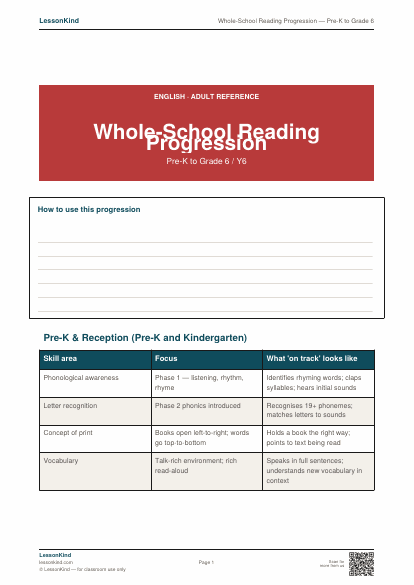
Whole-School Reading Progression — Pre-K to Grade 6
How reading skills develop across primary — phase 1 phonics through KS2 inference, summarisation, and critical reading. Includes year-by-year skill expectations, common misconceptions, and the assessment markers that show whether children are on track. The reference document an English Lead returns to most often.
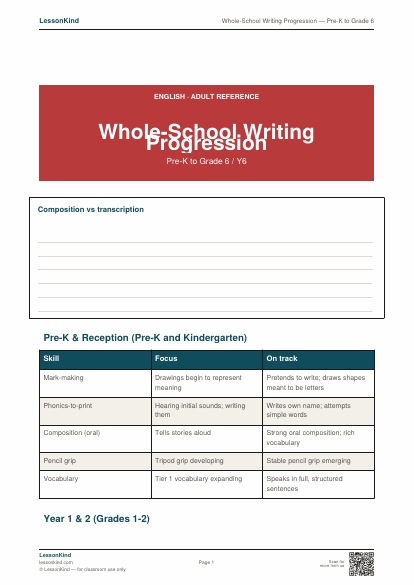
Whole-School Writing Progression — Pre-K to Grade 6
How writing skills develop across primary — emergent mark-making through KS2 sustained writing. Year-by-year skill expectations covering composition, transcription, vocabulary, sentence structure, and editing. Pairs with the reading progression as the English Lead's two foundational reference docs.
Reading for Pleasure — Whole-School Strategy
How English Leads build a school-wide reading culture. Covers the Open University's 4-strand model, library setup, daily read-aloud rituals, reluctant-reader strategies, parent engagement, and how to measure reading-for-pleasure (it's harder than measuring fluency). The most important single thing an English Lead does.
School Library — Setup and Management Guide
How to set up and run a primary school library — book selection, organisation, lending systems, refresh cycles, parent volunteer roles, and the difference between 'a room with books' and 'a library children actually use'. For English Leads inheriting a tired library or starting from scratch.
English CPD Pack for Class Teachers
Six 20-minute CPD sessions for English Leads to deliver to class teachers — covering reading aloud, comprehension teaching, writing feedback, vocabulary teaching, phonics for non-specialists, and reading-for-pleasure leadership. Designed for twilight INSETs.
English Lead Handover Document
When an English Lead leaves a school, the next person inherits chaos by default. This handover template captures everything — phonics scheme, reading data, library status, CPD history, key children, statutory data trends. Mirrors the music and assessment coordinator handover docs.

English Monitoring Walk — Prompt Sheet
What to look for during a 10-minute classroom monitoring walk for English. Specific prompts for reading lessons, writing lessons, phonics lessons, and book corner audits. Designed for English Leads doing learning walks without it feeling like inspection.
KS1 Reading List — Books for Year 1 and Year 2
Curated reading list for Year 1 and Year 2 children — picture books, early chapter books, poetry, and books for the children just becoming readers. Calibrated for the children who are decoding fluently and ready for richer stories.
KS2 Reading List — Books for Year 3 to Year 6
Curated reading list for Year 3 through Year 6 — chapter books, mysteries, fantasy, contemporary fiction, graphic novels, and books for children developing their personal reading taste. Calibrated for fluent readers building lifelong reading habits.
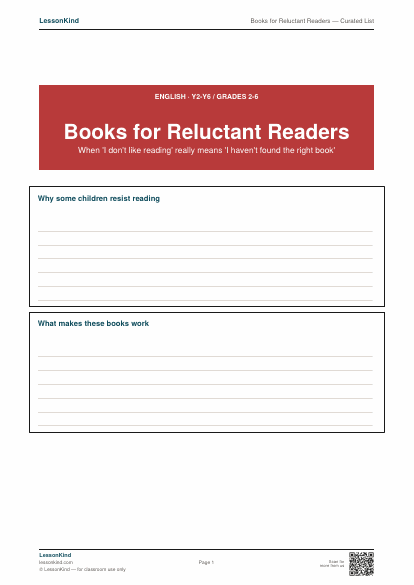
Books for Reluctant Readers — Curated List
Books specifically chosen to convert reluctant readers — short, accessible, often illustrated, always engaging. For the children who 'don't like reading' (because they haven't found the right book yet). Calibrated for Y2-Y6.
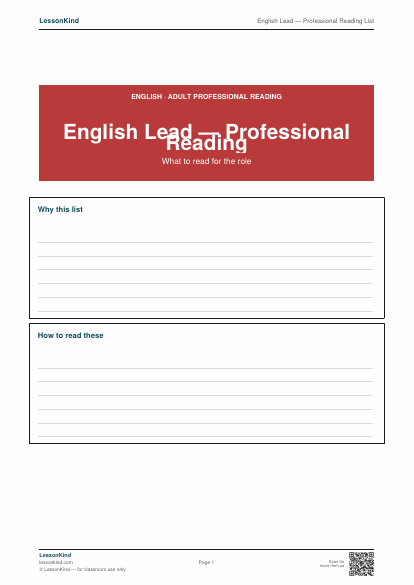
English Lead — Professional Reading List
Professional books every primary English Lead should read — the research-grounded titles on phonics, reading-for-pleasure, comprehension, vocabulary, and writing teaching. Honest about which are essential and which are optional.

Reading Passport — Printable Booklet
A printable Reading Passport — a fold-and-staple A4 booklet where children record every book read, the country/genre, and a star rating. Builds reading culture without competition or pressure.
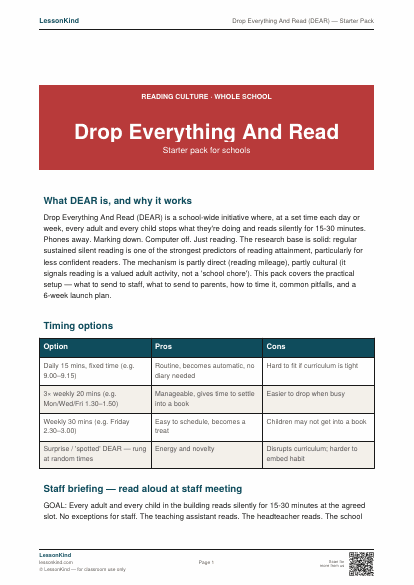
Drop Everything And Read (DEAR) — Starter Pack
Everything to launch a Drop Everything And Read programme — staff briefing, parent letter, signage, slot timing options, evidence base and FAQ. Ready to deploy in week 1.
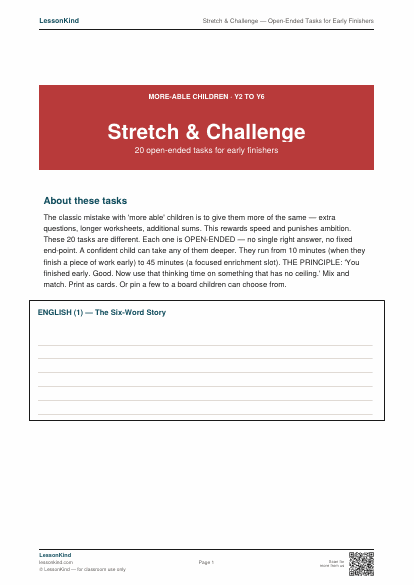
Stretch & Challenge — Open-Ended Tasks for Early Finishers
Twenty open-ended tasks designed for the children who finish first. No 'more of the same' — these are genuinely thinking-required tasks across English, maths, problem-solving and creative writing.
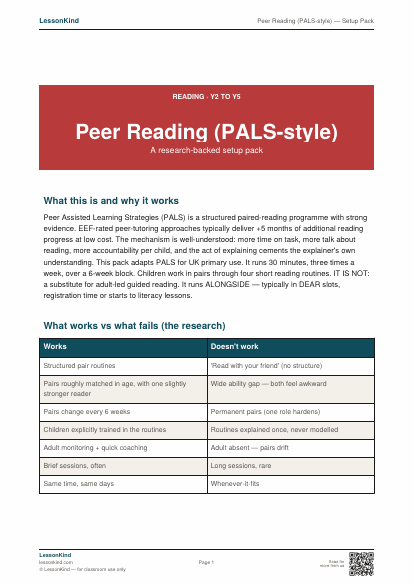
Peer Reading (PALS-style) — Setup Pack
A research-backed peer reading programme adapted from PALS — structured pairs, four reading routines (paired reading, retell, paragraph shrink, prediction), pairing rules, and a 6-week launch plan.

SATs Week Survival Guide
Practical guide for teachers and parents on supporting Y6 children through SATs week — sleep, food, anxiety, post-paper recovery, and the things that don't help.

Word Classes Poster (KS2)
Reference poster for every word class on the KS2 SATs Grammar paper. Definitions, examples, and quick spotting tests for each class.

Punctuation Poster (KS2)
Every punctuation mark used in KS2 writing — full stops to semicolons, with examples and rules. Display poster + quick reference.

Story Mountain Poster
Visual structure of a story — opening, build-up, problem, resolution, ending. The classic primary writing scaffold.

Sentence Types Poster (KS2)
Simple, compound, complex sentences, plus statements, questions, commands, exclamations. Reference poster for KS2 grammar.

Phonics Sounds Chart Poster
Reference chart of all 44 phonemes in English with example words. Display poster for Reception and Year 1.

Model Text — Persuasive Letter (Y4)
WAGOLL example of a Year 4 persuasive letter. Includes the model text, an annotated version highlighting language features, vocabulary list, and writing prompt. Perfect for shared reading and writing scaffolds.

Model Text — Newspaper Report (Y5)
WAGOLL example of a Year 5 newspaper report on a fictional event. Demonstrates the inverted-pyramid structure, direct/reported speech, formal third-person voice, and journalistic conventions.

Model Text — Narrative Opening (Y6)
WAGOLL example of a Year 6 narrative opening — atmospheric, character-driven, with sophisticated sentence variety. Demonstrates show-don't-tell, dialogue, and 'pathetic fallacy' for SATs writing standards.

Model Text — Non-Chronological Report (Y3)
WAGOLL example of a Year 3 non-chronological report on penguins. Demonstrates clear sub-headings, factual present tense, technical vocabulary, and information organisation appropriate for Year 3.

Model Text — Diary Recount (Y3)
WAGOLL example of a Year 3 diary entry recounting a school trip. Demonstrates first-person past-tense recount, time connectives, and emotional response — common Y3 writing genre.

Model Text — Instructions (Y2)
WAGOLL example of a Year 2 instructions text — How to Make a Paper Aeroplane. Demonstrates imperative verbs, time-order connectives, numbered steps, and clear language for KS1 instructional writing.

Model Text — Explanation (Y4)
WAGOLL example of a Year 4 explanation text — How Volcanoes Erupt. Demonstrates cause-and-effect language, technical vocabulary, present tense for general truths, and clear paragraph structure.

Model Text — Balanced Argument (Y6)
WAGOLL example of a Year 6 balanced argument essay — Should Children Have Mobile Phones? Demonstrates formal essay structure, both-sides reasoning, modal verbs, and a measured conclusion at SATs writing standard.

Model Text — Personal Recount (Y2)
WAGOLL example of a Year 2 personal recount — My First Day at School. Demonstrates first-person past-tense recount, simple time connectives, and feeling words for KS1.

Model Text — Setting Description (Y2)
WAGOLL example of a Year 2 setting description — The Beach. Demonstrates expanded noun phrases, the five senses, and adjectives for descriptive writing in KS1.

Model Text — Thank You Letter (Y3)
WAGOLL example of a Year 3 thank-you letter to a visiting author. Demonstrates letter conventions, paragraphing, and specific details that show genuine engagement.

Model Text — Persuasive Poster (Y3)
WAGOLL example of a Year 3 persuasive poster — Visit the Local Park! Demonstrates rhetorical questions, emotive language, alliteration, and visual conventions of persuasive posters for younger writers.

Model Text — Historical Diary (Y4)
WAGOLL example of a Year 4 historical diary — A Roman Centurion in Britain. Cross-curricular link to Romans history unit. Demonstrates first-person past-tense recount with historical detail and authentic voice.

Model Text — Suspenseful Setting Description (Y4)
WAGOLL example of a Year 4 suspenseful setting description — The Abandoned House. Demonstrates atmospheric language, varied sentence openers, and personification for building tension.

Model Text — Biography (Y5)
WAGOLL example of a Year 5 biography of Mary Anning, fossil hunter. Cross-curricular link to KS2 science (rocks and fossils). Demonstrates third-person past-tense biography structure with chronological organisation.

Model Text — Discussion Text (Y5)
WAGOLL example of a Year 5 discussion text — Are Computers Better Than Books for Learning? Demonstrates balanced both-sides structure, formal connectives, and a measured conclusion below the harder Y6 standard.

Model Text — Free Verse Poetry (Y6)
WAGOLL example of Year 6 free verse poetry — The Old Library. Demonstrates imagery, metaphor, line breaks, and emotional weight without rhyme. Useful for SATs reading and for poetry units.

Model Text — Persuasive Speech (Y6)
WAGOLL example of a Year 6 persuasive speech — for school council election. Demonstrates direct address, rhetorical devices (rule of three, repetition, rhetorical questions), and pace control for spoken delivery at SATs writing standard.

Home–School Reading Record
Printable reading record booklet for primary pupils — weekly log with book title, pages read, date, pupil comment, and parent/carer sign-off. Designed to travel between home and school.

Readers' Theatre — Jack and the Beanstalk (Y1–Y3)
A 3-page readers' theatre script of Jack and the Beanstalk with 7 roles — Jack, Mother, Giant, Narrator (×2), and 2 chorus parts. No props or costumes needed. Perfect for guided reading or English.

Performance Poem — The Seasons (Y2–Y5)
A four-stanza performance poem about the four seasons — one stanza per season, designed for whole-class choral reading with solos. Includes actions and sound effects guide. Suitable for assemblies and literacy.

Debate Script — Should School Start Later? (Y5–Y6)
A structured persuasion debate script for upper KS2 — four speakers on each side, chair, and rebuttal round. Topic: should the school day start at 9:30 instead of 9:00? Teaches argument and counter-argument.
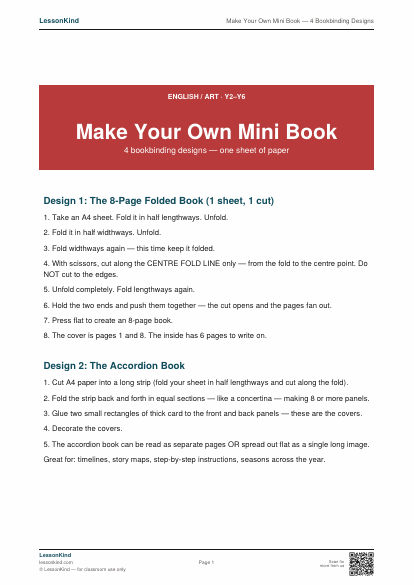
Make Your Own Mini Book — 4 Bookbinding Designs
Instructions for making 4 types of mini book from a single sheet of paper: the 8-page accordion, the 4-page folded book, the concertina, and the pocket staple book. Perfect for writing, topic work, and gifts.
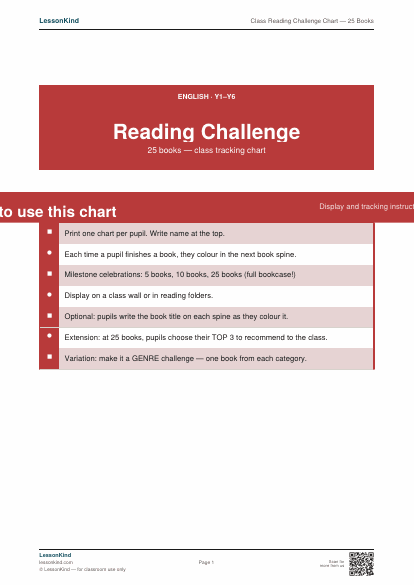
Class Reading Challenge Chart — 25 Books
A printable whole-class reading challenge chart for tracking 25 books per pupil over the year. Includes a pupil name strip and 25 numbered book spines to colour in. Doubles as a classroom display.
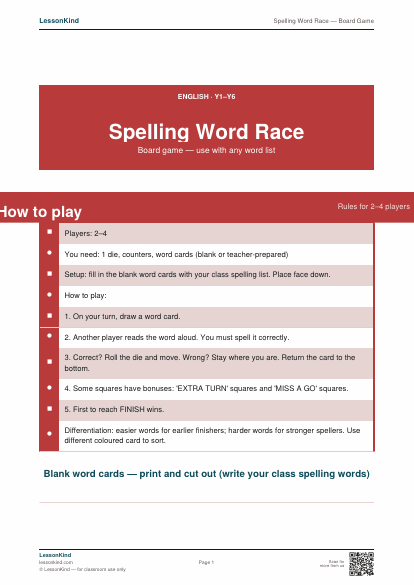
Spelling Word Race — Board Game
A printable board game where players draw a word card and must spell the word correctly to move. Blank word cards included so teachers can insert their own class spelling lists. For 2–4 players.

Recommended Books for Ages 5–7 (KS1) — Teacher's Reading List
A curated reading list of 30 picture books and early readers for KS1 — covering fiction, non-fiction, poetry, and diverse voices. With curriculum links and a brief annotation for each title.

Recommended Books for Ages 7–11 (KS2) — Teacher's Reading List
A curated reading list of 40 novels, non-fiction books, and poetry collections for KS2 — annotated with reading age, curriculum links, and a sentence on why each book earns its place.

Book Recommendation Display — Pupil Review Template
Printable A5 book recommendation cards for pupils to fill in and display — title, author, star rating, one-sentence summary, who they'd recommend it to. For classroom reading displays.

Guided Reading Session Record Sheet
A teacher-facing record sheet for guided reading sessions — group members, text level, focus skills, observations per pupil, and next steps. One sheet per session.
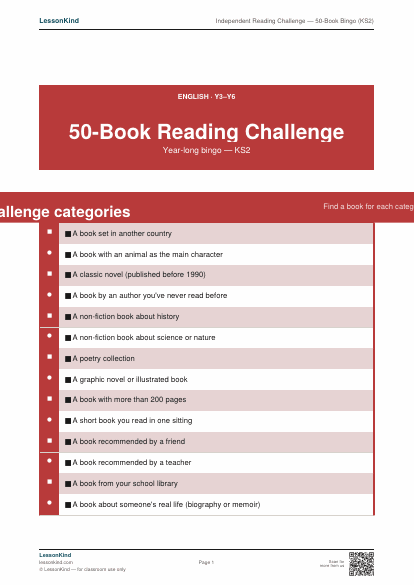
Independent Reading Challenge — 50-Book Bingo (KS2)
A 50-book reading bingo card for KS2 with genre categories — one fiction, one non-fiction, one poetry, one from a different country, one by a new author, and more. A year-long reading challenge.

Desk Prompt Strip — Maths & English
A printable A4 desk prompt strip covering key maths and English reference points — number lines to 100, common spellings, punctuation rules, and grammar terms. Laminate for long-term use.
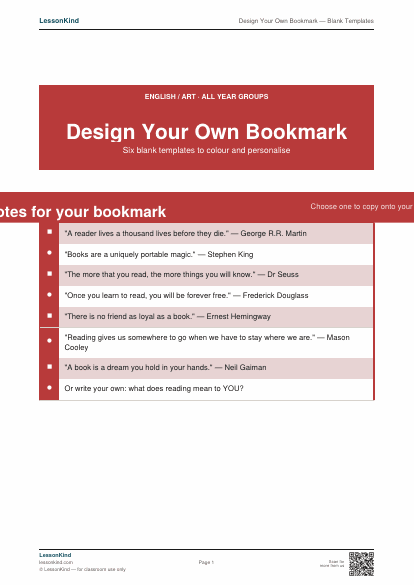
Design Your Own Bookmark — Blank Templates
Six printable blank bookmark templates in different shapes and sizes — for pupils to design, colour, and personalise. Includes motivational reading quote suggestions. Print on card, laminate, and use.

Word Puzzles & Riddles — English Pack
25 word puzzles and riddles for primary — homophones, anagrams, compound words, wordplay, and classic riddles. Great for literacy lessons, wet break, or as starters.

Grammar & Punctuation Knowledge Organiser — Year 5/6
A complete KS2 grammar and punctuation reference — word classes, sentence types, punctuation marks, and key terminology. Covers the SPaG content children need to know from Y2–Y6.

Poetry & Language Features Knowledge Organiser
A printable reference for poetry analysis — poetic forms, language features, structural techniques, and key terminology for analysing poems in KS2 and KS3.

Word Types & Phrases Knowledge Organiser — KS1/2
A child-friendly reference for the key word types and phrase types encountered in primary English — nouns, verbs, adjectives, adverbs, conjunctions, and expanded noun phrases, with examples.

Reading Comprehension Skills Knowledge Organiser — KS2
A KS2 English knowledge organiser on reading comprehension — the key skills (retrieval, inference, vocabulary in context, author's effect, summarising) with strategies for each.

Writing Types & Purposes Knowledge Organiser
A KS2 reference for the main non-fiction writing types — persuasion, explanation, recount, instruction, report, and discussion — with purpose, audience, key features, and sentence starters for each.

Vocabulary & Word Choice Knowledge Organiser — KS2
A KS2 vocabulary reference — word families, prefixes and suffixes, synonyms and antonyms, connotation and denotation, and how to make powerful word choices in writing.

Narrative Fiction Knowledge Organiser
A KS2 knowledge organiser on fiction writing — story structure, character, setting, atmosphere, narrative hooks, and the craft techniques that separate good writing from great writing.

Early Reading & Phonics Knowledge Organiser — EYFS/KS1
A Reception and KS1 reference for early reading — phonics phases, common exception words, the alphabetic code, blending and segmenting, and early comprehension development.

Speaking & Listening — Oracy Knowledge Organiser
A KS2 oracy reference — formal and informal speaking, features of effective talk, listening skills, vocabulary for discussion, and the four strands of oracy (physical, linguistic, cognitive, social/emotional).

Persuasive Writing Knowledge Organiser — KS2
A KS2 English knowledge organiser on persuasive writing — structure, rhetorical devices, formal language features, audience awareness, and the key techniques that make persuasion effective.

Narrative Structure & Story Planning — Knowledge Organiser KS2
A KS2 English knowledge organiser on narrative structure — story mountains, Freytag's pyramid, character development, setting, plot types, and how professional authors structure their stories.

Poetry Forms & Techniques Knowledge Organiser — KS2
A KS2 English knowledge organiser on poetry — key poetic forms (haiku, sonnet, free verse, limerick, ballad), poetic devices (metaphor, simile, alliteration, assonance, onomatopoeia), and how to analyse and write poetry.

Grammar & Punctuation Knowledge Organiser — KS2
A KS2 English knowledge organiser on grammar and punctuation — word classes, sentence types, clauses, conjunctions, and the most important punctuation marks. Covers the key KS2 SPaG content.

Non-Fiction Writing Knowledge Organiser — KS2 English
A KS2 English knowledge organiser on non-fiction text types — explanation, persuasion, report, recount, instruction. Features, language choices, structure, and audience for each genre.
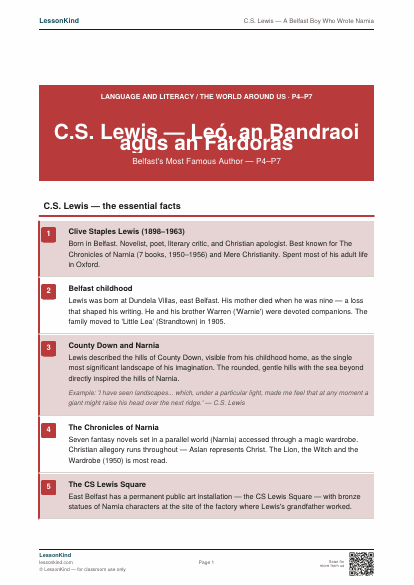
C.S. Lewis — A Belfast Boy Who Wrote Narnia
A P4–P7 literacy and culture resource on C.S. Lewis — born in Belfast, the landscapes of County Down that inspired Narnia, his life and works, and classroom activities using The Lion, the Witch and the Wardrobe.

Reading Comprehension Strategies Knowledge Organiser — KS2
A KS2 English knowledge organiser on reading comprehension strategies — retrieval, inference, vocabulary, author intent, summarising, and how to answer comprehension questions well.

Adjectives Pack — Identify, Choose, Improve
Ready-made adjectives worksheet covering identification, choosing the best adjective, and using adjectives to improve writing. KS1 and lower KS2 friendly.

Adverbs Pack — Identify and Use
Ready-made adverbs worksheet covering manner, time, place and frequency adverbs. KS2 focused.

Nouns & Pronouns Pack
Ready-made nouns and pronouns worksheet — common, proper, abstract nouns plus personal and possessive pronouns. KS1 and KS2.

Verbs & Tenses Pack
Ready-made verbs worksheet covering action verbs, state verbs, and the three main tenses (past, present, future). KS2 focused.

Punctuation Basics Pack (KS1)
KS1 punctuation pack — capital letters, full stops, question marks, exclamation marks. Ready-made print-and-go.

Punctuation Practice Pack (KS2)
KS2 punctuation pack — commas in lists, commas after fronted adverbials, apostrophes, speech marks, and brackets. Ready-made for Y3-Y6.

Apostrophes Pack — Contraction & Possession
Focused practice on the two uses of apostrophes — contractions (don't) and possession (Sarah's). Lower KS2 level.

Sentence Types Pack — Simple, Compound, Complex
Sentence-types practice covering simple, compound and complex sentences plus the four sentence purposes (statement, question, command, exclamation). Upper KS2 focused.

SATs Grammar & Punctuation Paper Prep
Comprehensive prep for the KS2 SATs Grammar, Punctuation and Spelling (GPS) paper. Coverage of every concept tested, plus practice questions and answer keys.

Non-Fiction Text Types Knowledge Organiser — KS2
A KS2 English knowledge organiser on non-fiction text types — recount, report, explanation, instruction, persuasion, and discussion — their purpose, structure, language features, and how to read and write each.

Spoken Language & Oracy Knowledge Organiser — KS2
A KS2 English knowledge organiser on oracy — formal and informal spoken language, Standard English, debate and discussion skills, active listening, drama and roleplay, and why speaking and listening matter.

Poetry Knowledge Organiser — KS2
A KS2 English knowledge organiser on poetry — poetic forms (haiku, sonnet, limerick, ballad, free verse), language devices (metaphor, simile, personification, alliteration, assonance, onomatopoeia), and how to read and write poetry.
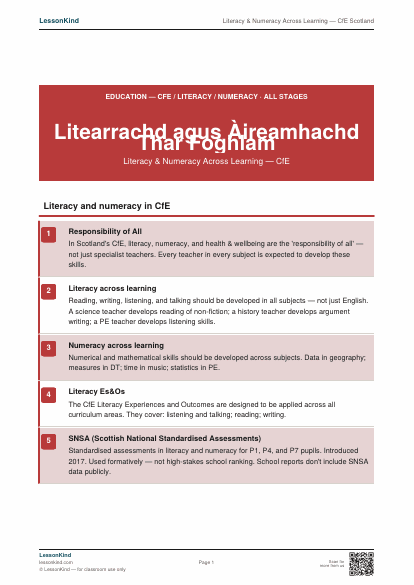
Literacy & Numeracy Across Learning — CfE Scotland
A guide to Scotland's cross-curricular literacy and numeracy requirements — how CfE embeds literacy and numeracy in every subject, the role of all teachers, and what this means in practice for primary teachers.

Writing Genres Knowledge Organiser — KS2
A KS2 English knowledge organiser covering all main writing genres — narrative, recount, explanation, instruction, persuasion, discussion, and report — their features, structure, and how to plan each.

Spelling Patterns & Rules Knowledge Organiser — KS2
A KS2 English knowledge organiser on spelling rules and patterns — prefixes, suffixes, silent letters, homophones, common rules (adding -ing, doubling, dropping e), and the most frequently misspelled words.

Tier 2 Academic Vocabulary Knowledge Organiser — KS2
A KS2 English knowledge organiser on Tier 2 academic vocabulary — the most important words across all subjects. Verbs (analyse, evaluate, justify), nouns (evidence, consequence, perspective), and language for writing.

Reading Fluency Knowledge Organiser — KS1/KS2
A KS1/KS2 English knowledge organiser on reading fluency — what it is, how it develops, reading rate, prosody (reading with expression), and how fluency relates to comprehension.

Advanced Grammar Knowledge Organiser — KS2 (Y5-Y6)
A Y5-Y6 English knowledge organiser on advanced grammar — subjunctive, passive voice, modal verbs, relative clauses, fronted adverbials, and how to use grammatical knowledge to improve writing.

Comprehension Skills Knowledge Organiser — KS2
A KS2 English knowledge organiser on reading comprehension — retrieval, inference, word meaning, summarising, authorial intent, comparing texts, and how to answer each type of exam question.

KS1 Grammar Knowledge Organiser — Y1/Y2
A KS1 English knowledge organiser on grammar — capital letters and full stops, nouns and verbs, adjectives, joining words (and, but, because), question marks, exclamation marks, and apostrophes for contraction.

Punctuation Knowledge Organiser — KS2
A KS2 English knowledge organiser on all punctuation — commas, speech marks, colons and semicolons, parentheses (brackets, dashes, commas), hyphens, apostrophes for possession, and ellipsis.
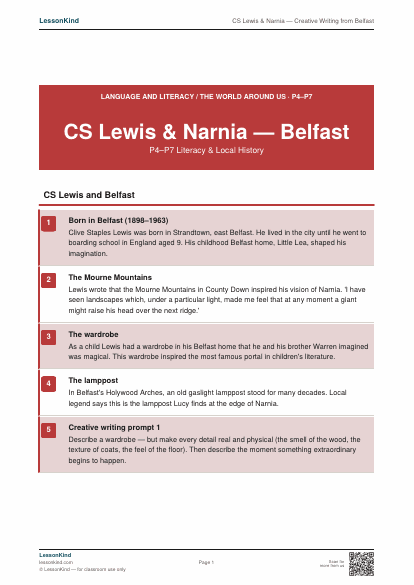
CS Lewis & Narnia — Creative Writing from Belfast
A P4–P7 Literacy and Local History resource on CS Lewis — his childhood in Belfast, the inspirations for Narnia in the Northern Irish landscape, and creative writing prompts based on his work.

Poetry — Features & Forms Knowledge Organiser — KS2
A KS2 English knowledge organiser on poetry — key features (rhyme, rhythm, imagery, metaphor, simile, alliteration), poetic forms (haiku, limerick, sonnet, free verse), and how to read and analyse a poem.

Myths, Legends & Traditional Tales Knowledge Organiser — KS2
A KS2 English knowledge organiser on myths and legends — definitions, features of traditional tales, key world myths (Greek, Norse, African, Aboriginal Dreamtime), and how myths transmit cultural values.

KS2 SATs Reading Comprehension Revision Pack — Year 6
A Year 6 revision pack for the KS2 SATs Reading paper — question types (retrieval, inference, vocabulary, prediction, summarising), text types, and time management. Free download.

KS2 SATs SPaG Revision Pack — Year 6
A Year 6 revision pack for the KS2 SATs Grammar, Punctuation & Spelling papers — every grammar concept, the spelling paper format, and exam strategies. Free download.

SPaG Knowledge Organiser — Year 6 (SATs-Ready)
A Year 6 SPaG knowledge organiser covering all grammar terms tested on the KS2 GPS SATs paper — word classes, sentence types, tenses, punctuation, and the subjunctive mood.

Writing Composition Knowledge Organiser — Year 3/4
A Year 3/4 English knowledge organiser on writing composition — paragraphing, story structure, fronted adverbials, expanded noun phrases, and proofreading.

Handwriting Knowledge Organiser — Year 3
A Year 3 English knowledge organiser on handwriting — joined writing introduction, letter formation families, posture and pencil grip, and how to develop fluent legibility.

Non-Fiction Writing Knowledge Organiser — Year 4
A Year 4 English knowledge organiser on non-fiction writing — explanation, instruction, persuasion, report, recount, and discussion text features.

Poetry Features Knowledge Organiser — Year 5
A Year 5 English knowledge organiser on poetic features — metaphor, simile, alliteration, personification, onomatopoeia, rhythm, rhyme schemes, and the difference between free verse and structured poetry.

Punctuation Knowledge Organiser — Year 2
A Year 2 English knowledge organiser on punctuation — capital letters, full stops, question marks, exclamation marks, commas in lists, and apostrophes for contractions.

Narrative Writing Knowledge Organiser — KS2
A KS2 English knowledge organiser on narrative writing — story structure (Freytag's pyramid), narrative hooks, showing not telling, speech and dialogue, and the writer's toolkit for KS2.

Introduction to Shakespeare — Upper KS2
An upper KS2 English knowledge organiser on Shakespeare — his life, the Globe Theatre, iambic pentameter, and routes into four plays.

Poetry Appreciation Knowledge Organiser — KS2
A KS2 English knowledge organiser on appreciating poetry — form, rhythm, imagery, voice and tone, PEE analysis, and accessing classic and modern poems.

Clauses & Sentence Types Knowledge Organiser — KS2
A KS2 English grammar knowledge organiser on clauses — main and subordinate, relative, co-ordination and subordination, compound and complex sentences, and punctuating them.

Note-Taking & Research Skills Knowledge Organiser — KS2
A KS2 English/computing knowledge organiser on research and note-taking — how to evaluate sources, take notes, avoid plagiarism, and organise research into writing.

Editing & Proofreading Knowledge Organiser — KS2
A KS2 English knowledge organiser on the editing and proofreading process — how to edit for content, clarity, and effect; how to proofread for accuracy; and how to improve a first draft.

Narrative Writing Craft Knowledge Organiser — KS2
A KS2 English knowledge organiser on the craft of narrative writing — story structure, characterisation, setting, tension and pace, dialogue, and what separates good writing from great.

Vocabulary & Word Study Knowledge Organiser — KS2
A KS2 English knowledge organiser on building vocabulary — prefixes, suffixes, root words, etymology, word families, and strategies for working out unfamiliar words.

Playscripts & Drama Knowledge Organiser — KS2
A KS2 English knowledge organiser on playscripts — how they differ from prose, stage directions, performance skills, and how to write and read a playscript.

Formal Writing Knowledge Organiser — Upper KS2
An upper KS2 English knowledge organiser on formal writing — formal vs informal register, passive voice, subordination, impersonal language, and formal text types.

Gothic & Horror Writing Knowledge Organiser — Upper KS2
An upper KS2 English knowledge organiser on Gothic and horror writing conventions — atmosphere, suspense, characterisation of heroes and villains, Gothic settings, and darkness in literature.

Author Study Knowledge Organiser — KS2 English
A KS2 English knowledge organiser on how to conduct an author study — research, reading multiple texts, identifying style and themes, and responding to an author's work.

Descriptive Writing Worksheet — Year 3
A Year 3 descriptive writing worksheet with guided sentence starters, word banks, and a short passage to write describing a magical forest.

Newspaper Report Worksheet — Year 5
A Year 5 English worksheet for writing a newspaper report — structure, headline, byline, quotes, and language features of news journalism.

Poetry Forms Knowledge Organiser — KS2 English
A KS2 English knowledge organiser on poetry forms — sonnets, ballads, free verse, haiku, odes, limericks, and how to analyse and write in each form.

Spoken Language & Debate Knowledge Organiser — Upper KS2
An upper KS2 English knowledge organiser on spoken language — formal debate structure, rhetoric, logical argument, persuasion techniques, and evaluating spoken communication.

Adventure & Quest Writing Knowledge Organiser — KS2
A KS2 English knowledge organiser on adventure and quest writing — the hero's journey structure, world-building, pacing, tension, and making a quest story compelling.

Biography & Autobiography Knowledge Organiser — KS2
A KS2 English knowledge organiser on biography and autobiography — how they differ, structure, features, selecting evidence, and writing about a real person's life.

Reading Comprehension — A Day in Roman Britain
Original 300-word historical recount set in Roman Britain, with retrieval, inference, vocabulary and summarising questions and a full mark scheme.

Reading Comprehension — How Do We Know About Dinosaurs?
Original 310-word explanation of how fossils tell us about dinosaurs, with retrieval, vocabulary, inference and summarising questions and a full mark scheme.

Reading Comprehension — Why the Greeks Still Matter
Original 370-word persuasive text on the legacy of Ancient Greece, with retrieval, inference, vocabulary and author-intent questions and a full mark scheme.

Reading Comprehension — The Planet That Spins on Its Side
Original 380-word non-fiction text about Uranus with SATs-style retrieval, inference, vocabulary and author-choice questions plus a full mark scheme.

Reading Comprehension — What Is an Algorithm?
Original 300-word explanation of algorithms for KS2, with retrieval, vocabulary, inference and summarising questions and a full mark scheme.

Reading Comprehension — Shackleton's Impossible Journey
Original 350-word biographical recount of Shackleton's Antarctic survival, with retrieval, inference, vocabulary and character questions and a full mark scheme.

Reading Comprehension — The Mountain That Blew Its Top
Original 360-word non-fiction recount of a volcanic eruption, with retrieval, inference, vocabulary and author-craft questions and a full mark scheme.

Reading Comprehension — The Great Wall of China
Original 350-word non-fiction text on the Great Wall of China, with retrieval, vocabulary, inference and myth-correction questions and a full mark scheme.

Reading Comprehension — The Minibeast Hunt
Original 160-word KS1 narrative about a minibeast hunt, with retrieval, sequencing and simple inference questions and a full answer key.

Reading Comprehension — Could You Survive the Desert?
Original 320-word explanation of how desert animals survive, with retrieval, vocabulary, inference and summarising questions and a full mark scheme.

Reading Comprehension — The First Olympics
Original 350-word non-fiction text on the ancient Olympic Games, with retrieval, inference, vocabulary, comparison and summarising questions and a full mark scheme.

Reading Comprehension — The Heart's Busy Day
Original 310-word explanation of how the heart works, with retrieval, vocabulary, inference and summarising questions and a full mark scheme.

Reading Comprehension — Inside the Castle Walls
Original 170-word KS1 narrative set in a medieval castle, with retrieval, sequencing and simple inference questions and a full answer key.

Reading Comprehension — The Deepest Diver
Original 310-word non-fiction text about the sperm whale, with retrieval, vocabulary, inference and summarising questions and a full mark scheme.

Reading Comprehension — The River's Journey (Poem)
Original poem about a river from source to sea, with retrieval, vocabulary, figurative-language and inference questions and a full mark scheme.

Reading Comprehension — The Real Vikings
Original 350-word myth-busting non-fiction text about the Vikings, with retrieval, inference, vocabulary and author-intent questions and a full mark scheme.

Reading Comprehension — Ug's New Idea
Original 260-word Stone Age narrative about an early discovery, with retrieval, inference and vocabulary questions and a full mark scheme.

Reading Comprehension — Pip and the Last Conker
Original 150-word KS1 narrative with simple retrieval, sequencing and feelings questions, plus a full answer key. Read-aloud friendly.

Reading Comprehension — The Animals That Glow
Original 320-word non-fiction text on bioluminescence with retrieval, inference, vocabulary and summarising questions, plus a full mark scheme.

Reading Comprehension — The City in the Jungle
Original 360-word non-fiction text on the Maya and their abandoned cities, with retrieval, inference, vocabulary and author-craft questions and a full mark scheme.

Reading Comprehension — The Riddle of Sutton Hoo
Original 370-word non-fiction text on the Sutton Hoo discovery, with retrieval, inference, vocabulary and author-craft questions and a full mark scheme.

Reading Comprehension — The Empty Beach (Playscript)
Original short playscript about litter on a beach, with retrieval, playscript-feature, inference and message questions and a full mark scheme.

Reading Comprehension — How to Make a Mummy
Original 320-word explanation of ancient Egyptian mummification, with retrieval, sequencing, vocabulary and inference questions and a full mark scheme.

Reading Comprehension — Local School Wins Wellbeing Award (News Report)
Original 360-word news report about a school wellbeing scheme, with retrieval, news-feature, inference and author-intent questions and a full mark scheme.

Reading Comprehension — The Girl Who Found the Sea Dragons
Original 330-word biography of fossil hunter Mary Anning, with retrieval, inference, vocabulary and character questions and a full mark scheme.

Reading Comprehension — Should Schools Ban Homework?
Original 400-word balanced argument text for upper KS2 with SATs-style retrieval, inference, vocabulary, author-intent and summarising questions, plus a mark scheme.

Reading Comprehension — A Tudor Child's Diary
Original 300-word diary entry from a Tudor child, with retrieval, vocabulary, inference and diary-feature questions and a full mark scheme.

Reading Comprehension — Who Eats Whom in the Rainforest?
Original 300-word explanation text on rainforest food chains, with retrieval, vocabulary, inference and summarising questions and a full mark scheme.

Year 1 Common Exception Words — Practice Pack
The full Year 1 statutory common exception words with a look-cover-write-check grid, tracing support and a simple test sheet.

Year 2 Common Exception Words — Practice Pack
The full Year 2 statutory common exception words with look-cover-write-check, sorting by tricky pattern and a test sheet.

Years 3–4 Spelling List — Practice Pack
The full statutory Years 3-4 spelling word list, grouped for teaching, with look-cover-write-check, a definitions task and weekly test sheets.

Spelling Rule — Adding -ing, -ed, -er, -est
Clear explainer of the three suffix rules (double, drop the e, change y to i) with worked examples and graded practice, plus an answer key.

Spelling — Homophones: Their, There, They're
Explainer and practice for the most-confused homophones (their/there/they're, to/too/two, your/you're) with a choosing task, sentences and answer key.

Handwriting — Long-Ladder Letters (l, i, t, u, j, y)
Letter-formation practice for the long-ladder letter family with verbal cues, trace models and independent lines, plus teacher guidance on grip and common reversals.

Handwriting — One-Armed-Robot Letters (r, n, m, h, b, p, k)
Letter-formation practice for the one-armed-robot family with verbal cues, trace models and independent lines, plus guidance on common reversals.

Handwriting — Curly-Caterpillar Letters (c, a, d, o, s, g, q, e, f)
Letter-formation practice for the curly-caterpillar family (all begin with the c-shape) with verbal cues, trace models and independent lines.

Handwriting — First Cursive Joins (in, un, an, um)
Introduction to the first cursive joins (diagonal join to letters without ascenders) with model words, trace and independent practice.

Handwriting — Pencil Control & Pre-Writing Patterns
Pre-writing pattern practice (lines, curves, zigzags, loops) to build pencil control before letter formation, with teacher guidance on grip.

Phonics — Phase 2 First Sounds (s, a, t, p, i, n)
The first Phase 2 sounds (s a t p i n) with say-the-sound, find-the-sound and first CVC blending (sat, pin, tap), plus teacher guidance on pure sounds.

Phonics — Phase 3 Digraph 'sh'
The 'sh' digraph with say-the-sound, read and write 'sh' words (ship, shop, fish), a decodable caption and teacher guidance.

Phonics — Phase 3 Vowel Digraph 'ai'
The 'ai' vowel digraph with say-the-sound, read and write 'ai' words (rain, train, snail), a decodable caption and teacher guidance.

Phonics — Phase 4 CCVC Blends (st, fr, sl, sn)
Phase 4 adjacent-consonant blending (CCVC: stop, frog, slug, snap) with sound buttons, read and write practice, and teacher guidance on the blend.

Phonics — Phase 5 Split Digraph 'a-e' (magic e)
The a-e split digraph (cake, name, game) with say-the-sound, read and write practice, a same-word-with-and-without-e sort, and teacher guidance.

Story Starter — The Mysterious Door
A narrative story starter with an opening paragraph to continue, plus a word bank, sentence openers, a planning box and success criteria.

Picture Prompt — The Lighthouse in the Storm
A descriptive/narrative picture prompt (a storm-battered lighthouse) with ambitious vocabulary, figurative-language prompts, sentence models and success criteria.

Sentence Quick-Writes — My Weekend
KS1 sentence-writing prompts about the weekend, with a word bank, sentence starters, a capital-letter/full-stop reminder and a writing line for each.

Themed Writing — Send a Postcard from Space
A cross-curricular postcard-writing task set in space, with a word bank, postcard format guide, sentence starters and success criteria. Links to the space topic.

Persuasive Writing Prompt — Save Our School Pond
A persuasive writing task (save the school pond) with a word bank, persuasive-technique reminders, sentence starters, a planning box and success criteria.
Reading Comprehension — The Battle of Bannockburn
Original 360-word non-fiction recount of the Battle of Bannockburn (1314), with retrieval, inference, vocabulary and author-craft questions and a full mark scheme. Links to Scottish history resources.
Reading Comprehension — Owain Glyndŵr, Prince of Wales
Original 360-word biography of Owain Glyndŵr, with retrieval, inference, vocabulary and author-intent questions and a full mark scheme. Links to Welsh history resources.
Reading Comprehension — The Story of Saint Patrick
Original 340-word non-fiction recount about Saint Patrick, with retrieval, inference, vocabulary and fact-vs-legend questions and a full mark scheme. Links to Irish history resources.
Reading Comprehension — The Giant's Causeway
Original 350-word text on the Giant's Causeway blending myth and science, with retrieval, inference, vocabulary and fact-vs-myth questions and a full mark scheme. Links to NI geography resources.
Reading Comprehension — The Great Barrier Reef
Original 350-word non-fiction text on the Great Barrier Reef, with retrieval, inference, vocabulary and summarising questions and a full mark scheme. For Australian primary classrooms.
Reading Comprehension — Canada's National Animal
Original 340-word non-fiction text on the beaver and its role in Canada's history, with retrieval, inference, vocabulary and summarising questions and a full mark scheme. For Canadian primary classrooms.
Reading Comprehension — The Curious Kiwi
Original 330-word non-fiction text on New Zealand's kiwi bird, with retrieval, inference, vocabulary and summarising questions and a full mark scheme. For New Zealand primary classrooms.
Reading Comprehension — The Story of ANZAC Day
Original 350-word non-fiction recount about ANZAC Day and Gallipoli, with retrieval, inference, vocabulary and author-intent questions and a full mark scheme. For Australian and NZ classrooms.
Themed Writing — A Postcard from Australia
A cross-curricular postcard-writing task set in Australia, with a word bank, postcard format guide, sentence starters and success criteria. Links to the Australia hub.
Reading Comprehension — Terry Fox's Marathon of Hope
Original 350-word biography of Terry Fox, with retrieval, inference, vocabulary and author-intent questions and a full mark scheme. For Canadian classrooms.
Themed Writing — A Postcard from Canada
A cross-curricular postcard-writing task set in Canada, with a word bank, postcard format guide, sentence starters and success criteria. Links to the Canada hub.
Reading Comprehension — The Power of Niagara Falls
Original 340-word non-fiction text on Niagara Falls, with retrieval, inference, vocabulary and summarising questions and a full mark scheme. For Canadian classrooms.
Themed Writing — A Postcard from New Zealand
A cross-curricular postcard-writing task set in New Zealand, with a word bank, postcard format guide, sentence starters and success criteria. Links to the NZ hub.
Reading Comprehension — Waitangi Day
Original 340-word non-fiction text on Waitangi Day and the Treaty of Waitangi, with retrieval, inference, vocabulary and balanced-perspective questions and a full mark scheme.
Reading Comprehension — How Māui Tamed the Sun
Original 350-word retelling of the Māori legend of Māui slowing the sun, with retrieval, inference, vocabulary and author-craft questions and a full mark scheme. For New Zealand classrooms.
Reading Comprehension — The Kangaroo
Original non-fiction text on kangaroos with retrieval, inference, vocabulary and summarising questions and a full mark scheme.
Reading Comprehension — The Heart of Australia: Uluru
Original non-fiction text on Uluru and its cultural significance, with retrieval, inference, vocabulary and respect-themed questions and a full mark scheme.
Reading Comprehension — The Voyage of the First Fleet
Original non-fiction recount of the First Fleet's voyage in 1787–88, with retrieval, inference, vocabulary and perspective questions and a full mark scheme.
Writing — A Story Set in the Outback
A narrative-writing prompt set in the Australian Outback, with a scenario, word bank and success criteria.
Writing — Write a Report on an Australian Animal
A non-chronological report writing frame for an Australian animal, with structure, word bank and success criteria.
Writing — Persuade Others to Save the Reef
A persuasive-writing task about protecting the Great Barrier Reef, with techniques, word bank and success criteria.
Writing — A Convict's Diary on the First Fleet
A diary-writing task in role as a First Fleet convict, with a word bank, features guide and success criteria.
Reading Comprehension — The Koala
Original non-fiction text on koalas, with retrieval, inference, vocabulary and summarising questions and a full mark scheme.
Spelling & Vocabulary — Australian Place Names
A spelling and vocabulary worksheet exploring Australian place names, many from Aboriginal languages.
Reading Comprehension — Life on the Goldfields
Original non-fiction recount of life on the 1850s Australian goldfields, with retrieval, inference, vocabulary and summarising questions and a full mark scheme.
Writing — A Stampeder's Diary
A diary-writing task in role as a Klondike gold-rush stampeder, with features, word bank and success criteria.
Writing — Persuade Others to Protect the Arctic
A persuasive-writing task about protecting Canada's warming Arctic, with techniques, word bank and success criteria.
Reading Comprehension — Nature's Engineers
Original non-fiction text on how beavers build dams and shape their environment, with retrieval, inference, vocabulary and explanation questions and a full mark scheme.
Writing — Report on a Canadian Animal
A non-chronological report frame for a Canadian animal, with structure, word bank and success criteria.
Reading Comprehension — Race to the Klondike
Original non-fiction recount of the Klondike Gold Rush, with retrieval, inference, vocabulary and summarising questions and a full mark scheme.
Spelling & Vocabulary — Canadian Place Names
A spelling and vocabulary worksheet exploring Canadian place names, many from Indigenous languages and French.
Reading Comprehension — Dancing Lights
Original non-fiction text on the northern lights, with retrieval, inference, vocabulary and explanation questions and a full mark scheme.
Reading Comprehension — The Living Fossil
Original non-fiction text on the tuatara, New Zealand's ancient reptile, with retrieval, inference, vocabulary and explanation questions and a full mark scheme.
Spelling & Vocabulary — New Zealand Place Names
A spelling and vocabulary worksheet exploring New Zealand place names, many from te reo Māori.
Reading Comprehension — To the Top of the World
Original non-fiction recount of Edmund Hillary and Tenzing Norgay's 1953 Everest climb, with retrieval, inference, vocabulary and summarising questions and a full mark scheme.
Writing — Report on a New Zealand Animal
A non-chronological report frame for a New Zealand animal, with structure, word bank and success criteria.
Reading Comprehension — The Power of the Haka
Original non-fiction text on the haka, its meaning and respectful place in Māori culture, with retrieval, inference, vocabulary and meaning questions and a full mark scheme.
Writing — Persuade Others to Protect NZ Wildlife
A persuasive-writing task about protecting New Zealand's unique wildlife, with techniques, word bank and success criteria.
Writing — Write Your Own Legend
A narrative-writing task inviting pupils to write a legend that explains something in nature, inspired by Māori storytelling.
Free Age-Appropriate Classroom Activities
Discount School Supply offers a huge library of free, downloadable activity ideas — perfect for lesson planning and cover days.
Get Free Activities →As an Amazon Associate and affiliate partner, LessonKind earns from qualifying purchases and referrals at no extra cost to you. Full disclosure →
NordVPN
Protect your devices when working from home or on school Wi-Fi — trusted by teachers and remote workers worldwide.
Get NordVPN →NordPass
One secure vault for every school platform, subscription and login — stop the forgotten-password routine for good.
Get NordPass →