123 resources
Science
Free printable science resources for primary and elementary teachers — no sign-up required.
All resources
Science — 123 free resources

My Five Senses
Match each sense to its body part and to things you can sense with it.

Day and Night
Sort activities into day and night. Introduces the Sun, Moon and Earth's rotation.

Parts of a Plant — Labelling Activity
Label the roots, stem, leaves, flower and seeds of a flowering plant.

Animal Habitats
Match animals to their habitats — desert, ocean, rainforest, polar, grassland.

Materials Sorting Worksheet
Sort objects by their material — wood, metal, plastic, glass, fabric, paper.

Life Cycle of a Butterfly
Sequence the four stages of metamorphosis with descriptions and a labelling task.

Human Skeleton Labelling
Label 12 key bones, then answer questions about their function.

Rocks and Minerals
Three rock types — igneous, sedimentary, metamorphic — with examples and a quick-id key.

States of Matter Poster
Solid, liquid and gas — particle ideas, properties and everyday examples on one sheet.

The Water Cycle
Label stages of the water cycle and answer questions about evaporation and precipitation.

Solar System Fact File
Each planet on its own row — diameter, distance from Sun, day/year length and a key fact.

Forces Vocabulary Mat
Key terms: gravity, friction, air resistance, water resistance, upthrust, balanced/unbalanced.

Food Chains and Webs
Build a food chain and a food web. Label producers, consumers and decomposers.

Classification of Living Things
Use a classification key to sort vertebrates and invertebrates.

Circuit Symbols Reference Sheet
All standard circuit symbols (cell, battery, switch, bulb, motor, buzzer, ammeter).

Photosynthesis Explained
How plants make their own food. Vocabulary, equation, and a labelled-diagram task.

States of Matter — Three Mini Experiments
Three short hands-on investigations exploring melting, freezing and evaporation.

Building Simple Circuits
Diagram four simple circuits (working bulb, broken circuit, two bulbs, switch added) and predict outcomes.

Human Body Systems
Seven body systems compared — main organs, function, and one health tip for each.

Evolution and Adaptation
How animals develop traits that help them survive — with five clear examples and a Darwin biography mini-card.

Ecosystems Vocabulary Mat
Producers, consumers, decomposers, habitats, biotic, abiotic — the language of ecology.

Magnets and Magnetism
What's magnetic, what isn't, and how to test things in the classroom. Includes a sorting investigation.

Weather Symbols Poster
12 universal weather symbols with names. For weather charts and morning meeting routines.

Germs and How Disease Spreads
Four ways germs spread, and how to stop them. Plus a quick-reference 'when to wash hands' checklist.

Seasonal Changes — A Tree Through the Year
Observe and draw a deciduous tree in each of the four seasons. Builds pattern-recognition over time.

The Respiratory System
How we breathe — from nostril to alveoli. With a labeling activity and three quick health facts.

The Scientific Method Poster
Six steps of the scientific method explained for elementary students. Build it into every investigation.

Sound and Vibration
How sound is made, how it travels and how we hear it. Plus a quick-test investigation.

Famous Scientists Fact File
Eight scientists who changed the world — Newton, Curie, Hawking, Goodall, and more.

Earth and Space Poster
Sun, Earth, Moon — relative sizes, distances and how they create day, night, year, seasons and tides.

Light and Shadows
How shadows form, why they change size, and a quick experiment to test it.

Science Investigation Template
Plan a science investigation using the scientific method — question, hypothesis, variables, results.

Animal Classification Key
Use a branching key to classify animals as mammal, bird, reptile, amphibian, fish or invertebrate.

Weather Instruments
Six instruments meteorologists use — thermometer, barometer, anemometer and more.

Rocks and Soil
Three types of rock — igneous, sedimentary, metamorphic — and how soil is formed.

Forces — Pushes and Pulls
Identify pushes and pulls in everyday actions. Sort 12 actions and discuss what forces do.
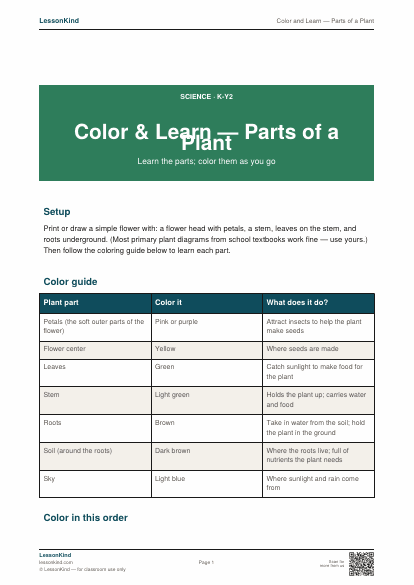
Color and Learn — Parts of a Plant
Coloring activity that teaches children the parts of a plant — roots, stem, leaves, flower, petals — by following coloring instructions. Pairs with a labeled diagram and a quick comprehension check.
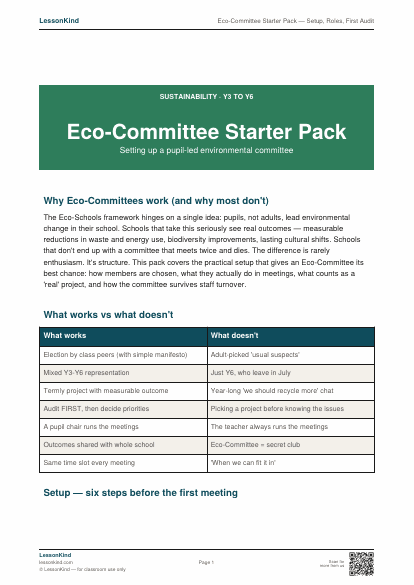
Eco-Committee Starter Pack — Setup, Roles, First Audit
How to set up a pupil-led Eco-Committee that works — election structure, terms of reference, role descriptions, an environmental audit template, and a first-meeting agenda.
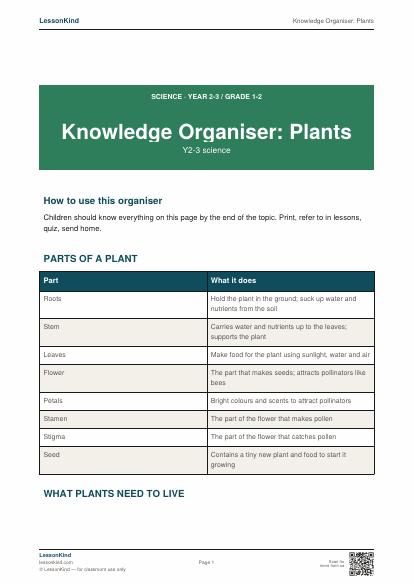
Knowledge Organiser: Plants
A single-page A4 knowledge organiser on plants for Y2-3 — parts of a plant, what plants need, life cycles, photosynthesis basics. Aligned with NC science.
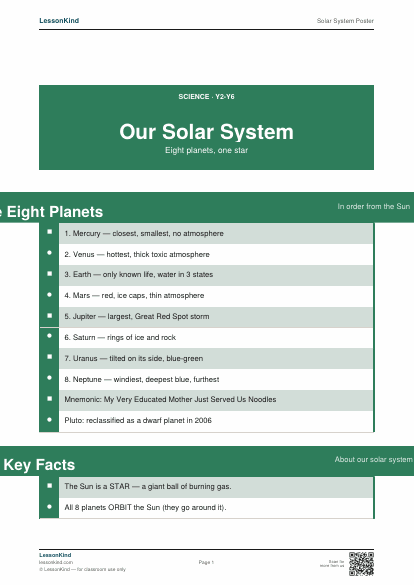
Solar System Poster
All 8 planets in order from the Sun, with key facts about each. The science classroom standard.
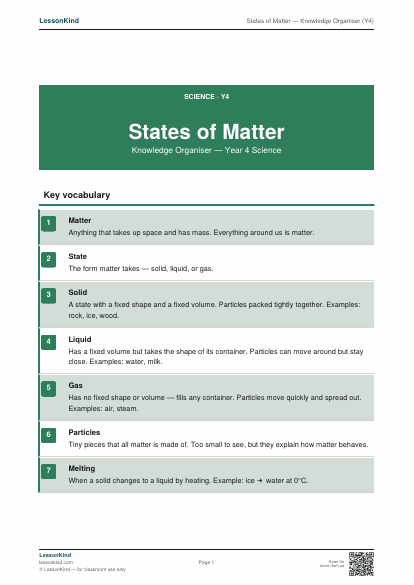
States of Matter — Knowledge Organiser (Y4)
Single-page reference for KS2 states of matter — solids, liquids, gases, particles, changes of state, melting, evaporation. Aligns with Year 4 NC science. Free alternative to subscription-only competitors.
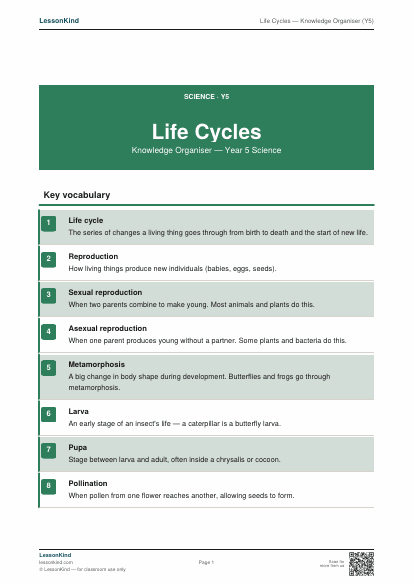
Life Cycles — Knowledge Organiser (Y5)
Single-page reference for KS2 life cycles unit — mammals, amphibians, insects, birds, plants. Covers metamorphosis, reproduction, and key vocabulary. Aligns with Year 5 NC science.

Electricity Knowledge Organiser — KS2 Science
A KS2 science knowledge organiser on electricity — circuits, conductors and insulators, series and parallel circuits, switches, batteries, the relationship between voltage and brightness.

Forces and Magnets — Knowledge Organiser (Y3 & Y5)
Single-page reference for KS2 forces and magnets unit — gravity, friction, push/pull, magnetism, magnetic poles. Covers Year 3 (forces and magnets) and Year 5 (forces in detail) NC requirements.

Light Knowledge Organiser — KS2 Science
A KS2 science knowledge organiser on light — how light travels, reflection, refraction, shadows, the visible spectrum, and how the eye sees. Common misconceptions addressed.

Sound Knowledge Organiser — KS2 Science
A KS2 science knowledge organiser on sound — vibration, pitch and volume, how sound travels through different media, hearing, and why sounds fade with distance.

Plants — Knowledge Organiser (Y3)
Single-page reference for KS2 plants unit — parts of a plant, photosynthesis, what plants need, life cycle, pollination. Aligns with Year 3 NC science.

Animals & Food Chains — Knowledge Organiser (Y4 & Y6)
Single-page reference for KS2 animals and food chains unit — classification, herbivores/carnivores/omnivores, food chains, food webs, energy. Aligns with Year 4 (food chains) and Year 6 (classification) NC science.

Rocks & Minerals — Knowledge Organiser (Y3–Y4)
Single-page reference for KS2 rocks unit — types of rock, how they form, minerals, fossils, and the rock cycle. Aligns with Year 3 NC science.

Evolution & Adaptation — Knowledge Organiser (Y6)
Single-page reference for KS2 evolution unit — natural selection, adaptation, inheritance, fossil evidence, and key scientists. Aligns with Year 6 NC science.

Readers' Theatre — The Rainforest Debate (Y4–Y6)
A structured debate script set in the Amazon rainforest — 8 roles representing different viewpoints (farmer, scientist, indigenous elder, logging company, government official, etc.). Develops oracy and argument skills.
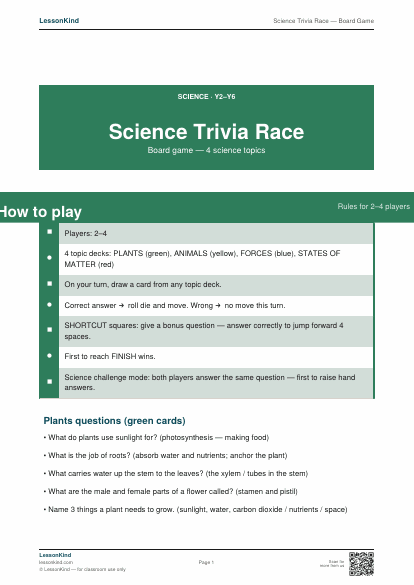
Science Trivia Race — Board Game
A printable science trivia board game with 40 question cards across 4 topics: plants, animals, forces, and states of matter. Suitable for KS1/KS2 revision or a rainy day science activity.

The Human Body Knowledge Organiser
A KS2 knowledge organiser on the human body — major organ systems, skeletal system, muscular system, digestive system, circulatory system, and healthy living.

Materials Knowledge Organiser — Properties and Changes
A KS2 knowledge organiser on materials — properties of materials, comparing materials, reversible and irreversible changes, dissolving, melting, and thermal insulators and conductors.

Earth and Space Knowledge Organiser
A KS2 knowledge organiser on Earth and space — the solar system, the Moon, day and night, seasons, the Sun, gravity, and key space exploration milestones.

Habitats & Ecosystems Knowledge Organiser
A KS2 knowledge organiser on habitats and ecosystems — food chains and webs, adaptation, biodiversity, endangered species, and how humans affect habitats.

Seasonal Changes Knowledge Organiser — KS1
A KS1 knowledge organiser on the four seasons — weather, daylight, plant and animal changes across spring, summer, autumn, and winter. Includes simple observations to make outdoors.

Animals Including Humans Knowledge Organiser — KS1/KS2
A KS1/lower KS2 knowledge organiser on animals including humans — body parts, senses, nutrition, skeleton and muscles, growth, and comparing animals.

Working Scientifically Knowledge Organiser
A KS1/KS2 reference for the skills and vocabulary of scientific enquiry — types of investigation, fair testing, variables, measurement, and drawing conclusions.

Microorganisms Knowledge Organiser — KS2
A KS2 knowledge organiser on microorganisms — bacteria, viruses, fungi, and useful microbes. Covers food spoilage, disease, the immune system, and how we use microorganisms beneficially.

Evolution & Inheritance Knowledge Organiser — Y6
A Year 6 science knowledge organiser on evolution and inheritance — Charles Darwin, natural selection, variation, adaptation, fossils as evidence, and how characteristics are inherited.
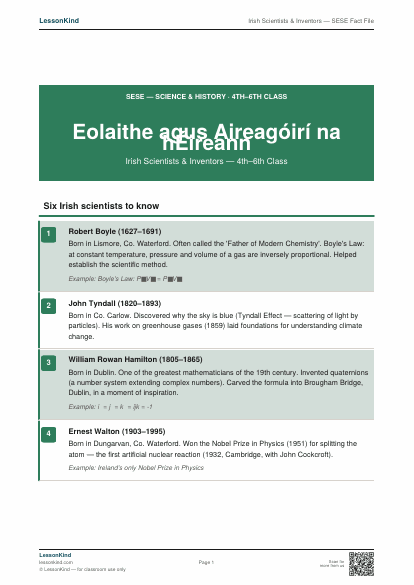
Irish Scientists & Inventors — SESE Fact File
A 4th–6th Class SESE resource on Ireland's most significant scientists and inventors — Robert Boyle, John Tyndall, Ernest Walton, Jocelyn Bell Burnell, William Rowan Hamilton, and others. Links science, history, and Irish identity.
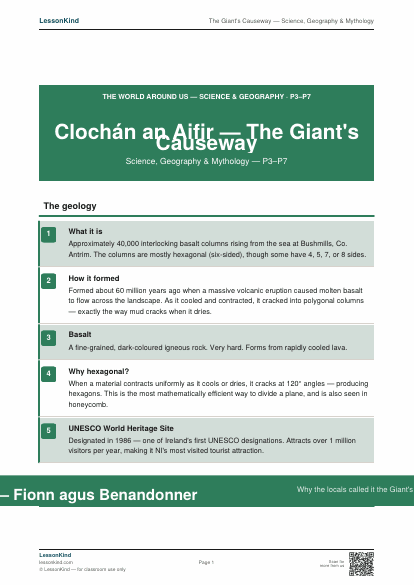
The Giant's Causeway — Science, Geography & Mythology
A P3–P7 cross-curricular resource on the Giant's Causeway — its geological formation (volcanic basalt columns), its mythology (Fionn Mac Cumhaill), and its status as a UNESCO World Heritage Site.
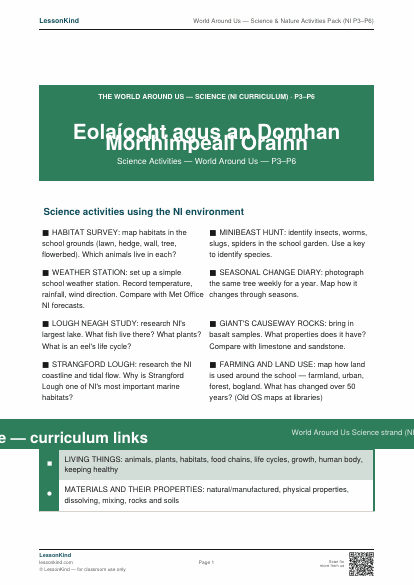
World Around Us — Science & Nature Activities Pack (NI P3–P6)
A P3–P6 activity pack aligned to the 'World Around Us' Science strand of the NI Curriculum — habitats, minibeasts, weather observation, materials, forces, and seasonal change, all using the Northern Ireland environment.
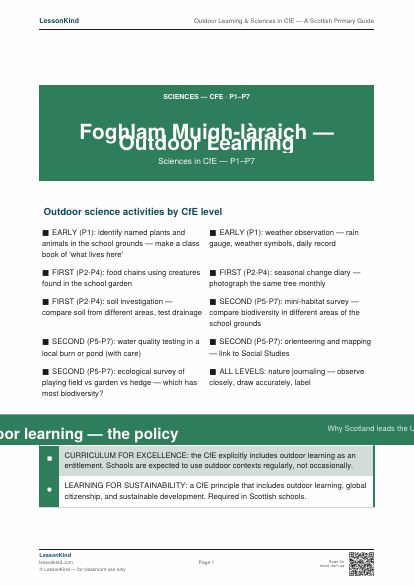
Outdoor Learning & Sciences in CfE — A Scottish Primary Guide
A P1–P7 guide to outdoor learning in the Sciences within Scotland's Curriculum for Excellence — why Scotland leads the UK in outdoor learning, practical ideas for all CfE levels, and the policy context.
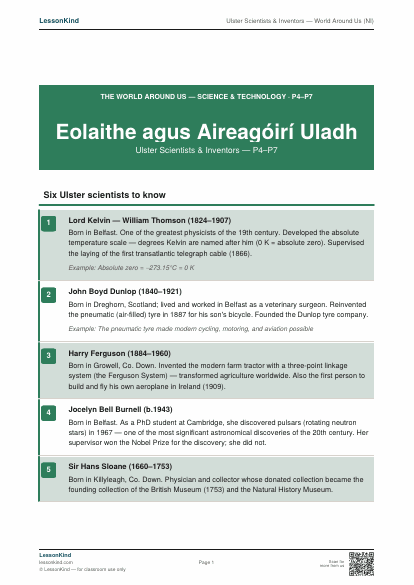
Ulster Scientists & Inventors — World Around Us (NI)
A P4–P7 World Around Us resource on scientists and inventors from Ulster — Lord Kelvin (Belfast), John Boyd Dunlop (Dreghorn, later Belfast), Harry Ferguson (Co. Down), and other NI contributors to science and technology.
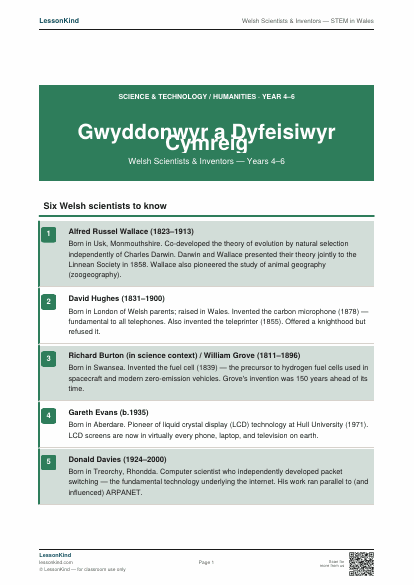
Welsh Scientists & Inventors — STEM in Wales
A Years 4–6 Science & Technology resource on Wales's significant contributions to science and technology — Alfred Russel Wallace, David Hughes, the computer pioneer Dannie Abse, and others.
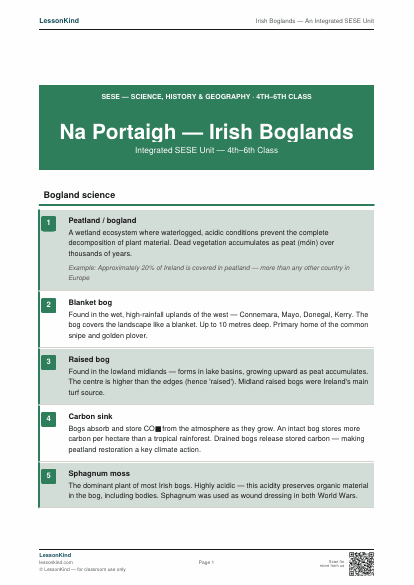
Irish Boglands — An Integrated SESE Unit
A 4th–6th Class integrated SESE unit on Irish boglands — science (bog ecology, decomposition, carbon storage), history (turf-cutting tradition, bog bodies, preserved artefacts), and geography (where are Irish bogs, blanket vs raised bog).
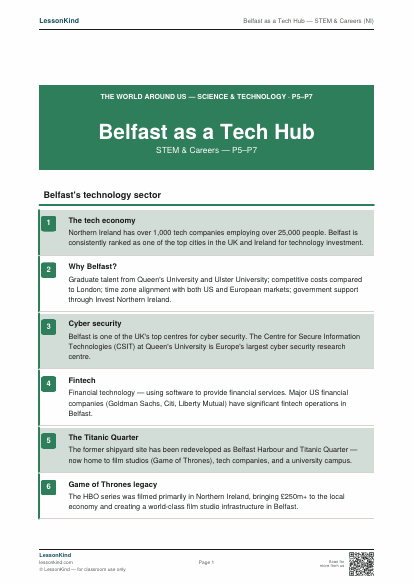
Belfast as a Tech Hub — STEM & Careers (NI)
A P5–P7 resource on Belfast's growing technology sector — why global tech companies locate in Belfast, cyber security, fintech, and how STEM skills connect to career opportunities in Northern Ireland.
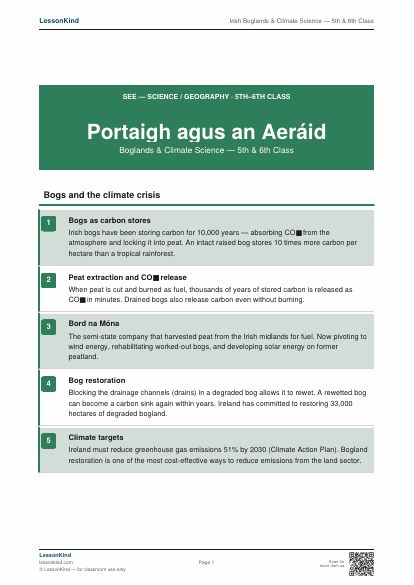
Irish Boglands & Climate Science — 5th & 6th Class
An extended 5th–6th Class science/SESE resource on Irish boglands and climate change — carbon storage, carbon release from drained bogs, Bord na Móna's shift to renewables, and why restoring bogs matters for Ireland's climate targets.
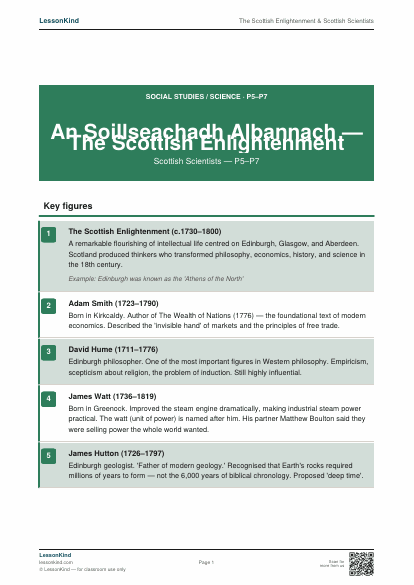
The Scottish Enlightenment & Scottish Scientists
A P5–P7 resource on the Scottish Enlightenment and Scotland's extraordinary scientific tradition — Hume, Smith, Watt, Hutton, Fleming, Logie Baird, and why Scotland punched far above its weight in science and philosophy.
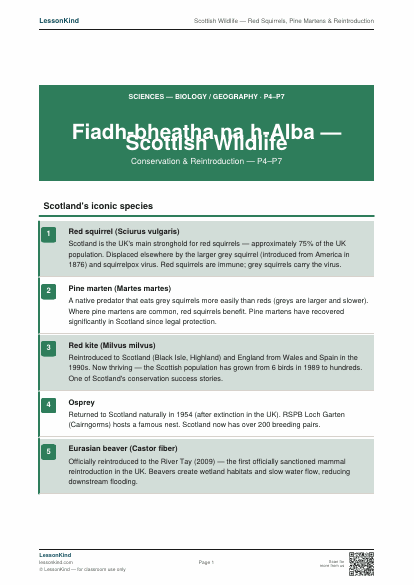
Scottish Wildlife — Red Squirrels, Pine Martens & Reintroduction
A P4–P7 science resource on Scotland's iconic wildlife and conservation — red squirrels, pine martens, red kites, osprey, and beaver reintroduction. What conservation success looks like.

Evolution & Inheritance Knowledge Organiser — KS2 Science
A KS2 science knowledge organiser on evolution and inheritance — natural selection, adaptation, Darwin, fossils as evidence, variation, and how species change over generations.

Earth & Space Knowledge Organiser — KS2
A KS2 science knowledge organiser on Earth and Space — the solar system, planets, the Moon and its phases, day and night, the seasons, and famous astronauts and astronomers.

Materials & Their Properties Knowledge Organiser — KS2
A KS2 science knowledge organiser on materials — properties (hardness, flexibility, transparency), natural vs synthetic, solids/liquids/gases, reversible vs irreversible changes, and separating mixtures.

Living Things & Habitats Knowledge Organiser — KS2
A KS2 science knowledge organiser on living things and habitats — classification, food chains and food webs, ecosystems, the impact of environmental change, and threatened habitats.

Plants & Growth Knowledge Organiser — KS2 Science
A KS2 science knowledge organiser on plants — structure and function of roots, stem, leaves, and flowers; photosynthesis; reproduction; seed dispersal; and what plants need to grow.
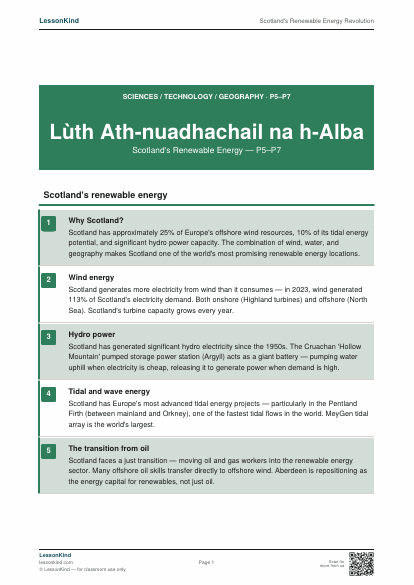
Scotland's Renewable Energy Revolution
A P5–P7 Science and Geography resource on Scotland's extraordinary renewable energy sector — wind (onshore and offshore), hydro, tidal, the transition from fossil fuels, and Scotland's net zero ambitions.
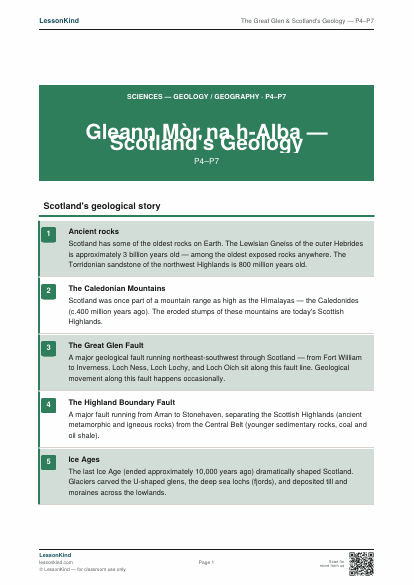
The Great Glen & Scotland's Geology — P4–P7
A P4–P7 Science and Geography resource on Scotland's remarkable geology — the Great Glen fault, the Caledonian mountain range, the Highland Boundary Fault, and how geological history shaped the Scottish landscape.

Human Body & Health Knowledge Organiser — KS2
A KS2 science knowledge organiser on the human body — the major organ systems (skeletal, muscular, digestive, circulatory, respiratory), how they work, and what we need for a healthy body.

States of Matter & Changes of State Knowledge Organiser — KS2
A KS2 science knowledge organiser on states of matter — properties of solids, liquids, and gases; particle theory; changes of state (melting, boiling, condensing, freezing, evaporating, sublimating); and the water cycle.

Forces & Motion Knowledge Organiser — KS2
A KS2 science knowledge organiser on forces and motion — push, pull, gravity, friction, air resistance, water resistance, magnetic force, balanced and unbalanced forces, and Newton's three laws (simplified).

Living Things & Classification Knowledge Organiser — Year 6
A Year 6 science knowledge organiser on living things and classification — Carl Linnaeus's system, the five kingdoms, vertebrates and invertebrates, and how scientists classify newly discovered species.

Electricity Knowledge Organiser — Year 6
A Year 6 science knowledge organiser on electricity — circuits, conductors and insulators, the brightness of bulbs, the voltage of cells, and how the National Grid works.

Rocks & Soils Knowledge Organiser — Year 3
A Year 3 science knowledge organiser on rocks and soils — three rock types (igneous, sedimentary, metamorphic), fossils, soil composition, and rock testing investigations.

States of Matter Knowledge Organiser — Year 4
A Year 4 science knowledge organiser on states of matter — solids, liquids, gases, particle arrangement, melting and freezing, evaporation and condensation, and the water cycle.

Sound Knowledge Organiser — Year 4
A Year 4 science knowledge organiser on sound — how sound travels, vibration, pitch and volume, how we hear, ear safety, and investigations with sound.

Plants Knowledge Organiser — Year 3
A Year 3 science knowledge organiser on plants — what plants need to grow, the functions of roots/stems/leaves/flowers, pollination, seed dispersal, and a simple plant life cycle.

Habitats — The World Around Us (P3-P6)
A P3-P6 The World Around Us resource on habitats — what a habitat is, local NI habitats (hedgerow, woodland, shoreline), animals and plants in each, and why habitats need protecting.

Northern Ireland's Environment & Climate — P5/P7
A P5-P7 science/geography resource on NI's climate, environmental challenges, and what NI is doing about climate change — agriculture, renewable energy, and biodiversity.

Wales's Natural Resources — Years 4-6 Geography/Science
A Years 4-6 resource on Wales's natural resources — water (water supply to England), slate, forestry, wind energy, and how Wales uses its landscape for sustainable energy.

Farming & Agriculture in Northern Ireland — P4/P6
A P4-P6 resource on farming in Northern Ireland — landscape and land use, dairy farming, beef, arable farming, and the challenges and changes in NI agriculture.

Northern Ireland's Geology — P5/P7
A P5-P7 science/geography resource on Northern Ireland's distinctive geology — the basalt plateau, limestone, the Giant's Causeway formation, and how geology shapes the landscape.

Renewable Energy in Wales (Years 5/6)
A Years 5/6 resource on Wales's renewable energy — wind, hydroelectric, Dinorwig, Gwynt y Mor, tidal potential, and net-zero targets.

North Sea Oil — P5/P7
A P5-P7 resource on North Sea oil — discovery, extraction, Aberdeen, the political debate over revenues, and the transition to renewables.

Scotland's Renewable Energy — P5/P7
A P5-P7 resource on Scotland's renewable energy — wind, hydro, pumped storage at Cruachan, tidal energy at EMEC, and Scotland's energy targets.

Bogs & Peatlands in Ireland — SESE
A SESE resource on Ireland's remarkable peatlands — how bogs form, bog bodies, ecological importance, peat as fuel, and conservation.

Ireland's Environment & Climate Change — 4th-6th Class
A 4th-6th Class SESE resource on Ireland's environment — biodiversity, agricultural emissions, rewilding, marine environment, and climate targets.

Scotland's Weather & Climate — P3/P5
A P3-P5 resource on Scotland's distinctive weather — the west-east divide, the haar, wind, snow in the Highlands, and climate change impacts.

Classification — Living Things Worksheet — Year 3/4
A Year 3/4 science worksheet on classifying living things — plants and animals, vertebrates and invertebrates, using a classification key.

Forces & Motion Worksheet — Year 5
A Year 5 science worksheet on forces — gravity, air resistance, friction, upthrust, and how balanced and unbalanced forces affect motion.
Bushfires & the Australian Environment — Knowledge Organiser
A knowledge organiser on bushfires — why they happen in Australia, how some plants depend on fire, and staying safe.
The Great Barrier Reef — Knowledge Organiser
A knowledge organiser on the Great Barrier Reef — what it is, the life it supports, and the threats it faces. Pairs with the reef comprehension.
Australian Animals & Adaptation — Knowledge Organiser
A knowledge organiser on Australia's unique animals — marsupials, monotremes and more — and how they are adapted to survive.
Maple Syrup & Canada's Forests — Knowledge Organiser
A knowledge organiser on how maple syrup is made and why the maple tree is so important to Canada.
The Arctic & Inuit Life — Knowledge Organiser
A knowledge organiser on Canada's Arctic, its climate and wildlife, and how Inuit peoples live there.
Volcanoes & Geysers: Rotorua — Knowledge Organiser
A knowledge organiser on New Zealand's volcanic landscape — geysers, hot springs and the geothermal wonders of Rotorua.
Protecting NZ Wildlife: Predator-Free — Knowledge Organiser
A knowledge organiser on how New Zealand protects its unique wildlife, including predator-free islands and the national Predator Free goal.
New Zealand's Unique Wildlife — Knowledge Organiser
A knowledge organiser on New Zealand's unusual native wildlife — flightless birds and ancient reptiles — and why so many are endangered.
Australia's Extreme Weather — Knowledge Organiser
A knowledge organiser on Australia's extreme weather — droughts, floods, cyclones and heatwaves.
Marsupials: Kangaroos & Koalas — Knowledge Organiser
A knowledge organiser on marsupials — the pouched mammals like kangaroos and koalas that Australia is famous for.
The Southern Sky & Stars — Knowledge Organiser
A knowledge organiser on the southern night sky, the Southern Cross, and Aboriginal astronomy.
Great Barrier Reef Food Chains — Knowledge Organiser
A knowledge organiser on food chains and webs on the Great Barrier Reef, building on the reef topic.
The Platypus & Monotremes — Knowledge Organiser
A knowledge organiser on monotremes — the platypus and echidna — the world's only egg-laying mammals.
Forest Animals of Canada — Knowledge Organiser
A knowledge organiser on the animals of Canada's vast forests, from moose to black bears.
Forces & Motion in Winter Sports — Knowledge Organiser
A knowledge organiser linking forces and motion to Canadian winter sports like skating and skiing.
The Science of Farming — Knowledge Organiser
A knowledge organiser on the science behind New Zealand's farms — grass, animals and the seasons.
Earthquakes & the Shaky Isles — Knowledge Organiser
A knowledge organiser on why New Zealand has so many earthquakes and how people prepare.
Weather & the Water Cycle — Knowledge Organiser
A knowledge organiser on weather and the water cycle, using New Zealand's wet, changeable climate.
New Zealand's Marine Life — Knowledge Organiser
A knowledge organiser on New Zealand's rich sea life, from dolphins and whales to the world's smallest penguin.
Native Forests & Ferns — Knowledge Organiser
A knowledge organiser on New Zealand's native forests, giant kauri trees and the famous silver fern.
Saving the Kākāpō — Knowledge Organiser
A knowledge organiser on the rare kākāpō parrot and the famous effort to save it from extinction.
New Zealand Birds & Adaptation — Knowledge Organiser
A knowledge organiser on how New Zealand's birds adapted to a land without mammals.
Tinkerer STEAM Box
Monthly hands-on science and engineering projects for curious minds — curated by educators for ages 6–14. Perfect for classroom extension and home learning.
Explore Tinkerer →STEM & Curriculum Supplies — Discount School Supply
Hands-on science kits, lab equipment and curriculum materials for US classrooms — trusted by elementary educators nationwide.
Shop STEM Supplies →As an Amazon Associate and affiliate partner, LessonKind earns from qualifying purchases and referrals at no extra cost to you. Full disclosure →
NordVPN
Protect your devices when working from home or on school Wi-Fi — trusted by teachers and remote workers worldwide.
Get NordVPN →NordPass
One secure vault for every school platform, subscription and login — stop the forgotten-password routine for good.
Get NordPass →