🎁 Instant access to 1,825+ free resources — no sign-up needed. Or grab our 5 free bundles.

Science

Irish Boglands — An Integrated SESE Unit

A 4th–6th Class integrated SESE unit on Irish boglands — science (bog ecology, decomposition, carbon storage), history (turf-cutting tradition, bog bodies, preserved artefacts), and geography (where are Irish bogs, blanket vs raised bog).

Activity PackGrade 4Grade 5Grade 6Free

Preview

First page preview of Irish Boglands — An Integrated SESE Unit 📄 Open full PDF →

Page count: 3. Print-ready PDF — letter / A4 friendly. Click image to see all pages.

Bogland science

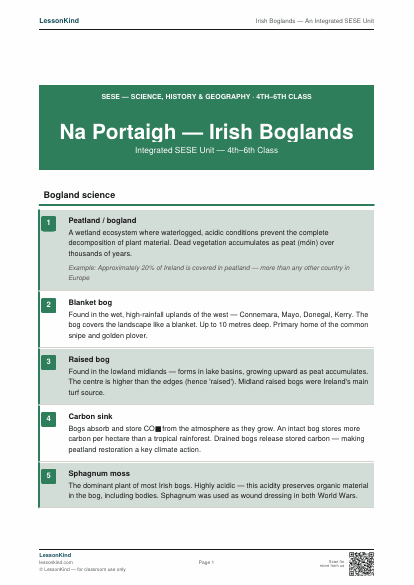
  1. 1 Peatland / bogland A wetland ecosystem where waterlogged, acidic conditions prevent the complete decomposition of plant material. Dead vegetation accumulates as peat (móin) over thousands of years. e.g. Approximately 20% of Ireland is covered in peatland — more than any other country in Europe
  2. 2 Blanket bog Found in the wet, high-rainfall uplands of the west — Connemara, Mayo, Donegal, Kerry. The bog covers the landscape like a blanket. Up to 10 metres deep. Primary home of the common snipe and golden plover.
  3. 3 Raised bog Found in the lowland midlands — forms in lake basins, growing upward as peat accumulates. The centre is higher than the edges (hence 'raised'). Midland raised bogs were Ireland's main turf source.
  4. 4 Carbon sink Bogs absorb and store CO₂ from the atmosphere as they grow. An intact bog stores more carbon per hectare than a tropical rainforest. Drained bogs release stored carbon — making peatland restoration a key climate action.
  5. 5 Sphagnum moss The dominant plant of most Irish bogs. Highly acidic — this acidity preserves organic material in the bog, including bodies. Sphagnum was used as wound dressing in both World Wars.

Bogs through three SESE lenses

History, Geography, Science integrated

  • SCIENCE: bog ecology — sphagnum moss, sundew (carnivorous plant), bog cotton. Anaerobic decomposition. Carbon storage. Why restoring bogs helps tackle climate change.
  • HISTORY: turf-cutting tradition — bán-turf, slean (the cutting implement), stacking and drying, the smell of a turf fire. Bog bodies — Clonycavan Man, Old Croghan Man (both National Museum, Dublin). Bronze and Iron Age artefacts preserved in peat for 3,000 years.
  • GEOGRAPHY: blanket bog (west) vs raised bog (midlands). Bord na Móna's industrial peat extraction and its environmental legacy. Peatland restoration projects — removing drains to rewet bogs.
  • ACTIVITY — BOG WATER: filter bog water through sphagnum moss. Measure pH before and after. Discuss why the acidic water preserves organic material.
  • ACTIVITY — MAP WORK: locate the main Irish bogland areas on a map of Ireland. Which province has the most? Why (think about rainfall).
  • DISCUSSION: should peat harvesting be banned to protect bogs and tackle climate change? What about communities who have relied on turf for generations?

Learning objective

Describe Irish boglands scientifically (ecology, carbon storage, sphagnum); understand the historical tradition of turf cutting and the significance of bog bodies; locate Irish bogs geographically; and evaluate the environmental debate around peat extraction.

About this resource

  • Subject: Science
  • Type: Activity Pack
  • Grade levels: Grade 4 (ages 9-10, ≈ Year 5), Grade 5 (ages 10-11, ≈ Year 6), Grade 6 (ages 11-12, ≈ Year 7)
  • Pages: 3
  • Date added: 2026-05-29
  • Credit: Qualified primary teacher