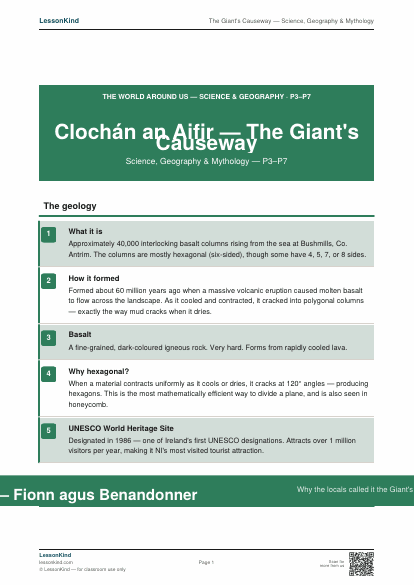
The Giant's Causeway — Science, Geography & Mythology
A P3–P7 cross-curricular resource on the Giant's Causeway — its geological formation (volcanic basalt columns), its mythology (Fionn Mac Cumhaill), and its status as a UNESCO World Heritage Site.
Preview
Page count: 3. Print-ready PDF — letter / A4 friendly. Click image to see all pages.
The geology
- 1 What it is Approximately 40,000 interlocking basalt columns rising from the sea at Bushmills, Co. Antrim. The columns are mostly hexagonal (six-sided), though some have 4, 5, 7, or 8 sides.
- 2 How it formed Formed about 60 million years ago when a massive volcanic eruption caused molten basalt to flow across the landscape. As it cooled and contracted, it cracked into polygonal columns — exactly the way mud cracks when it dries.
- 3 Basalt A fine-grained, dark-coloured igneous rock. Very hard. Forms from rapidly cooled lava.
- 4 Why hexagonal? When a material contracts uniformly as it cools or dries, it cracks at 120° angles — producing hexagons. This is the most mathematically efficient way to divide a plane, and is also seen in honeycomb.
- 5 UNESCO World Heritage Site Designated in 1986 — one of Ireland's first UNESCO designations. Attracts over 1 million visitors per year, making it NI's most visited tourist attraction.
The mythology — Fionn agus Benandonner
Why the locals called it the Giant's Causeway
- ▶ THE LEGEND: the giant Fionn Mac Cumhaill (Finn McCool) built the causeway as a bridge to Scotland so he could fight the Scottish giant Benandonner.
- ▶ THE TRICK: when Benandonner came to Ireland and turned out to be much bigger than Fionn, Fionn's wife Oonagh dressed Fionn as a baby. When Benandonner saw the 'baby', he concluded that Fionn must be enormous — and fled back to Scotland, destroying the causeway behind him.
- ▶ THE SCIENCE AND THE STORY: The columns DO stretch to Scotland — Fingal's Cave on the island of Staffa is made of the same basalt and formed in the same eruption.
- ▶ CROSS-CURRICULAR: Compare scientific explanation with the legend. Both are attempts to explain the same thing. One is factual; one uses story. What does each one tell us that the other doesn't?
- ▶ ACTIVITY: draw the geological cross-section (lava → cooling → cracking → columns). Then illustrate the legend. Present both to the class.
Learning objective
Describe how the Giant's Causeway was formed geologically; explain the legendary account and who Fionn Mac Cumhaill was; compare scientific and mythological explanations of a natural phenomenon.