🎁 Instant access to 1,825+ free resources — no sign-up needed. Or grab our 5 free bundles.

PSHE & SEL

Northern Ireland Curriculum — A Teacher's Guide (P1–P7)

A clear guide to the Northern Ireland Curriculum for primary teachers — the 6 Areas of Learning, key differences from England/Scotland/Wales, the 11+ transfer test, Shared Education, and ETI inspections.

Fact FilePre-KindergartenKindergartenGrade 1Grade 2Grade 3Grade 4Grade 5Grade 6Free

Preview

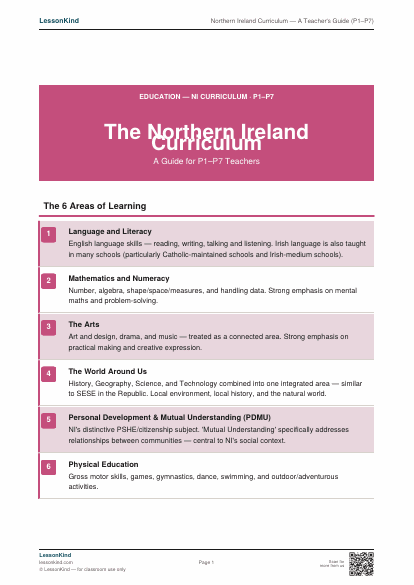
First page preview of Northern Ireland Curriculum — A Teacher's Guide (P1–P7) 📄 Open full PDF →

Page count: 3. Print-ready PDF — letter / A4 friendly. Click image to see all pages.

The 6 Areas of Learning

  1. 1 Language and Literacy English language skills — reading, writing, talking and listening. Irish language is also taught in many schools (particularly Catholic-maintained schools and Irish-medium schools).
  2. 2 Mathematics and Numeracy Number, algebra, shape/space/measures, and handling data. Strong emphasis on mental maths and problem-solving.
  3. 3 The Arts Art and design, drama, and music — treated as a connected area. Strong emphasis on practical making and creative expression.
  4. 4 The World Around Us History, Geography, Science, and Technology combined into one integrated area — similar to SESE in the Republic. Local environment, local history, and the natural world.
  5. 5 Personal Development & Mutual Understanding (PDMU) NI's distinctive PSHE/citizenship subject. 'Mutual Understanding' specifically addresses relationships between communities — central to NI's social context.
  6. 6 Physical Education Gross motor skills, games, gymnastics, dance, swimming, and outdoor/adventurous activities.

How the NI Curriculum differs

Key differences from other UK curricula

  • P1–P7 year groups (same as Scotland — very different from England's Year 1–6 numbering)
  • THE WORLD AROUND US: combines History, Geography, Science, and Technology — no separate subjects until secondary (same philosophy as Irish SESE)
  • PDMU (Personal Development & Mutual Understanding): unique to NI — addresses community relations, diversity, and respect between traditions
  • 11+ TRANSFER TEST: grammar schools still exist in NI. Transfer tests (AQE and GL Assessment) taken in autumn of P7. About 40% of pupils sit them.
  • CONTROLLED and MAINTAINED SCHOOLS: state-controlled schools are mainly attended by Protestant pupils; Catholic-maintained schools are mainly Catholic. Integrated schools (both traditions together) are a third type, growing in numbers.
  • SHARED EDUCATION: a government programme bringing together pupils from controlled and maintained schools for joint activities and learning
  • ETI INSPECTIONS: the Education and Training Inspectorate (ETI) inspects NI schools — different from Ofsted, HMIE, or Estyn
  • ASSESSMENT: no SATs. Teacher assessment throughout. KS1 assessment tasks (P4) and transfer tests (P7) are the key assessment points.

Learning objective

Understand the structure of the NI Curriculum; explain how it differs from other UK curricula; identify key features including PDMU, Shared Education, and the 11+ transfer test.

About this resource

  • Subject: PSHE & SEL
  • Type: Fact File
  • Grade levels: Pre-Kindergarten (ages 3-4, ≈ Nursery), Kindergarten (ages 4-6, ≈ Reception / Y1), Grade 1 (ages 6-7, ≈ Year 2), Grade 2 (ages 7-8, ≈ Year 3), Grade 3 (ages 8-9, ≈ Year 4), Grade 4 (ages 9-10, ≈ Year 5), Grade 5 (ages 10-11, ≈ Year 6), Grade 6 (ages 11-12, ≈ Year 7)
  • Pages: 3
  • Date added: 2026-05-28
  • Credit: Qualified primary teacher