🎁 Instant access to 1,825+ free resources — no sign-up needed. Or grab our 5 free bundles.

PSHE & SEL

Conflict Resolution Knowledge Organiser — KS2 PSHE

A KS2 PSHE knowledge organiser on conflict resolution — why conflict happens, the difference between conflict and bullying, resolution strategies, and how to be a peacemaker.

Knowledge OrganiserGrade 3Grade 4Grade 5Grade 6Free

Preview

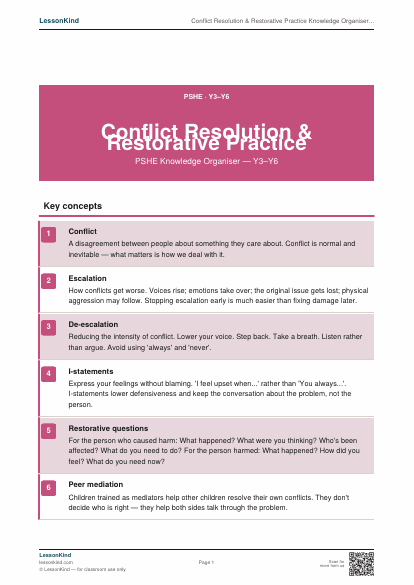
First page preview of Conflict Resolution Knowledge Organiser — KS2 PSHE 📄 Open full PDF →

Page count: 2. Print-ready PDF — letter / A4 friendly. Click image to see all pages.

Conflict resolution

  1. 1 What is conflict? A disagreement or dispute between people who have different needs, ideas, or goals. Conflict is normal — it happens in all relationships. The question is not how to avoid conflict (impossible) but how to resolve it well.
  2. 2 Conflict vs bullying Conflict: two or more people having a disagreement — power is roughly equal. Bullying: repeated, deliberate harm where there is a power imbalance. Both need addressing — but differently. Not all conflict is bullying; not all bullying appears as conflict.
  3. 3 Why conflicts escalate Name-calling. Physical pushing. Bringing in friends. Refusing to listen. Assuming the other person is entirely wrong. Saying 'I don't care' when you do care. Each escalation step makes resolution harder.
  4. 4 De-escalation strategies Space: step away from the situation. Time: come back when calmer. Acknowledge the other person's feelings: 'I can see you are angry.' Speak about your own feelings: 'I felt hurt when...' rather than 'You made me feel...'. Avoid blame language.
  5. 5 The resolution conversation Listen properly (don't plan your response while they speak). Say what you think and feel calmly. Find common ground (what does both people want?). Propose a solution. Compromise if needed. Shake on it or agree clearly.
  6. 6 When to involve an adult If the conflict involves physical harm. If de-escalation hasn't worked. If there is a significant power imbalance. If it is recurring. Involving an adult is not 'telling tales' — it is using the right resource for the problem.
  7. 7 Being a peacemaker A peacemaker sees a conflict and chooses to help resolve it rather than escalate it or walk away. They listen to both sides. They don't take sides unless safety requires it. Being a peacemaker takes courage and skill.

Learning objective

Define conflict and distinguish from bullying; explain why conflicts escalate; apply de-escalation strategies; structure a resolution conversation; know when to involve an adult; describe peacemaking.

About this resource

  • Subject: PSHE & SEL
  • Type: Knowledge Organiser
  • Grade levels: Grade 3 (ages 8-9, ≈ Year 4), Grade 4 (ages 9-10, ≈ Year 5), Grade 5 (ages 10-11, ≈ Year 6), Grade 6 (ages 11-12, ≈ Year 7)
  • Pages: 2
  • Date added: 2026-10-01
  • Credit: Qualified primary teacher