
About this resource
What ADHD actually looks like in primary school (it's not 'lack of focus'), and the practical strategies that consistently help in mainstream classrooms.
What's included
- Print-ready PDF — A4 and US Letter compatible
- No sign-up required — download instantly
- Free to use in your classroom
More like this
More SEND & Inclusion resources
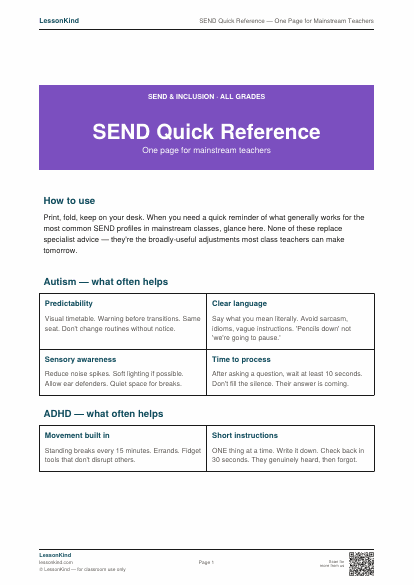
SEND Quick Reference — One Page for Mainstream Teachers
A one-page reference summarising the most useful adjustments for the four most common SEND profiles — autism, ADHD, dyslexia, anxiety. Print and stick on your desk.

SEND Classroom Adjustments — Universal Design Checklist
A walk-through audit of adjustments that benefit children with SEND but help everyone else too. Audit your classroom in 15 minutes.

Pupil Passport Template — Know This Child
A one-page profile of a child with SEND — strengths, what helps, what doesn't, who to contact. Print one per child, share with supply teachers and TAs.

50 SEND Strategies — A Staff Meeting Handout
50 specific, named, takeaway-able strategies for supporting children with SEND in mainstream classrooms. Use as a CPD handout — discuss 5 a fortnight.

Autism-Friendly Classroom Checklist
A practical audit of the things that make a classroom genuinely welcoming for autistic children — sensory, communication, predictability, social.

Sensory Strategies — A Practical Toolkit
Practical sensory strategies for the four common patterns — sensory seekers, sensory avoiders, mixed and unpredictable. With low-cost classroom kit ideas.
This page contains affiliate links. We may earn a commission at no extra cost to you.
Stay Safe Online with NordVPN
Protect your connection on school networks and at home. NordVPN is trusted by millions — recommended for teachers and students alike.
Get NordVPN →