🎁 Instant access to 1,825+ free resources — no sign-up needed. Or grab our 5 free bundles.

Social Studies

The Gaeltacht — Irish-Speaking Regions — Geography & Culture

A 4th–6th Class SESE resource on the Gaeltacht — Ireland's Irish-speaking regions, where they are, why they matter, Gaelscoileanna, Raidió na Gaeltachta, and what it means to preserve a living language.

Fact FileGrade 4Grade 5Grade 6Free

Preview

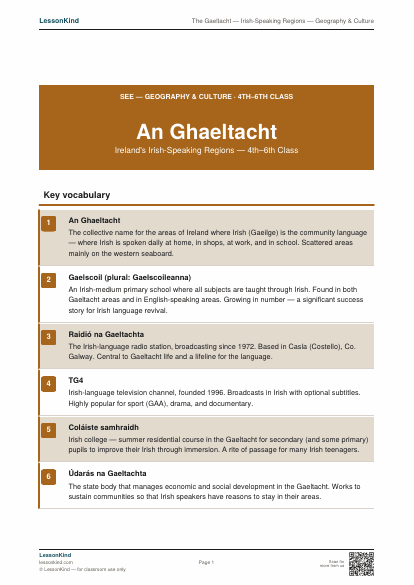
First page preview of The Gaeltacht — Irish-Speaking Regions — Geography & Culture 📄 Open full PDF →

Page count: 3. Print-ready PDF — letter / A4 friendly. Click image to see all pages.

Key vocabulary

  1. 1 An Ghaeltacht The collective name for the areas of Ireland where Irish (Gaeilge) is the community language — where Irish is spoken daily at home, in shops, at work, and in school. Scattered areas mainly on the western seaboard.
  2. 2 Gaelscoil (plural: Gaelscoileanna) An Irish-medium primary school where all subjects are taught through Irish. Found in both Gaeltacht areas and in English-speaking areas. Growing in number — a significant success story for Irish language revival.
  3. 3 Raidió na Gaeltachta The Irish-language radio station, broadcasting since 1972. Based in Casla (Costello), Co. Galway. Central to Gaeltacht life and a lifeline for the language.
  4. 4 TG4 Irish-language television channel, founded 1996. Broadcasts in Irish with optional subtitles. Highly popular for sport (GAA), drama, and documentary.
  5. 5 Coláiste samhraidh Irish college — summer residential course in the Gaeltacht for secondary (and some primary) pupils to improve their Irish through immersion. A rite of passage for many Irish teenagers.
  6. 6 Údarás na Gaeltachta The state body that manages economic and social development in the Gaeltacht. Works to sustain communities so that Irish speakers have reasons to stay in their areas.

The Gaeltacht regions

Where Irish is the community language

  • CO. GALWAY (Contae na Gaillimhe): the largest Gaeltacht — Connemara (An Cheathrú Rua, Ros Muc, Carna) and the Aran Islands (Oileáin Árann). Approximately 30,000 Irish speakers.
  • CO. DONEGAL (Contae Dhún na nGall): multiple Gaeltacht areas — Gaoth Dobhair (Gweedore), the Rosses, Glencolumbkille. Known for distinctive Donegal Irish dialect.
  • CO. MAYO (Contae Mhaigh Eo): Achill Island and Erris (Iorras). Smaller but significant.
  • CO. KERRY (Contae Chiarraí): the Dingle Peninsula (Corca Dhuibhne) and Iveragh Peninsula. Kerry Irish is considered one of the most musical dialects.
  • CO. MEATH (Contae na Mí): a small planned Gaeltacht created by resettlement in the 1930s — different from the naturally occurring western Gaeltachtaí.
  • DECLINE AND REVIVAL: the number of daily Irish speakers in the Gaeltacht has declined significantly since the 1920s. Government language planning aims to stabilise communities. Census 2022 showed 40,000+ daily Irish speakers in Gaeltacht areas.
  • IMPORTANCE: the Gaeltacht is where Irish is a living community language, not just a school subject. Preserving it is preserving the difference between a living language and an academic one.

Learning objective

Locate the main Gaeltacht regions on a map of Ireland; explain what Gaeltacht means and why it matters; understand the role of Gaelscoileanna, Raidió na Gaeltachta, and TG4 in sustaining the Irish language.

About this resource

  • Subject: Social Studies
  • Type: Fact File
  • Grade levels: Grade 4 (ages 9-10, ≈ Year 5), Grade 5 (ages 10-11, ≈ Year 6), Grade 6 (ages 11-12, ≈ Year 7)
  • Pages: 3
  • Date added: 2026-05-28
  • Credit: Qualified primary teacher