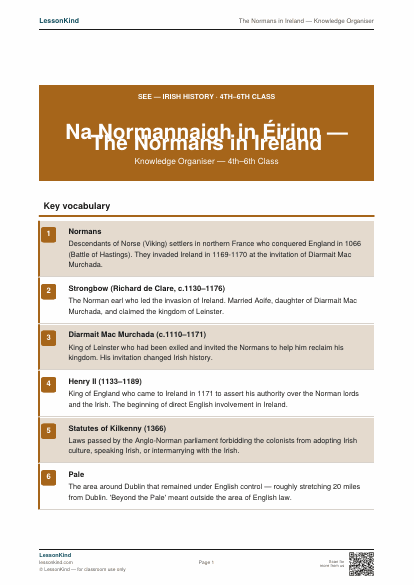
About this resource
A 4th–6th Class SESE knowledge organiser on the Norman invasion of Ireland (1169–1170), Strongbow, the arrival of Henry II, the Statutes of Kilkenny, and the cultural impact of the Normans on Ireland.
What's included
- Print-ready PDF — A4 and US Letter compatible
- No sign-up required — download instantly
- Free to use in your classroom
More like this
More Social Studies resources

Community Helpers
Match each community helper to their tool, vehicle and what they do.

Map Skills — Compass Rose, Key, Scale
Read a simple map. Use the compass, key and scale to answer questions.

Great Fire of London — Timeline
Order key events from the Great Fire of London (1666) on a printable timeline.

World Cultures Overview — 6 Countries
Short fact files for Japan, Mexico, Egypt, India, Brazil and Kenya — flag, capital, language, food, festival.

Stone Age vs Iron Age — Comparison
Compare daily life, tools, homes and beliefs across the two eras.

Ancient Egypt Fact File
Pharaohs, gods, the Nile, mummification and the pyramids on a single reference page.
This page contains affiliate links. We may earn a commission at no extra cost to you.
Stay Safe Online with NordVPN
Protect your connection on school networks and at home. NordVPN is trusted by millions — recommended for teachers and students alike.
Get NordVPN →