🎁 Instant access to 1,825+ free resources — no sign-up needed. Or grab our 5 free bundles.

Social Studies

The 1798 Rebellion — Knowledge Organiser (Ireland)

A 5th–6th Class SESE knowledge organiser on the United Irishmen rebellion of 1798 — Wolfe Tone, the impact of the French Revolution, the rebellion itself, the Act of Union, and why 1798 matters in Irish history.

Knowledge OrganiserGrade 5Grade 6Free

Preview

First page preview of The 1798 Rebellion — Knowledge Organiser (Ireland) 📄 Open full PDF →

Page count: 3. Print-ready PDF — letter / A4 friendly. Click image to see all pages.

Key figures and events

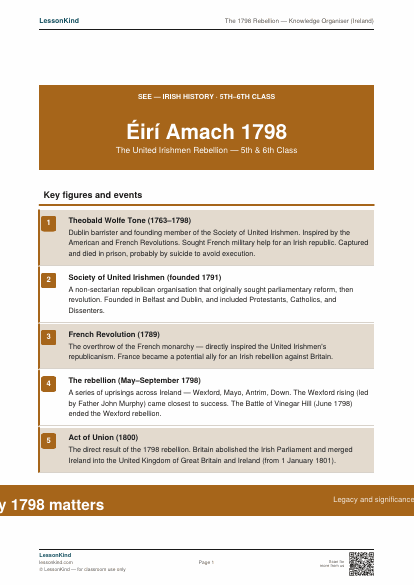
  1. 1 Theobald Wolfe Tone (1763–1798) Dublin barrister and founding member of the Society of United Irishmen. Inspired by the American and French Revolutions. Sought French military help for an Irish republic. Captured and died in prison, probably by suicide to avoid execution.
  2. 2 Society of United Irishmen (founded 1791) A non-sectarian republican organisation that originally sought parliamentary reform, then revolution. Founded in Belfast and Dublin, and included Protestants, Catholics, and Dissenters.
  3. 3 French Revolution (1789) The overthrow of the French monarchy — directly inspired the United Irishmen's republicanism. France became a potential ally for an Irish rebellion against Britain.
  4. 4 The rebellion (May–September 1798) A series of uprisings across Ireland — Wexford, Mayo, Antrim, Down. The Wexford rising (led by Father John Murphy) came closest to success. The Battle of Vinegar Hill (June 1798) ended the Wexford rebellion.
  5. 5 Act of Union (1800) The direct result of the 1798 rebellion. Britain abolished the Irish Parliament and merged Ireland into the United Kingdom of Great Britain and Ireland (from 1 January 1801).

Why 1798 matters

Legacy and significance

  • FIRST REBELLION FOR AN IRISH REPUBLIC: the United Irishmen were the first organised movement to seek a separate Irish republic, not just parliamentary reform.
  • CROSS-COMMUNITY: the United Irishmen included Protestants, Catholics, and Dissenters — a brief moment of cross-community nationalism.
  • SCALE: the 1798 rebellion was one of the bloodiest events in Irish history — estimates of up to 30,000 killed.
  • ACT OF UNION: the rebellion directly caused the abolition of the Irish Parliament, binding Ireland to Britain more tightly than before.
  • LEGACY: 1798 became one of the founding myths of Irish nationalism. Every subsequent generation of Irish nationalists looked back to Wolfe Tone and the United Irishmen.
  • THE YEAR OF THE FRENCH (Connacht, 1798): a French force landed at Killala Bay, Co. Mayo, and briefly joined the rebellion before being defeated.
  • WEXFORD REBELLION: the Wexford rising was the most intense — largely a peasant uprising led by priests, fighting with pikes against muskets.

Learning objective

Explain who Wolfe Tone was and what he wanted; describe the 1798 Rebellion and its outcome; understand how 1798 led to the Act of Union; and explain why 1798 is significant in Irish history.

About this resource

  • Subject: Social Studies
  • Type: Knowledge Organiser
  • Grade levels: Grade 5 (ages 10-11, ≈ Year 6), Grade 6 (ages 11-12, ≈ Year 7)
  • Pages: 3
  • Date added: 2026-05-28
  • Credit: Qualified primary teacher