🎁 Instant access to 1,825+ free resources — no sign-up needed. Or grab our 5 free bundles.

Social Studies

Brian Boru & The Vikings in Ireland — Knowledge Organiser

A 4th–6th Class SESE knowledge organiser on the Vikings in Ireland (795–1014 CE), their settlements, their impact on Irish culture, and Brian Boru's unification of Ireland and the Battle of Clontarf.

Knowledge OrganiserGrade 4Grade 5Grade 6Free

Preview

First page preview of Brian Boru & The Vikings in Ireland — Knowledge Organiser 📄 Open full PDF →

Page count: 3. Print-ready PDF — letter / A4 friendly. Click image to see all pages.

Key vocabulary

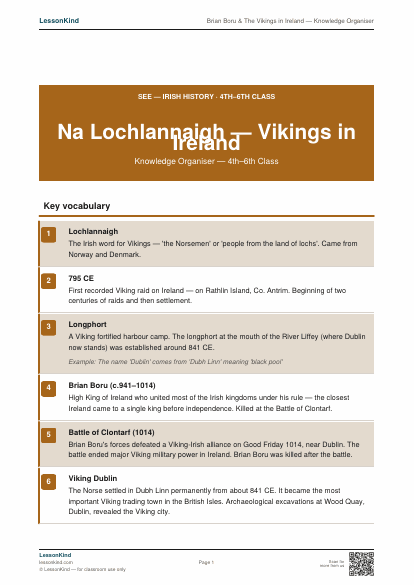
  1. 1 Lochlannaigh The Irish word for Vikings — 'the Norsemen' or 'people from the land of lochs'. Came from Norway and Denmark.
  2. 2 795 CE First recorded Viking raid on Ireland — on Rathlin Island, Co. Antrim. Beginning of two centuries of raids and then settlement.
  3. 3 Longphort A Viking fortified harbour camp. The longphort at the mouth of the River Liffey (where Dublin now stands) was established around 841 CE. e.g. The name 'Dublin' comes from 'Dubh Linn' meaning 'black pool'
  4. 4 Brian Boru (c.941–1014) High King of Ireland who united most of the Irish kingdoms under his rule — the closest Ireland came to a single king before independence. Killed at the Battle of Clontarf.
  5. 5 Battle of Clontarf (1014) Brian Boru's forces defeated a Viking-Irish alliance on Good Friday 1014, near Dublin. The battle ended major Viking military power in Ireland. Brian Boru was killed after the battle.
  6. 6 Viking Dublin The Norse settled in Dubh Linn permanently from about 841 CE. It became the most important Viking trading town in the British Isles. Archaeological excavations at Wood Quay, Dublin, revealed the Viking city.

Viking impact on Ireland

What the Norse left behind

  • TOWNS: the main Irish coastal towns were founded or developed by Vikings — Dublin (Dubh Linn), Waterford (Veðrafjǫrðr), Wexford (Veisafjǫrðr), Cork, Limerick.
  • TRADE: Vikings introduced commercial trading networks. Dublin became the most important slave-trading port in northern Europe.
  • LANGUAGE: many Irish words have Norse origins — pingin (penny), margadh (market), long (ship), trosc (cod fish).
  • PLACE NAMES: Strangford, Carlingford, Wicklow, Wexford, Waterford all have Norse origins.
  • INTEGRATION: within 2-3 generations, many Vikings converted to Christianity and intermarried with the Irish — they became 'Hiberno-Norse'.
  • CRAFTSMANSHIP: Viking metalwork and woodworking influenced Irish art. The famous 'Crozier of Clonmacnoise' shows Hiberno-Norse craftsmanship.
  • HERITAGE: the National Museum of Ireland (Archaeology) in Dublin has the world's most significant collection of Viking artefacts found in Ireland.

Learning objective

Describe the Viking raids and settlements in Ireland; explain who Brian Boru was; understand the significance of the Battle of Clontarf; identify Viking influence on Irish place names and vocabulary.

About this resource

  • Subject: Social Studies
  • Type: Knowledge Organiser
  • Grade levels: Grade 4 (ages 9-10, ≈ Year 5), Grade 5 (ages 10-11, ≈ Year 6), Grade 6 (ages 11-12, ≈ Year 7)
  • Pages: 3
  • Date added: 2026-05-28
  • Credit: Qualified primary teacher