The Easter Rising 1916 — Knowledge Organiser
A 5th–6th Class knowledge organiser on the Easter Rising of 1916 — the key figures (Pádraig Pearse, James Connolly, Michael Collins), the events of Easter Week, the Proclamation, executions, and how 1916 changed Ireland forever.
Preview
Page count: 3. Print-ready PDF — letter / A4 friendly. Click image to see all pages.
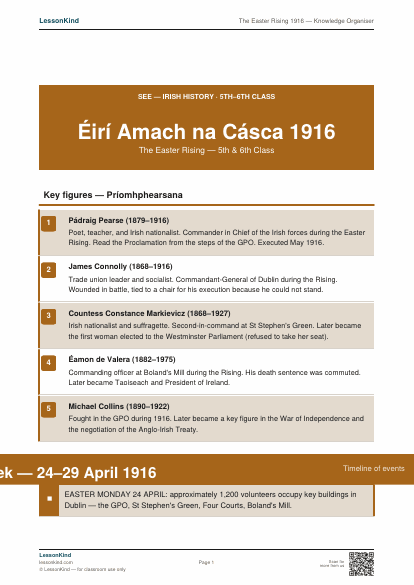
Key figures — Príomhphearsana
- 1 Pádraig Pearse (1879–1916) Poet, teacher, and Irish nationalist. Commander in Chief of the Irish forces during the Easter Rising. Read the Proclamation from the steps of the GPO. Executed May 1916.
- 2 James Connolly (1868–1916) Trade union leader and socialist. Commandant-General of Dublin during the Rising. Wounded in battle, tied to a chair for his execution because he could not stand.
- 3 Countess Constance Markievicz (1868–1927) Irish nationalist and suffragette. Second-in-command at St Stephen's Green. Later became the first woman elected to the Westminster Parliament (refused to take her seat).
- 4 Éamon de Valera (1882–1975) Commanding officer at Boland's Mill during the Rising. His death sentence was commuted. Later became Taoiseach and President of Ireland.
- 5 Michael Collins (1890–1922) Fought in the GPO during 1916. Later became a key figure in the War of Independence and the negotiation of the Anglo-Irish Treaty.
Easter Week — 24–29 April 1916
Timeline of events
- ▶ EASTER MONDAY 24 APRIL: approximately 1,200 volunteers occupy key buildings in Dublin — the GPO, St Stephen's Green, Four Courts, Boland's Mill.
- ▶ THE PROCLAMATION: Pádraig Pearse reads the Proclamation of the Irish Republic from the steps of the GPO. It declares an Irish Republic and lists equality for all citizens.
- ▶ BRITISH RESPONSE: the British Army brought in over 16,000 troops and a gunboat (the Helga) shelled parts of Dublin.
- ▶ SURRENDER 29 APRIL: after heavy fighting and civilian casualties, Pearse orders an unconditional surrender. Much of central Dublin is in ruins.
- ▶ EXECUTIONS: 15 leaders of the Rising were executed between 3–12 May 1916. The executions turned public opinion — which had initially been hostile — in favour of the rebels.
- ▶ SIGNIFICANCE: 1916 transformed Irish nationalism. The War of Independence followed (1919–1921) and led to the Anglo-Irish Treaty and the creation of the Irish Free State in 1922.
- ▶ THE GPO: the General Post Office on O'Connell Street remains the symbolic site of 1916 and Irish independence. The original Proclamation is displayed in the National Museum.
Learning objective
Name the key figures of the 1916 Rising and their roles; place the events of Easter Week in sequence; explain why the executions changed public opinion; and understand how 1916 led to Irish independence.