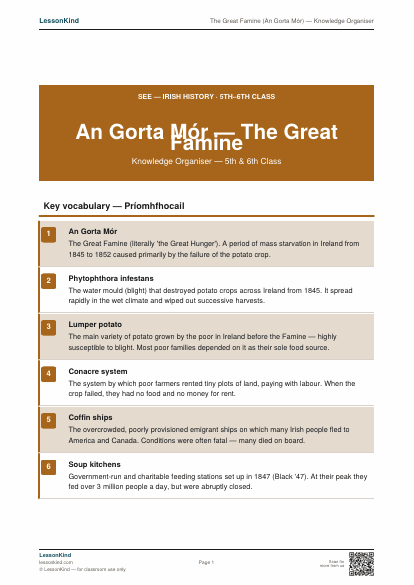
The Great Famine (An Gorta Mór) — Knowledge Organiser
A KS2/5th–6th Class knowledge organiser on the Irish Great Famine (1845–1852) — causes, the failure of the potato crop, British policy, emigration, and the lasting impact on Ireland and Irish communities worldwide.
Preview
Page count: 3. Print-ready PDF — letter / A4 friendly. Click image to see all pages.
Key vocabulary — Príomhfhocail
- 1 An Gorta Mór The Great Famine (literally 'the Great Hunger'). A period of mass starvation in Ireland from 1845 to 1852 caused primarily by the failure of the potato crop.
- 2 Phytophthora infestans The water mould (blight) that destroyed potato crops across Ireland from 1845. It spread rapidly in the wet climate and wiped out successive harvests.
- 3 Lumper potato The main variety of potato grown by the poor in Ireland before the Famine — highly susceptible to blight. Most poor families depended on it as their sole food source.
- 4 Conacre system The system by which poor farmers rented tiny plots of land, paying with labour. When the crop failed, they had no food and no money for rent.
- 5 Coffin ships The overcrowded, poorly provisioned emigrant ships on which many Irish people fled to America and Canada. Conditions were often fatal — many died on board.
- 6 Soup kitchens Government-run and charitable feeding stations set up in 1847 (Black '47). At their peak they fed over 3 million people a day, but were abruptly closed.
The Great Famine — key facts
1845–1852
- ▶ CAUSE: Phytophthora infestans (potato blight) destroyed the potato harvest in 1845, 1846, and 1848. Ireland had no other food source for the poor.
- ▶ SCALE: Ireland's population before the Famine: approximately 8 million. After: approximately 5 million (1.1m died of starvation and disease; 1.5m emigrated 1845–1851).
- ▶ BRITISH POLICY: food continued to be exported from Ireland during the Famine. The government's commitment to 'laissez-faire' economics limited effective relief.
- ▶ EMIGRATION: ships to America (Boston, New York) and Canada (Quebec). Those who survived became the foundation of large Irish-American and Irish-Canadian communities.
- ▶ LONG-TERM IMPACT: Ireland's population continued to fall for over a century. By 1900 it was 4 million. Today Ireland has the smallest population of any country in Europe that was similarly populated in 1845.
- ▶ LEGACY: Famine memorials in Dublin, New York, and cities worldwide. The Irish diaspora (estimated 70 million worldwide) traces roots to the Famine era.
- ▶ ONGOING DEBATE: whether British government policy amounted to genocide or criminal negligence remains contested by historians.
Learning objective
Explain the causes and effects of An Gorta Mór; describe British government policy during the Famine; and understand the lasting impact on Ireland and the global Irish diaspora.