🎁 Instant access to 1,825+ free resources — no sign-up needed. Or grab our 5 free bundles.

Social Studies

Irish War of Independence & Civil War — Knowledge Organiser

A 5th–6th Class SESE knowledge organiser on the War of Independence (1919–1921) and the Irish Civil War (1922–1923) — Michael Collins, Éamon de Valera, the Anglo-Irish Treaty, partition, and how Ireland became two separate states.

Knowledge OrganiserGrade 5Grade 6Free

Preview

First page preview of Irish War of Independence & Civil War — Knowledge Organiser 📄 Open full PDF →

Page count: 3. Print-ready PDF — letter / A4 friendly. Click image to see all pages.

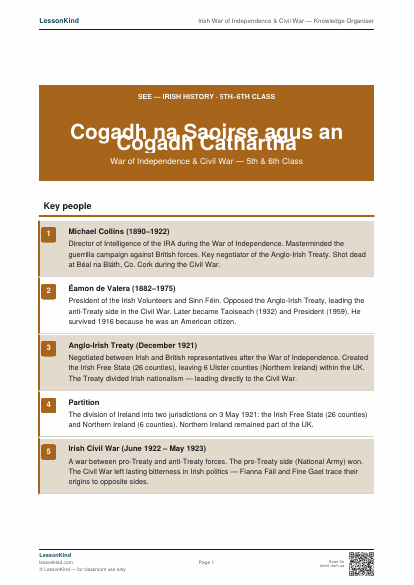
Key people

  1. 1 Michael Collins (1890–1922) Director of Intelligence of the IRA during the War of Independence. Masterminded the guerrilla campaign against British forces. Key negotiator of the Anglo-Irish Treaty. Shot dead at Béal na Bláth, Co. Cork during the Civil War.
  2. 2 Éamon de Valera (1882–1975) President of the Irish Volunteers and Sinn Féin. Opposed the Anglo-Irish Treaty, leading the anti-Treaty side in the Civil War. Later became Taoiseach (1932) and President (1959). He survived 1916 because he was an American citizen.
  3. 3 Anglo-Irish Treaty (December 1921) Negotiated between Irish and British representatives after the War of Independence. Created the Irish Free State (26 counties), leaving 6 Ulster counties (Northern Ireland) within the UK. The Treaty divided Irish nationalism — leading directly to the Civil War.
  4. 4 Partition The division of Ireland into two jurisdictions on 3 May 1921: the Irish Free State (26 counties) and Northern Ireland (6 counties). Northern Ireland remained part of the UK.
  5. 5 Irish Civil War (June 1922 – May 1923) A war between pro-Treaty and anti-Treaty forces. The pro-Treaty side (National Army) won. The Civil War left lasting bitterness in Irish politics — Fianna Fáil and Fine Gael trace their origins to opposite sides.

The road to independence — 1916–1923

Timeline of key events

  • 1916: Easter Rising — rebellion fails but executions create martyrs
  • 1918: Sinn Féin wins 73 seats in UK general election — refuse to sit at Westminster
  • January 1919: First Dáil meets in Dublin. IRA ambush at Soloheadbeg — War of Independence begins
  • 1919–1921: Guerrilla war. IRA attacks British forces. Bloody Sunday (November 1920). Black and Tans deployed.
  • July 1921: Truce agreed
  • December 1921: Anglo-Irish Treaty signed — 26-county Free State, 6 counties remain in UK
  • June 1922: Civil War begins. Pro-Treaty (Collins/Griffith) vs Anti-Treaty (de Valera/Rory O'Connor)
  • August 1922: Collins killed. Arthur Griffith dies. Massive losses on both sides.
  • May 1923: Anti-Treaty forces dump arms. Civil War ends.
  • 1937: New constitution (Bunreacht na hÉireann) — Ireland becomes a republic in all but name
  • 1949: Republic of Ireland Act — Ireland formally leaves the Commonwealth

Learning objective

Explain the causes and outcome of the War of Independence; describe why the Treaty divided nationalists; understand what partition meant and how it created two states; and explain the significance of the Civil War for modern Irish politics.

About this resource

  • Subject: Social Studies
  • Type: Knowledge Organiser
  • Grade levels: Grade 5 (ages 10-11, ≈ Year 6), Grade 6 (ages 11-12, ≈ Year 7)
  • Pages: 3
  • Date added: 2026-05-28
  • Credit: Qualified primary teacher