The Good Friday Agreement & the Peace Process — Knowledge Organiser (P5–P7)
A P5–P7 age-appropriate knowledge organiser on the Northern Ireland peace process — the causes and context of The Troubles, the Good Friday Agreement (1998), what it agreed, and what it means for Northern Ireland today.
Preview
Page count: 3. Print-ready PDF — letter / A4 friendly. Click image to see all pages.
Key context
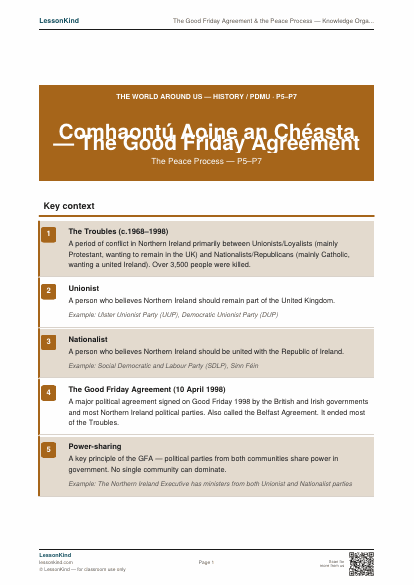
- 1 The Troubles (c.1968–1998) A period of conflict in Northern Ireland primarily between Unionists/Loyalists (mainly Protestant, wanting to remain in the UK) and Nationalists/Republicans (mainly Catholic, wanting a united Ireland). Over 3,500 people were killed.
- 2 Unionist A person who believes Northern Ireland should remain part of the United Kingdom. e.g. Ulster Unionist Party (UUP), Democratic Unionist Party (DUP)
- 3 Nationalist A person who believes Northern Ireland should be united with the Republic of Ireland. e.g. Social Democratic and Labour Party (SDLP), Sinn Féin
- 4 The Good Friday Agreement (10 April 1998) A major political agreement signed on Good Friday 1998 by the British and Irish governments and most Northern Ireland political parties. Also called the Belfast Agreement. It ended most of the Troubles.
- 5 Power-sharing A key principle of the GFA — political parties from both communities share power in government. No single community can dominate. e.g. The Northern Ireland Executive has ministers from both Unionist and Nationalist parties
- 6 Decommissioning The process of paramilitary organisations handing over their weapons. Required under the GFA. The IRA completed decommissioning in 2005.
What the Good Friday Agreement agreed
Key provisions of the 1998 agreement
- ▶ POWER-SHARING ASSEMBLY: a new Northern Ireland Assembly at Stormont, with ministers from both communities. First sitting in December 1999.
- ▶ THE PRINCIPLE OF CONSENT: Northern Ireland's constitutional status (part of the UK) can only change with the consent of a majority of its people in a referendum.
- ▶ NORTH-SOUTH BODIES: new cross-border institutions between Northern Ireland and the Republic of Ireland to cooperate on shared issues.
- ▶ PRISONER RELEASES: paramilitaries convicted of certain offences were released as part of the peace process.
- ▶ HUMAN RIGHTS: the Human Rights Act and a new NI Human Rights Commission.
- ▶ DECOMMISSIONING: paramilitary organisations required to hand over weapons.
- ▶ TWO REFERENDUMS (May 1998): approved by 71% in Northern Ireland and 94% in the Republic — showing overwhelming support.
- ▶ TODAY: the Assembly continues, though it has been suspended several times. Peace has held. The border between NI and the Republic is an open, invisible line.
Learning objective
Explain the context of the Good Friday Agreement; describe its key provisions; and understand what it means for Northern Ireland's present and future.