The Partition of Ireland 1921 — Knowledge Organiser (P5–P7)
A P5–P7 knowledge organiser on the partition of Ireland — why Ireland was divided in 1921, how the six counties were chosen, what unionism and nationalism meant, and how partition shaped both states.
Preview
Page count: 3. Print-ready PDF — letter / A4 friendly. Click image to see all pages.
Key vocabulary
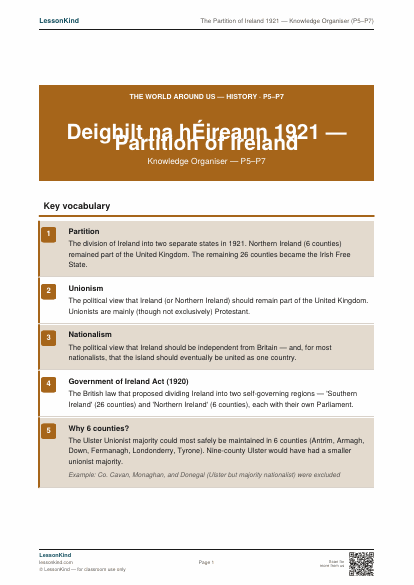
- 1 Partition The division of Ireland into two separate states in 1921. Northern Ireland (6 counties) remained part of the United Kingdom. The remaining 26 counties became the Irish Free State.
- 2 Unionism The political view that Ireland (or Northern Ireland) should remain part of the United Kingdom. Unionists are mainly (though not exclusively) Protestant.
- 3 Nationalism The political view that Ireland should be independent from Britain — and, for most nationalists, that the island should eventually be united as one country.
- 4 Government of Ireland Act (1920) The British law that proposed dividing Ireland into two self-governing regions — 'Southern Ireland' (26 counties) and 'Northern Ireland' (6 counties), each with their own Parliament.
- 5 Why 6 counties? The Ulster Unionist majority could most safely be maintained in 6 counties (Antrim, Armagh, Down, Fermanagh, Londonderry, Tyrone). Nine-county Ulster would have had a smaller unionist majority. e.g. Co. Cavan, Monaghan, and Donegal (Ulster but majority nationalist) were excluded
- 6 Northern Ireland Parliament (Stormont) The Northern Ireland Parliament, established 1921 at Stormont, Belfast. Governed NI until Direct Rule from Westminster was imposed in 1972 during the Troubles.
Two states — two paths after 1921
How the two parts of Ireland developed differently
- ▶ NORTHERN IRELAND (1921): remained in UK, with its own Parliament at Stormont. Industry (shipbuilding, linen) stronger than in the south. Unionist-dominated government.
- ▶ IRISH FREE STATE (1922): 26-county state with dominion status. Constitution in 1937 created 'Ireland' (Éire). Republic declared 1949. Left the Commonwealth.
- ▶ THE MINORITY IN EACH STATE: Catholic nationalists were a minority in NI. Protestant unionists were a minority in the Free State. Both minorities faced discrimination in the early decades.
- ▶ THE BORDER: at first strictly guarded. Roads were blocked, customs checks operated. Over decades, the border became invisible — then, after the Good Friday Agreement, entirely open.
- ▶ TODAY: the partition question remains live. Northern Ireland now has a slim nationalist/republican majority in its Assembly. A referendum on Irish unity is a real possibility.
- ▶ DISCUSSION QUESTION: why do you think Ireland was divided? Was partition a good solution or a bad one? What would have happened if Ireland had remained united?
Learning objective
Explain why and how Ireland was partitioned in 1921; understand the terms unionism and nationalism; and describe how the two states developed differently after partition.