🎁 Instant access to 1,825+ free resources — no sign-up needed. Or grab our 5 free bundles.

Social Studies

The Plantation of Ulster — Knowledge Organiser (P5–P7)

A P5–P7 knowledge organiser on the Plantation of Ulster (1610) — why it happened, who the settlers were, the impact on the native Irish population, and how the Plantation shaped Northern Ireland's society to this day.

Knowledge OrganiserGrade 4Grade 5Grade 6Free

Preview

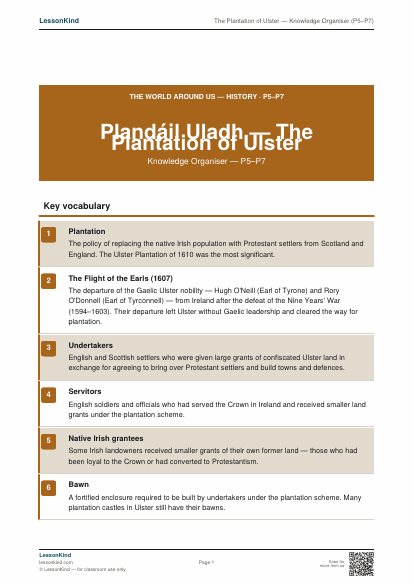
First page preview of The Plantation of Ulster — Knowledge Organiser (P5–P7) 📄 Open full PDF →

Page count: 3. Print-ready PDF — letter / A4 friendly. Click image to see all pages.

Key vocabulary

  1. 1 Plantation The policy of replacing the native Irish population with Protestant settlers from Scotland and England. The Ulster Plantation of 1610 was the most significant.
  2. 2 The Flight of the Earls (1607) The departure of the Gaelic Ulster nobility — Hugh O'Neill (Earl of Tyrone) and Rory O'Donnell (Earl of Tyrconnell) — from Ireland after the defeat of the Nine Years' War (1594–1603). Their departure left Ulster without Gaelic leadership and cleared the way for plantation.
  3. 3 Undertakers English and Scottish settlers who were given large grants of confiscated Ulster land in exchange for agreeing to bring over Protestant settlers and build towns and defences.
  4. 4 Servitors English soldiers and officials who had served the Crown in Ireland and received smaller land grants under the plantation scheme.
  5. 5 Native Irish grantees Some Irish landowners received smaller grants of their own former land — those who had been loyal to the Crown or had converted to Protestantism.
  6. 6 Bawn A fortified enclosure required to be built by undertakers under the plantation scheme. Many plantation castles in Ulster still have their bawns.

Impact of the Plantation

How the Plantation shaped Ulster — and why it still matters

  • LAND: millions of acres of Ulster land were confiscated from Gaelic Irish families and given to Scottish and English settlers. The original landowners became tenants on their own land.
  • RELIGION: settlers were Protestant (Church of Ireland and Presbyterian). The native Irish were Catholic. This religious divide was embedded in the landscape.
  • TOWNS: the plantation created many of Ulster's towns — Londonderry (Derry), Coleraine, Enniskillen, Strabane were plantation foundations.
  • LANGUAGE: Scots settlers brought Ulster Scots (a Germanic language, related to Lowland Scots) which became widely spoken in counties Antrim and Down.
  • LONG-TERM DIVISION: the 1610 settlement created the conditions for centuries of conflict between communities — ultimately contributing to the partition of 1921 and The Troubles.
  • CULCHIE WORDS: many everyday Ulster words come from Ulster Scots — 'brae' (hillside), 'burn' (stream), 'thole' (to endure), 'weans' (children), 'dander' (walk).
  • TODAY: plantation-era castles and bawns are visible across Ulster counties — visible reminders of the 1610 settlement.

Learning objective

Explain why the Plantation of Ulster happened and who the settlers were; describe the impact on the native Irish population; and understand why the Plantation is important for understanding Northern Ireland's history.

About this resource

  • Subject: Social Studies
  • Type: Knowledge Organiser
  • Grade levels: Grade 4 (ages 9-10, ≈ Year 5), Grade 5 (ages 10-11, ≈ Year 6), Grade 6 (ages 11-12, ≈ Year 7)
  • Pages: 3
  • Date added: 2026-05-28
  • Credit: Qualified primary teacher