The Troubles in Northern Ireland — An Age-Appropriate Guide (P5–P7)
A P5–P7 knowledge organiser on the Troubles (c.1968–1998) — what they were, who was involved, key events (Bloody Sunday, hunger strikes, Enniskillen), and how they ended. Written with care for the NI classroom context.
Preview
Page count: 3. Print-ready PDF — letter / A4 friendly. Click image to see all pages.
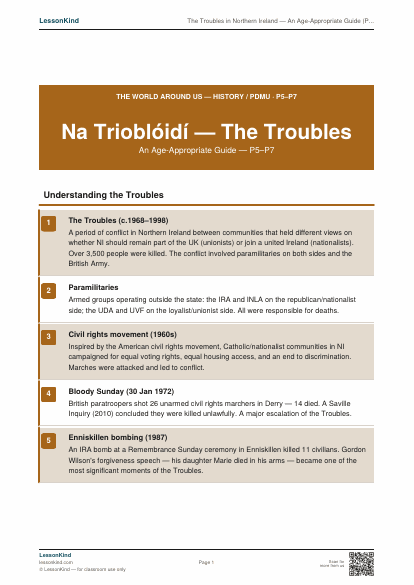
Understanding the Troubles
- 1 The Troubles (c.1968–1998) A period of conflict in Northern Ireland between communities that held different views on whether NI should remain part of the UK (unionists) or join a united Ireland (nationalists). Over 3,500 people were killed. The conflict involved paramilitaries on both sides and the British Army.
- 2 Paramilitaries Armed groups operating outside the state: the IRA and INLA on the republican/nationalist side; the UDA and UVF on the loyalist/unionist side. All were responsible for deaths.
- 3 Civil rights movement (1960s) Inspired by the American civil rights movement, Catholic/nationalist communities in NI campaigned for equal voting rights, equal housing access, and an end to discrimination. Marches were attacked and led to conflict.
- 4 Bloody Sunday (30 Jan 1972) British paratroopers shot 26 unarmed civil rights marchers in Derry — 14 died. A Saville Inquiry (2010) concluded they were killed unlawfully. A major escalation of the Troubles.
- 5 Enniskillen bombing (1987) An IRA bomb at a Remembrance Sunday ceremony in Enniskillen killed 11 civilians. Gordon Wilson's forgiveness speech — his daughter Marie died in his arms — became one of the most significant moments of the Troubles.
- 6 Ceasefires and peace IRA ceasefire: August 1994. Combined Loyalist Military Command ceasefire: October 1994. The Good Friday Agreement (1998) provided the political framework for lasting peace.
Teaching the Troubles sensitively
A note for teachers
- ▶ Many children in NI classrooms have family members who were directly affected by the Troubles — through bereavement, injury, imprisonment, or displacement. This is not history for them.
- ▶ APPROACH: factual and balanced. Acknowledge that people on all sides suffered. Do not assign blame in ways that identify with one community.
- ▶ LANGUAGE: 'people were killed' rather than 'terrorists killed'. 'Republicans' and 'loyalists' rather than terms that carry loaded local meaning.
- ▶ CHILDREN'S OWN STORIES: never require children to share their family's experience of the Troubles. Some may want to; this should be entirely voluntary.
- ▶ THE POSITIVE ENDING: the peace process is a genuine success story. Focus on people like Gordon Wilson, the Women's Coalition, John Hume, and David Trimble who worked for peace.
- ▶ RESOURCES: the Conflict Archive on the INternet (CAIN) at Ulster University is the most comprehensive academic resource on the Troubles.
Learning objective
Describe the causes and main events of the Troubles in age-appropriate terms; identify key moments including Bloody Sunday and Enniskillen; and understand how the conflict ended through the peace process.