🎁 Instant access to 1,825+ free resources — no sign-up needed. Or grab our 5 free bundles.

Social Studies

Burns Night Classroom Pack — 25 January

A cultural and cross-curricular resource for Burns Night (25 January) — who Robert Burns was, key poems (Auld Lang Syne, To a Mouse, Address to a Haggis), Scottish culture, and classroom activity ideas.

Activity PackPre-KindergartenKindergartenGrade 1Grade 2Grade 3Grade 4Grade 5Grade 6Free

Preview

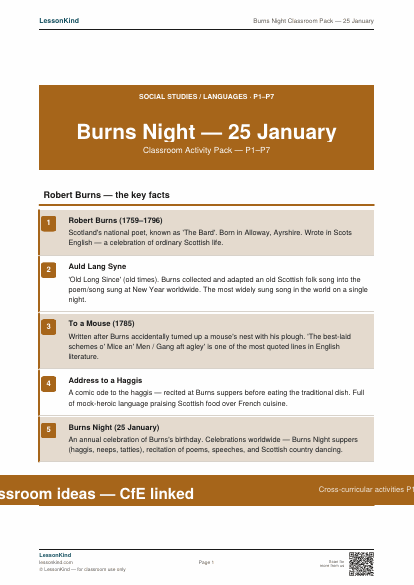
First page preview of Burns Night Classroom Pack — 25 January 📄 Open full PDF →

Page count: 3. Print-ready PDF — letter / A4 friendly. Click image to see all pages.

Robert Burns — the key facts

  1. 1 Robert Burns (1759–1796) Scotland's national poet, known as 'The Bard'. Born in Alloway, Ayrshire. Wrote in Scots English — a celebration of ordinary Scottish life.
  2. 2 Auld Lang Syne 'Old Long Since' (old times). Burns collected and adapted an old Scottish folk song into the poem/song sung at New Year worldwide. The most widely sung song in the world on a single night.
  3. 3 To a Mouse (1785) Written after Burns accidentally turned up a mouse's nest with his plough. 'The best-laid schemes o' Mice an' Men / Gang aft agley' is one of the most quoted lines in English literature.
  4. 4 Address to a Haggis A comic ode to the haggis — recited at Burns suppers before eating the traditional dish. Full of mock-heroic language praising Scottish food over French cuisine.
  5. 5 Burns Night (25 January) An annual celebration of Burns's birthday. Celebrations worldwide — Burns Night suppers (haggis, neeps, tatties), recitation of poems, speeches, and Scottish country dancing.

Burns Night classroom ideas — CfE linked

Cross-curricular activities P1–P7

  • LITERACY: read To a Mouse (P4+) — what is Burns saying about plans and unexpected change? Discuss the Scots English vocabulary.
  • MUSIC: learn Auld Lang Syne — discuss where it's sung worldwide. Scotland's gift to New Year celebrations everywhere.
  • ART: illustrate a scene from one of Burns's poems — the ploughing of the mouse's nest, the witch Nannie in Tam o' Shanter.
  • SOCIAL STUDIES: map Scotland's global connections — where do people celebrate Burns Night?
  • SCOTTISH WORDS: collect Scots English words. 'Braw' (fine), 'wee' (small), 'loch' (lake), 'bairn' (child), 'dreich' (grey and miserable weather). How many do the children already know?
  • FOOD: if appropriate — discuss what haggis, neeps, and tatties are. Haggis is sheep's offal, turnip, and potatoes. The formality of reciting a poem before eating is a distinctly Scottish tradition.

Learning objective

Describe who Robert Burns was and why he is celebrated; understand Auld Lang Syne's global reach; engage with Scots English vocabulary; plan cross-curricular Burns Night activities.

About this resource

  • Subject: Social Studies
  • Type: Activity Pack
  • Grade levels: Pre-Kindergarten (ages 3-4, ≈ Nursery), Kindergarten (ages 4-6, ≈ Reception / Y1), Grade 1 (ages 6-7, ≈ Year 2), Grade 2 (ages 7-8, ≈ Year 3), Grade 3 (ages 8-9, ≈ Year 4), Grade 4 (ages 9-10, ≈ Year 5), Grade 5 (ages 10-11, ≈ Year 6), Grade 6 (ages 11-12, ≈ Year 7)
  • Pages: 3
  • Date added: 2026-05-28
  • Credit: Qualified primary teacher