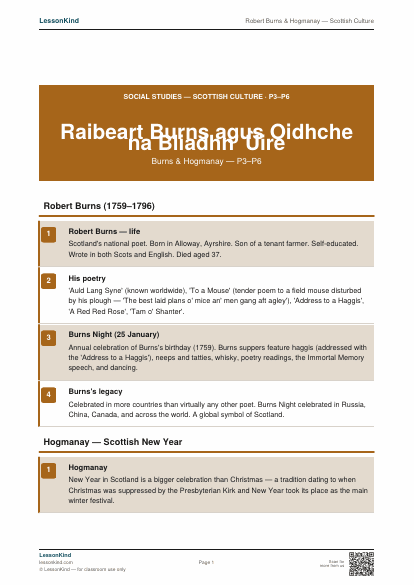
About this resource
A P3–P6 resource on Robert Burns — his life, his poetry, Burns Night traditions — and Hogmanay (Scottish New Year), its traditions (first footing, Auld Lang Syne), and their place in Scottish identity.
What's included
- Print-ready PDF — A4 and US Letter compatible
- No sign-up required — download instantly
- Free to use in your classroom
More like this
More Social Studies resources

Community Helpers
Match each community helper to their tool, vehicle and what they do.

Map Skills — Compass Rose, Key, Scale
Read a simple map. Use the compass, key and scale to answer questions.

Great Fire of London — Timeline
Order key events from the Great Fire of London (1666) on a printable timeline.

World Cultures Overview — 6 Countries
Short fact files for Japan, Mexico, Egypt, India, Brazil and Kenya — flag, capital, language, food, festival.

Stone Age vs Iron Age — Comparison
Compare daily life, tools, homes and beliefs across the two eras.

Ancient Egypt Fact File
Pharaohs, gods, the Nile, mummification and the pyramids on a single reference page.
This page contains affiliate links. We may earn a commission at no extra cost to you.
Stay Safe Online with NordVPN
Protect your connection on school networks and at home. NordVPN is trusted by millions — recommended for teachers and students alike.
Get NordVPN →