🎁 Instant access to 1,825+ free resources — no sign-up needed. Or grab our 5 free bundles.

Social Studies

The Glyndŵr Rising — A Deeper Study (Years 5–6)

An extended Years 5–6 Humanities study of the Glyndŵr Rising (1400–1415) — the causes, the military campaigns, the Pennal Letter in detail, why it failed, and how Owain Glyndŵr became a national symbol.

Knowledge OrganiserGrade 5Grade 6Free

Preview

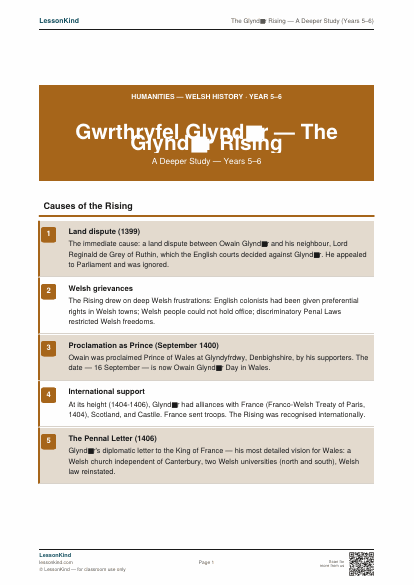
First page preview of The Glyndŵr Rising — A Deeper Study (Years 5–6) 📄 Open full PDF →

Page count: 3. Print-ready PDF — letter / A4 friendly. Click image to see all pages.

Causes of the Rising

  1. 1 Land dispute (1399) The immediate cause: a land dispute between Owain Glyndŵr and his neighbour, Lord Reginald de Grey of Ruthin, which the English courts decided against Glyndŵr. He appealed to Parliament and was ignored.
  2. 2 Welsh grievances The Rising drew on deep Welsh frustrations: English colonists had been given preferential rights in Welsh towns; Welsh people could not hold office; discriminatory Penal Laws restricted Welsh freedoms.
  3. 3 Proclamation as Prince (September 1400) Owain was proclaimed Prince of Wales at Glyndyfrdwy, Denbighshire, by his supporters. The date — 16 September — is now Owain Glyndŵr Day in Wales.
  4. 4 International support At its height (1404-1406), Glyndŵr had alliances with France (Franco-Welsh Treaty of Paris, 1404), Scotland, and Castile. France sent troops. The Rising was recognised internationally.
  5. 5 The Pennal Letter (1406) Glyndŵr's diplomatic letter to the King of France — his most detailed vision for Wales: a Welsh church independent of Canterbury, two Welsh universities (north and south), Welsh law reinstated.
  6. 6 Why it failed Henry IV's son (later Henry V) proved a brilliant military commander. English resources were far greater. French support faded. By 1415, the rebellion was over and Glyndŵr was in hiding.

Owain Glyndŵr's legacy

Why he remains central to Welsh identity

  • HIS VISION: the Pennal Letter shows Glyndŵr was not just a rebel — he had a coherent political vision for an independent Wales with its own church, universities, and legal system.
  • THE MYSTERY: Glyndŵr was never captured. He vanished around 1415. His grave is unknown. This mystery feeds the legend.
  • THE SLEEPING KING LEGEND: like Arthur, Glyndŵr is said to sleep in a mountain — waiting to return when Wales needs him. This legend connects Welsh mythology to Welsh national feeling.
  • IN POETRY: almost every generation of Welsh poets has written about Glyndŵr. He appears in Shakespeare's Henry IV, Part 1 as 'Owen Glendower.'
  • THE FLAG: Glyndŵr's coat of arms — four golden lions rampant on red — appears on the Royal Badge of Wales and the Prince of Wales's heraldry.
  • MODERN WALES: Owain Glyndŵr Day (16 September) is a proposed Welsh national day. Institutions across Wales — Glyndŵr University in Wrexham — bear his name.

Learning objective

Explain the causes of the Glyndŵr Rising in detail; describe the Pennal Letter and what it reveals about Glyndŵr's vision; understand why the Rising failed; and analyse why Glyndŵr remains a symbol of Welsh national identity.

About this resource

  • Subject: Social Studies
  • Type: Knowledge Organiser
  • Grade levels: Grade 5 (ages 10-11, ≈ Year 6), Grade 6 (ages 11-12, ≈ Year 7)
  • Pages: 3
  • Date added: 2026-05-29
  • Credit: Qualified primary teacher