17 resources
Trauma-Informed Practice
Free printable trauma-informed practice resources for primary and elementary teachers — no sign-up required.
All resources
Trauma-Informed Practice — 17 free resources

Trauma-Informed Teaching — A One-Page Introduction
What trauma-informed teaching actually is, what it isn't, and the four shifts that make a classroom safer for children with trauma backgrounds. Useful as a CPD opener.

ACEs Explained for Teachers
Adverse Childhood Experiences — what they are, how they affect children's brains and behaviour, and what teachers can actually do. Based on the original Felitti and Anda research and subsequent decades of follow-up.

The Brain Under Stress — Classroom Application
What happens neurologically when a child is in fight-flight-freeze, why reasoning doesn't work, and the practical implications for classroom response. Based on Bruce Perry's neurosequential model.

Building Safety — Daily Routines Checklist
The small daily routines that build felt safety for children with trauma backgrounds — entry rituals, transitions, exits. Audit your day.

The 'Safe Person' Role — A Practical Guide
What it means to be a child's 'safe person' at school — for vulnerable children, this single relationship can be the difference between thriving and not. With practical guidance and what NOT to do.

Predictability — A Staff-Room Poster
A poster for the staff room reminding adults of what predictability looks like in practice — and why it's the cheapest, most powerful intervention for vulnerable children.
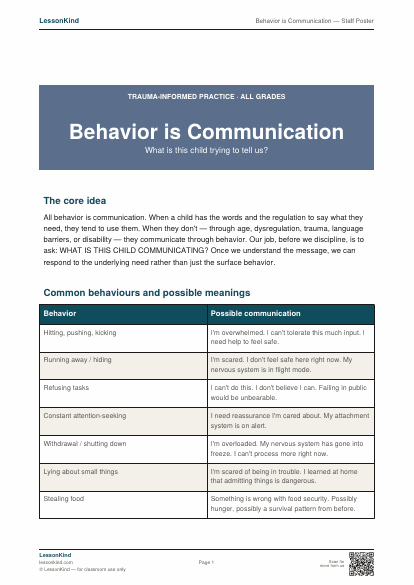
Behavior is Communication — Staff Poster
A staff-room poster reframing common 'difficult' behaviours as communications. The shift in lens is often the most powerful intervention there is.

Decoding Common Behaviors — A Practical Reference
A deeper reference for the behaviors most often seen in children with trauma backgrounds — what they often mean, what's often happening underneath, and what tends to help.

Repair After Incidents — Trauma-Sensitive Version
How to handle the after-an-incident conversation with a vulnerable child — when restorative scripts may need adapting, and when relationship repair matters more than reflection.

Looked-After and Adopted Children — Classroom Strategies
Practical strategies for children in care, post-adoption children, and children with previous looked-after status. Common patterns, what helps, and how to work with the adults around the child.

Refugee and Asylum-Seeker Children — Settling and Supporting
Practical guidance for supporting refugee and asylum-seeker children in mainstream classrooms — what they may have lived through, what helps in the first months, what to be careful about.

Bereaved Children — What Helps in Primary
How children at primary age process death — and what teachers can actually do to support a bereaved child returning to school. Includes what to say, what to avoid, and how to plan ahead.

Co-Regulation Script for Adults
What to actually say (and not say) when a child is dysregulated. Phrase by phrase, based on the principles of co-regulation. Useful for the staff briefing.

Body-Based Regulation Activities
Why traumatised children often can't 'think their way out' of dysregulation, and the body-based activities that help — proprioception, deep pressure, rhythmic movement, breath. With 20 specific activities.

When a Child Shuts Down — What to Do
Shut-down (dissociation, freeze) is often misread as defiance or rudeness — and the wrong response makes it worse. How to recognise it, what helps, and the timeline of recovery.

Trauma-Sensitive Family Meeting — Prep Guide
Preparing for a meeting with the family of a vulnerable or trauma-affected child — what to flag, what to avoid, how to share concerns without retraumatising or shaming the family.

Self-Care for Teachers Working with Vulnerable Children
Teachers who work with traumatised children carry secondary trauma whether they realise it or not. What it looks like, what helps, and how to sustain yourself in the work.
This page contains affiliate links. We may earn a commission at no extra cost to you. Full disclosure →
Stay Safe Online with NordVPN
Protect your connection on school networks and at home — trusted by millions. Recommended for teachers and students.
Get NordVPN →Teach English Abroad — Get TEFL Certified
An Ofqual-regulated TEFL certificate opens doors in 100+ countries. Study online at your own pace.
Start TEFL Course →