Behavior is Communication — Staff Poster
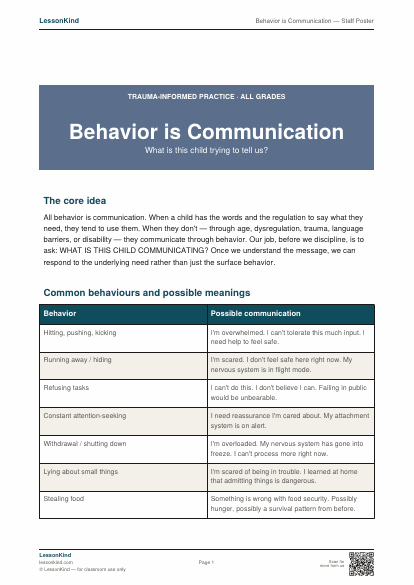
A staff-room poster reframing common 'difficult' behaviours as communications. The shift in lens is often the most powerful intervention there is.
Preview
Page count: 6. Print-ready PDF — letter / A4 friendly. Click image to see all pages.
Learning objective
Build a staff lens that sees behaviour as communication rather than misbehaviour.
About this resource
- Subject: Trauma-Informed Practice
- Type: Display Poster
- Grade levels: Kindergarten (ages 4-6, ≈ Reception / Y1), Grade 1 (ages 6-7, ≈ Year 2), Grade 2 (ages 7-8, ≈ Year 3), Grade 3 (ages 8-9, ≈ Year 4), Grade 4 (ages 9-10, ≈ Year 5), Grade 5 (ages 10-11, ≈ Year 6), Grade 6 (ages 11-12, ≈ Year 7)
- Pages: 6
- Date added: 2026-09-30
- Credit: Qualified primary teacher
Books on behaviour as communication
Convenience links if you'd like to look any of these up. We've recommended these books in the resource above.
Foundational
- I Inside I'm Hurting — Louise Bomber
- T The Whole-Brain Child — Daniel Siegel, Tina Payne Bryson
- N No-Drama Discipline — Daniel Siegel, Tina Payne Bryson
Disclosure: Links above go to Amazon. LessonKind may earn a small commission if you buy via these links — at no extra cost to you. We only link to books and items we already recommend in our resources. We are not paid by Amazon to recommend specific titles.
Part of these collections
Curated bundles where this resource appears alongside related ones.
Read more about this
Articles that go deeper on the topic this resource covers.
Behavior & classroom management · 8 min read
When the Kids Who Need You Most Are the Ones You Find Hardest
The marble jars and traffic lights work for the children who didn't really need them. Here's what actually moves the kids who keep blowing the system up.
Behavior & classroom management · 9 min read
What Trauma-Informed Teaching Actually Means in Year 4
'Trauma-informed' has become a school slogan, sometimes deployed by leadership without actually changing anything. This article is about what genuinely changes when the framework is taken seriously — and what doesn't.
Behavior & classroom management · 8 min read
When a Child's Behaviour Is Communication
Most adult responses to children's behaviour assume the behaviour IS the message. The trauma-informed reframe is simpler and more demanding: the behaviour is a SIGNAL of something underneath. The shift in response that follows is enormous.
Behavior & classroom management · 7 min read
Why Your Child Is Different at School and at Home
If your child is angelic at school and a wreck at home (or vice versa), the explanation isn't about parenting failure or spoiled behaviour. It's about a phenomenon called 'after-school restraint collapse,' and once you understand it, almost everything makes more sense.
Behavior & classroom management · 8 min read
Friendship Problems in Year 4: When to Step In, When to Wait
Year 4 is the age where friendships get politically complicated. Drama, exclusion, falling-out, falling-back-in. Most of it isn't bullying. Most of it doesn't need adult intervention. Some of it does. How to tell the difference, and what to do when your child comes home in tears.
You might also like
Selected based on subject, grade, and type — with a free option always included.
Predictability — A Staff-Room Poster
A poster for the staff room reminding adults of what predictability looks like in practice — and why it's the cheapest, most powerful intervention for vulnerable children.
Looked-After and Adopted Children — Classroom Strategies
Practical strategies for children in care, post-adoption children, and children with previous looked-after status. Common patterns, what helps, and how to work with the adults around the child.
Co-Regulation Script for Adults
What to actually say (and not say) when a child is dysregulated. Phrase by phrase, based on the principles of co-regulation. Useful for the staff briefing.
Trauma-Sensitive Family Meeting — Prep Guide
Preparing for a meeting with the family of a vulnerable or trauma-affected child — what to flag, what to avoid, how to share concerns without retraumatising or shaming the family.
Trauma-Informed Teaching — A One-Page Introduction
What trauma-informed teaching actually is, what it isn't, and the four shifts that make a classroom safer for children with trauma backgrounds. Useful as a CPD opener.
ACEs Explained for Teachers
Adverse Childhood Experiences — what they are, how they affect children's brains and behaviour, and what teachers can actually do. Based on the original Felitti and Anda research and subsequent decades of follow-up.