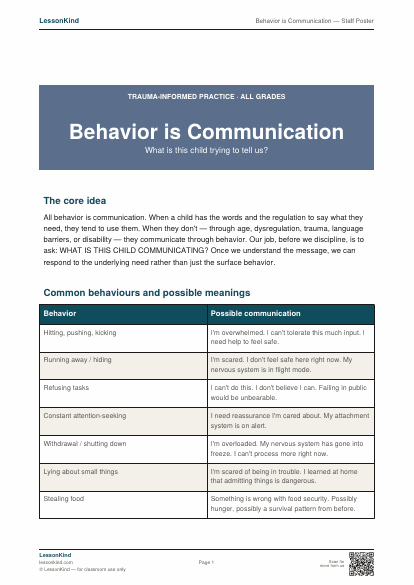
Trauma-Informed Teaching — A One-Page Introduction
What trauma-informed teaching actually is, what it isn't, and the four shifts that make a classroom safer for children with trauma backgrounds. Useful as a CPD opener.
Preview
Page count: 6. Print-ready PDF — letter / A4 friendly. Click image to see all pages.
Learning objective
Build foundational understanding of trauma-informed practice in primary settings.
About this resource
- Subject: Trauma-Informed Practice
- Type: Fact File
- Grade levels: Kindergarten (ages 4-6, ≈ Reception / Y1), Grade 1 (ages 6-7, ≈ Year 2), Grade 2 (ages 7-8, ≈ Year 3), Grade 3 (ages 8-9, ≈ Year 4), Grade 4 (ages 9-10, ≈ Year 5), Grade 5 (ages 10-11, ≈ Year 6), Grade 6 (ages 11-12, ≈ Year 7)
- Pages: 6
- Date added: 2026-09-27
- Credit: Qualified primary teacher
Foundational reading on trauma-informed practice
If this one-pager hooked you, these are the texts to read next.
Start here
-
I
Inside I'm Hurting: Practical strategies for supporting children with attachment difficulties — Louise Bomber
The single most-cited UK primary text on trauma in school - A Attachment in the Classroom — Heather Geddes
- A A Therapeutic Treasure Box for Working with Children — Karen Treisman
Going wider
- T The Body Keeps the Score — Bessel van der Kolk
- T The Whole-Brain Child — Daniel Siegel, Tina Payne Bryson
Disclosure: Links above go to Amazon. LessonKind may earn a small commission if you buy via these links — at no extra cost to you. We only link to books and items we already recommend in our resources. We are not paid by Amazon to recommend specific titles.
Part of these collections
Curated bundles where this resource appears alongside related ones.
Read more about this
Articles that go deeper on the topic this resource covers.
Behavior & classroom management · 9 min read
What Trauma-Informed Teaching Actually Means in Year 4
'Trauma-informed' has become a school slogan, sometimes deployed by leadership without actually changing anything. This article is about what genuinely changes when the framework is taken seriously — and what doesn't.
Behavior & classroom management · 9 min read
Anxiety in Primary Children: What's Normal and What's Not
Most primary-aged children worry. Some of them worry in ways that affect their lives. The line between these is the most consequential thing for parents to get right — and the most often blurred by anxiety culture going in both directions.
Behavior & classroom management · 9 min read
School Refusal: What's Actually Going On
School refusal has risen sharply post-pandemic. The standard responses — punishment, fines, force — usually make things worse. Here's what's actually happening, what works, and what families can do when they realise their child genuinely cannot get through the school gates.
You might also like
Selected based on subject, grade, and type — with a free option always included.
Looked-After and Adopted Children — Classroom Strategies
Practical strategies for children in care, post-adoption children, and children with previous looked-after status. Common patterns, what helps, and how to work with the adults around the child.
ACEs Explained for Teachers
Adverse Childhood Experiences — what they are, how they affect children's brains and behaviour, and what teachers can actually do. Based on the original Felitti and Anda research and subsequent decades of follow-up.
The 'Safe Person' Role — A Practical Guide
What it means to be a child's 'safe person' at school — for vulnerable children, this single relationship can be the difference between thriving and not. With practical guidance and what NOT to do.
Repair After Incidents — Trauma-Sensitive Version
How to handle the after-an-incident conversation with a vulnerable child — when restorative scripts may need adapting, and when relationship repair matters more than reflection.
Refugee and Asylum-Seeker Children — Settling and Supporting
Practical guidance for supporting refugee and asylum-seeker children in mainstream classrooms — what they may have lived through, what helps in the first months, what to be careful about.
Bereaved Children — What Helps in Primary
How children at primary age process death — and what teachers can actually do to support a bereaved child returning to school. Includes what to say, what to avoid, and how to plan ahead.