Assessment & feedback · 7 min read
Feedback That Changes the Work
Most feedback teachers give doesn't improve outcomes. Here's what does.
Published 2026-05-14
The research on feedback in education is, by educational research standards, unusually robust. John Hattie's synthesis of thousands of studies identified feedback as one of the highest-leverage interventions available to teachers. But it comes with a significant caveat: not all feedback is equal. Much of what passes for feedback in schools has no measurable effect on outcomes. Some of it makes things worse.
The central problem
Feedback is only useful if it changes what the learner does. If the learner reads your comment, nods, closes the book, and does the same thing again — that is not feedback. It is marking.
The distinction sounds harsh. But it's important. Teachers in England spend more time on written marking than almost any other country in the world. The time cost is enormous. The return, in terms of improved pupil outcomes, is often close to zero — not because feedback doesn't work, but because the conditions for it to work aren't present.
What the research says works
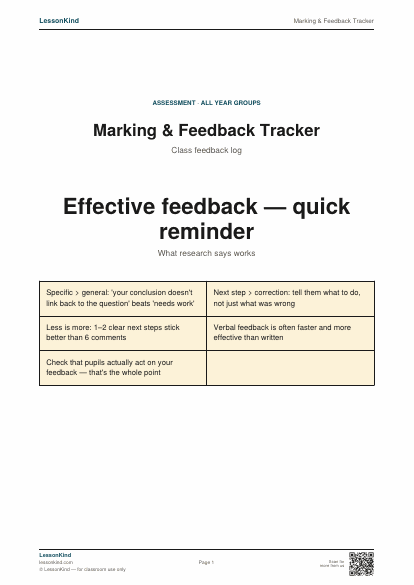
**Immediate, specific, actionable.** Feedback that arrives within a lesson, refers to a specific aspect of the work, and tells the pupil clearly what to do next produces more improvement than detailed written comments a week later. By the time you've written "your argument would be stronger if you used counter-evidence", the child is on a different topic.
**Task-focused, not person-focused.** "Your opening paragraph lacks a clear topic sentence — see if you can add one in the next two minutes" produces more improvement than "well done, great effort". The latter tells the pupil nothing about the work; the former tells them exactly what to do.
**The pupil must act on the feedback.** This sounds obvious. It isn't. Research consistently shows that the gap between feedback given and feedback acted upon is enormous. A comment about apostrophes that the pupil doesn't apply to their next piece of writing has done nothing. Effective feedback builds in an action step — and checks it.
**Less is more.** Multiple simultaneous pieces of feedback overwhelm. One clear next-step focus, applied consistently over several pieces of work, produces more improvement than comprehensive commentary on everything.
**Verbal beats written in most cases.** A 90-second conversation at a pupil's desk produces faster, more significant improvement than a written comment that takes three times as long to compose. The pupil can ask questions; you can demonstrate; you can check they've understood. None of this is possible with written marking.
What the research says doesn't work
**Grades attached to comments.** When grades accompany written feedback, pupils focus on the grade and ignore the comment. This is well-evidenced and completely counterintuitive to most marking traditions. If you want pupils to engage with written feedback, delay or remove the grade.
**Praise without specificity.** "Brilliant!" on a piece of work tells the pupil nothing about what made it brilliant, which means they can't repeat it intentionally. "Brilliant opener — you started in the middle of the action, which is exactly right" is actionable.
**'Even better if...' without follow-up.** The 'two stars and a wish' format is common. The wish is useful only if the pupil later applies it. If there's no structured time to respond to EBI comments, the EBI is a ritual without effect.
What to do instead
**Live marking.** During independent work, circulate and write one brief comment on work in progress — not after the lesson, during it. "Add an adverb to this sentence" takes 5 seconds and the pupil can act on it while you watch.
**Whole-class feedback sheets.** Instead of annotating individual books, note patterns across the class during marking: common strengths, common errors, next steps for different groups. Spend 5 minutes at the start of the next lesson addressing these patterns. Everyone benefits. You've saved an hour.
**DIRT (Dedicated Improvement and Reflection Time).** Set aside lesson time for pupils to respond to feedback. Without this, feedback accumulates in the margins of books without any effect.
**Verbal feedback stamps.** If you've given significant verbal feedback, note it briefly: "VF: discussed apostrophe use." This creates a record without the time cost of written marking, and reminds the pupil that feedback was given.
The marking policy problem
Many of the issues above are school policy problems rather than individual teacher choices. Marking policies that mandate specific formats, frequency, and detail produce enormous time costs with uncertain returns.
If you have any influence over your school's marking policy, the question to press is: "What evidence do we have that this approach produces better pupil outcomes than alternatives?" That is the only question that matters.
Free bundle for this topic
KS2 Maths Pack
10 maths resources designed for retrieval practice and low-stakes review.
Practical resources for this
Take this further
Printable, classroom-ready resources for the topics in this article.
Going deeper
Books on feedback and marking
Books we'd recommend on the topics raised in this article.
For teachers
Convenience links to Amazon. As an Amazon Associate we earn from qualifying purchases at no extra cost to you. Read our affiliate disclosure.
Keep reading
Assessment & feedback
Assessment for Learning: 7 Techniques That Actually Work
Formative assessment is one of the highest-leverage things a teacher can do. Here are seven techniques with strong evidence and clear practical application.
8 min read
Teaching strategy
Retrieval Practice: What the Research Says and What to Do on Monday
Retrieval practice is among the most robust findings in educational psychology. Here's what it is, why it works, and how to implement it without it taking over your planning.
7 min read