Teaching strategy · 7 min read
Growth Mindset: What the Research Actually Says
Beyond the poster on the wall — the evidence, the limitations, and what actually makes a difference
Published 2026-05-19
Growth mindset — the idea that intelligence and ability can be developed through effort and practice, rather than being fixed at birth — is one of the most widely adopted concepts in primary education. Every school seems to have the poster. Many have dedicated PSHE lessons on it. Some have renamed their learning platforms after it.
The research behind it is worth understanding carefully, because the version taught in most schools is significantly more optimistic than the evidence actually supports.
What Carol Dweck's research shows
Carol Dweck's research at Stanford, accumulated across several decades, found that students with a growth mindset — who believed their intelligence could grow — tended to show more persistence after failure, seek more challenging tasks, and ultimately achieve more than students with a fixed mindset.
This finding is real. The correlation between mindset beliefs and academic persistence is well-supported.
What the research doesn't show
It does not show that: telling children they have a growth mindset changes their outcomes. It does not show that: praise for effort is straightforwardly better than praise for ability. It does not show that: growth mindset posters or assemblies produce lasting change.
Several large replication studies — including a major 2017 meta-analysis — found effect sizes for growth mindset interventions significantly smaller than Dweck's original studies suggested. The more carefully controlled the study, the smaller the effect.
What actually makes a difference
The most robust finding from the research is not about mindset at all: it's about the specific feedback given after failure. Feedback that focuses on strategy ('what could you try differently?') rather than effort alone ('you just need to try harder') produces more improvement. The research also consistently shows that teacher practice matters more than pupil mindset: a teacher who designs appropriately challenging tasks, provides specific feedback, and treats errors as diagnostic information creates the conditions for growth regardless of what posters are on the wall.
What to keep and what to quietly retire
**Keep:** the idea that praising effort and strategy is more useful than praising intelligence. The evidence for this is solid.
**Keep:** the word 'yet'. It is genuinely useful and backed by Dweck's original work.
**Keep:** the idea that children benefit from understanding neuroplasticity — that the brain changes with practice.
**Quietly retire:** the idea that growth mindset is a panacea, or that talking about it is sufficient. The research suggests that explicit teaching of growth mindset, decoupled from good teaching practice, produces little measurable benefit.
Practical resources for this
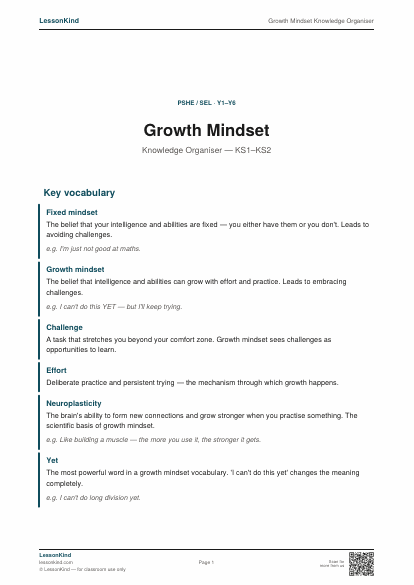
Take this further
Printable, classroom-ready resources for the topics in this article.
Going deeper
Books on growth mindset and learning science
Books we'd recommend on the topics raised in this article.
Essential reading
Convenience links to Amazon. As an Amazon Associate we earn from qualifying purchases at no extra cost to you. Read our affiliate disclosure.
Keep reading
Math
'I'm Not a Maths Person' Is a Lie — And We Need to Stop Telling It
The belief that mathematical ability is fixed and innate is widespread, wrong, and directly harmful to children's development. Here's the evidence — and what to say instead.
6 min read
Math
'I'm Not a Maths Person' Is a Lie — And We Need to Stop Telling It
The belief that mathematical ability is fixed and innate is widespread, wrong, and directly harmful. Here's the evidence — and what to say instead.
6 min read
Teaching strategy
Retrieval Practice: What the Research Says and What to Do on Monday
Retrieval practice is among the most robust findings in educational psychology. Here's what it is, why it works, and how to implement it without it taking over your planning.
7 min read