Math · 6 min read
Maths Mastery in Primary: What It Is and What It Isn't
The approach that's reshaped primary maths teaching — and the misconceptions that have grown up around it
Published 2026-05-22
Maths mastery — also called teaching for mastery — has been the dominant approach to primary mathematics in England since the Department for Education funded the Maths Hubs programme from 2014, drawing on approaches observed in Singapore and Shanghai. Most primary schools in England now claim to use it. Many use it well. Many have adopted the language without the substance.
What mastery actually means
The core principle: all pupils can achieve in maths, given sufficient time and the right teaching. This is not the same as saying all pupils will achieve at the same rate — it says the destination is the same for all, even if the journey is different.
Three interrelated components define genuine mastery teaching:
**Depth before breadth.** Rather than moving quickly through a topic to cover more material, mastery teaching dwells — going deeper into fewer topics, ensuring genuinely secure understanding before moving on. A class that thoroughly understands place value has a stronger foundation than one that has covered place value and fractions and multiplication in the same week.
**Conceptual and procedural knowledge together.** The procedure (how to do it) and the concept (why it works) are taught simultaneously, not sequentially. Children who can execute a calculation but cannot explain it, or who can explain it but cannot execute it, do not have mastery. Both are required.
**Concrete, pictorial, abstract (CPA).** Mathematical ideas are introduced through physical objects (concrete), then visual representations (pictorial), then symbolic notation (abstract). This is not a linear sequence — pupils should move between all three throughout their school career, not progress from one to the next and leave the earlier ones behind.
What mastery is not
It is not mixed attainment teaching (though it challenges fixed setting). It is not banning challenge or extension work. It is not a specific set of textbooks or resources. It is not anything specific to Singapore or Shanghai that cannot be applied elsewhere.
Common misapplications
'No differentiation' — the most damaging misreading. Mastery does not mean giving everyone the same task and hoping for the best. It means designing tasks that are rich enough to offer different depths of engagement, and providing scaffolding for those who need it while offering challenge for those who don't.
'Slower = mastery' — slowing the pace without deepening the thinking is not mastery. It is just slower. The depth must come from richer tasks, better questioning, and genuine conceptual discussion.
'Bar models solve everything' — bar models are a powerful representational tool, not a universal method. Applying them mechanically to every problem they don't fit is worse than not using them.
Free bundle for this topic
KS2 Maths Pack
10 favourite maths resources — times tables, fact families, mental maths, fractions.
Practical resources for this
Take this further
Printable, classroom-ready resources for the topics in this article.
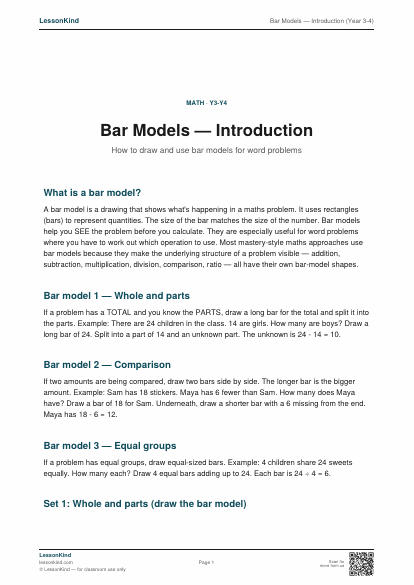
Bar Models — Introduction (Year 3-4)
A clear introduction to bar models for KS2 children. Concrete-pictorial-abstract approach, with worked examples and 24 practice problems.
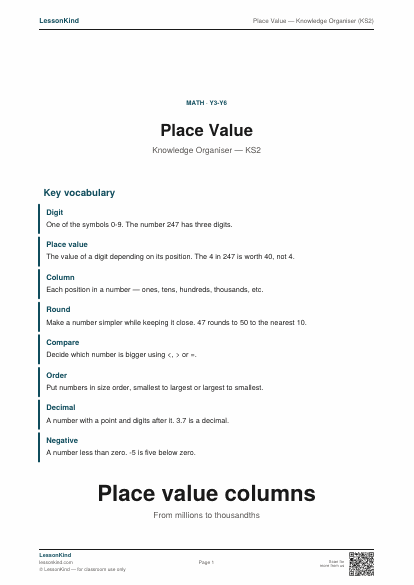
Place Value — Knowledge Organiser (KS2)
One-page reference for all KS2 place value: digits, columns, rounding, comparing, ordering, and decimals. Aligns with Autumn Block 1 in most primary maths schemes.
Going deeper
Books on maths mastery
Books we'd recommend on the topics raised in this article.
For teachers
Convenience links to Amazon. As an Amazon Associate we earn from qualifying purchases at no extra cost to you. Read our affiliate disclosure.
Keep reading
Math
'I'm Not a Maths Person' Is a Lie — And We Need to Stop Telling It
The belief that mathematical ability is fixed and innate is widespread, wrong, and directly harmful to children's development. Here's the evidence — and what to say instead.
6 min read
Math
'I'm Not a Maths Person' Is a Lie — And We Need to Stop Telling It
The belief that mathematical ability is fixed and innate is widespread, wrong, and directly harmful. Here's the evidence — and what to say instead.
6 min read
Math
The Complete Guide to Teaching Times Tables in Primary
Times tables fluency by Year 4 is a statutory requirement. Here's how to build genuine fluency — not just test performance — and how to support the children who are still struggling.
7 min read