Classroom culture · 7 min read
The Power of Slow
Why slowing down your teaching — even when it feels wrong — produces better results
Published 2026-05-12
There is a constant pull in teaching toward speed. Curriculum to cover. Standards to meet. Objectives to tick off. The fear that if you slow down for one class, they'll fall behind the other class. The feeling, at the end of a lesson, that you didn't get through everything you'd planned.
This pull is understandable. It is also, according to most of the research on learning, pointing in the wrong direction.
Here's the case for slow.
What 'slow' actually means
Slow doesn't mean low expectations. It doesn't mean less content, necessarily. It means:
**Dwelling on hard ideas until they're actually understood**, rather than covering them briefly and moving on to the next thing.
**Revisiting** — returning to something from last week, last month, last term — rather than treating the curriculum as a one-way conveyor belt from which content falls off the back as you move forward.
**Making time for confusion** — creating space for children to not understand, to ask the question they've been holding, to work through the thing that isn't quite clicking. Not treating confusion as an obstacle but as the actual location of learning.
**Reducing pace during explanation** — speaking more slowly than feels natural when introducing something new. Pausing. Asking. Looking at faces before moving on.
Why covering ground is a trap
The 'coverage' model of teaching — teaching something once, in sequence, moving on — has real problems.
The main one is that knowledge not revisited is knowledge lost. The forgetting curve, documented consistently in cognitive science, is steep: without any revisiting, a significant proportion of what's learned in a lesson will be forgotten within a week. Teaching something on Tuesday, never returning to it, and then asking children to use it in a test three months later is asking them to recall information they have almost certainly forgotten.
Coverage creates the illusion of learning while often producing very little of it.
The evidence for retrieval and revisiting
The cognitive science on this is not new or contested. Retrieval practice — recalling information from memory, rather than re-reading or re-presenting it — significantly strengthens long-term retention. Spaced practice — revisiting material at intervals — significantly outperforms massed practice (doing everything in one block).
In practical terms: a five-minute 'what did we cover last week?' exercise at the start of a lesson does more for long-term retention than using those five minutes to push further into new content. Returning to fractions in January, even though you 'covered' them in October, produces better outcomes than never returning.
This is a reframe of what it means to use time well. It feels slow. It is, in terms of long-term learning, fast.
What slowing down looks like in practice
**Interleaved practice.** Rather than blocking all fraction work together, interleave it with other content throughout the term. This is more confusing for students in the short term and significantly more effective in the long term.
**Do fewer things, but do them until they're secure.** The temptation when you're behind is to rush. The often-better choice is to acknowledge that you can't cover everything and make a deliberate decision about what matters most. Three concepts understood deeply are worth more than eight concepts touched.
**Use wait time.** After asking a question, pause for three to five seconds before taking an answer. This feels like an eternity. It significantly increases the quality and quantity of thinking that happens. Children who would never answer in a faster-paced exchange will answer after genuine wait time.
**Resist the urge to immediately explain.** When a child gives a wrong answer, the default is to correct it quickly and keep moving. The more useful response is to slow down: 'That's interesting — tell me more about how you got there.' The thinking behind the wrong answer is often more useful than the wrong answer itself, and the child who explains their thinking out loud often finds their own way to the correction.
**Check understanding before moving on.** This sounds obvious. In practice, most teachers underuse this. 'Does everyone understand?' produces nods that mean nothing. Better: a quick written task, a whiteboard response, a think-pair-share, a targeted question to the child you suspect didn't follow. If more than a third of the class is confused, slowing down is almost always the right call.
The culture piece
The power-of-slow argument isn't just instructional — it's cultural. A classroom where the norm is 'we cover things once, fast, and move on' sends children a message about what learning is: performance. Getting through. Keeping up.
A classroom where the norm is 'we revisit things, we go back, we stay with something until it's secure' sends a different message: learning takes time. Confusion is normal. We don't leave ideas behind.
This is a healthier model for children's relationship with their own learning. It makes the classroom feel less like a race. It reduces the anxiety of the child who didn't quite get it the first time.
The practical objection
The objection is always: but there's so much curriculum. I can't afford to slow down.
This is a real constraint, not an excuse. Curricula are often overloaded. Teachers face real coverage pressures.
But it's worth asking: what does covering more content, more quickly, actually produce if the content isn't retained? If children reach the end of the year having technically encountered ninety percent of the planned curriculum but understood and retained thirty percent of it, what was gained by the speed?
The answer is usually: less than you'd think. The slower, deeper approach — fewer concepts, truly secured — typically produces better outcomes than the faster, wider one. And it produces better outcomes over time, as secured concepts become foundations for new learning, rather than half-remembered fragments that keep needing to be re-taught.
Slow, in the classroom, is often the fastest way to get where you're trying to go.
Free bundle for this topic
Cover Day Survival Pack
9 resources for cover days and routines, including behavior systems and morning meeting scripts.
Practical resources for this
Take this further
Printable, classroom-ready resources for the topics in this article.
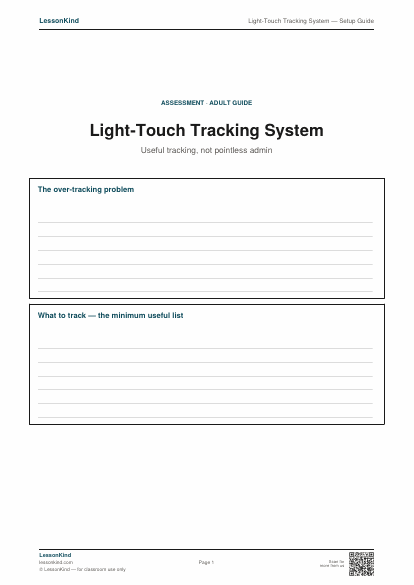
Light-Touch Tracking System — Setup Guide
How to set up a school assessment tracking system that's USEFUL and doesn't drown teachers in admin. Covers what to track, what to leave alone, paper vs digital, frequency, and the assessment data SLT actually need vs what they ask for.
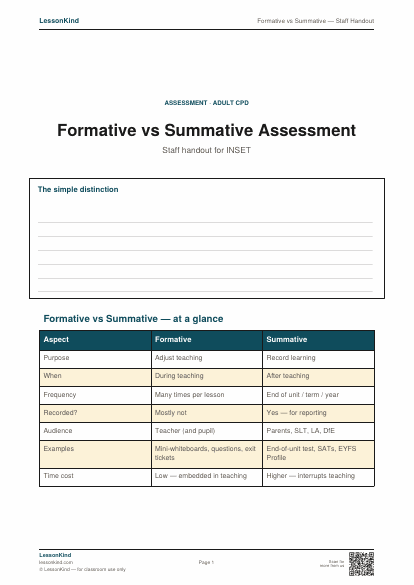
Formative vs Summative — Staff Handout
A 4-page staff handout explaining the difference between formative assessment (during learning) and summative assessment (at the end), with specific classroom techniques for each. For staff INSETs and new-teacher induction. Designed to settle the 'we test too much' / 'we don't test enough' debate.
Keep reading
Assessment & feedback
Assessment FOR Learning vs Assessment OF Learning
Most schools assess constantly but don't always know why. The distinction between formative and summative assessment is one of the most useful ideas in teaching.
5 min read
Assessment & feedback
What we got wrong about formative assessment
Assessment for Learning was supposed to transform teaching. In practice it became a checklist of techniques applied formulaically — learning objectives, success criteria, traffic lights, peer marking. The research it came from said something more interesting.
8 min read